Artificial intelligence has moved far beyond simple chatbots. The best AI tools in 2026 can research information, analyze files, create content, assist with software development, automate business processes, support sales teams, generate designs, and help professionals complete complex work more efficiently.
One of the biggest changes in artificial intelligence is the shift from AI that simply answers questions toward AI that can participate in workflows, use connected tools, analyze information, and increasingly take action.
That creates another challenge: there are now hundreds of AI products competing for attention. Instead of subscribing to everything, businesses should select tools based on the specific problems they actually need to solve.
This XVIFS guide compares 20 of the best AI tools in 2026 for business, productivity, automation, marketing, design, research, coding, sales, and content creation.
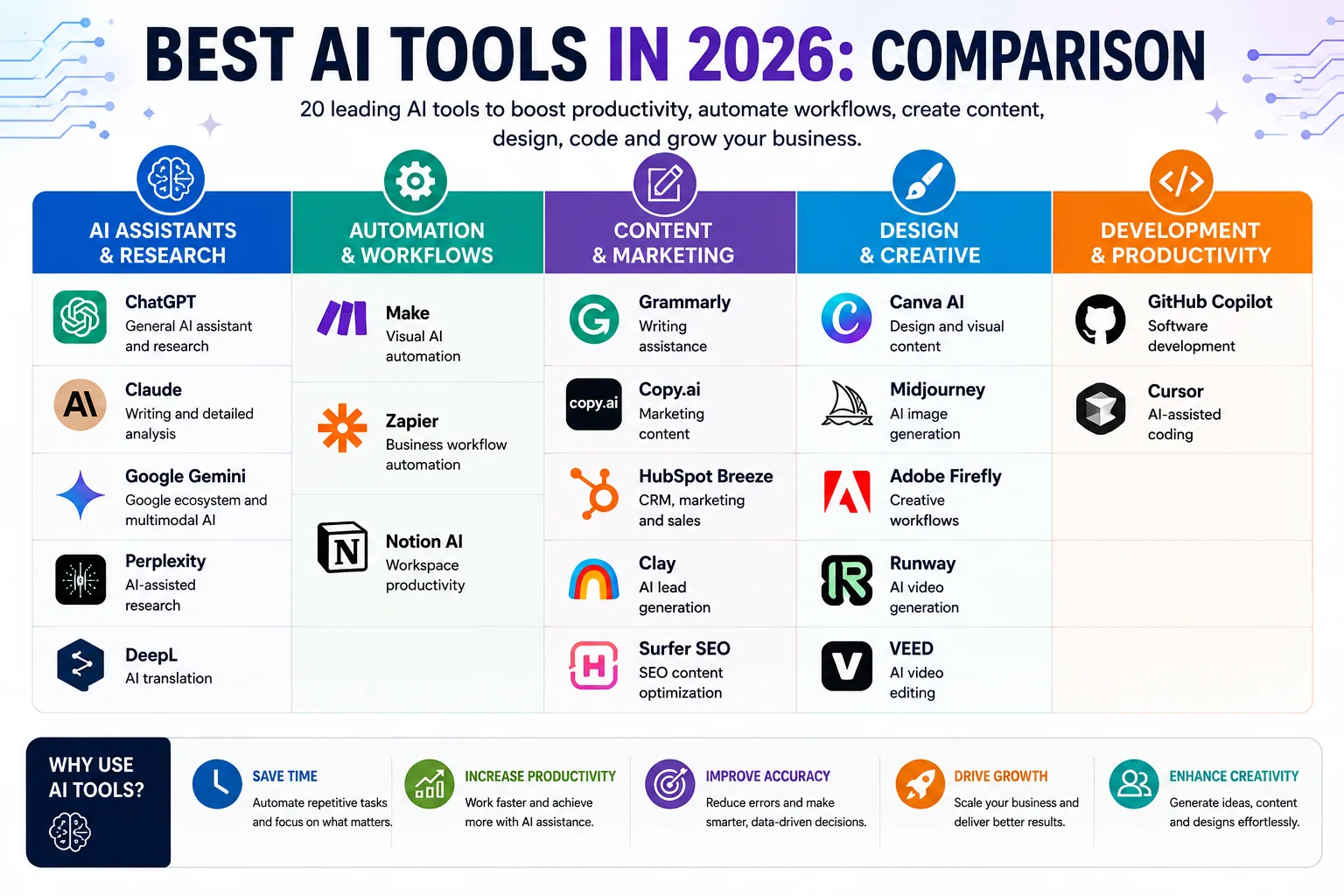
Best AI Tools in 2026: Quick Comparison
| AI Tool | Best For |
|---|---|
| ChatGPT | General AI assistant and research |
| Claude | Writing and detailed analysis |
| Google Gemini | Google ecosystem and multimodal AI |
| Make | Visual AI automation |
| Zapier | Business workflow automation |
| Notion AI | Workspace productivity |
| Canva AI | Design and visual content |
| GitHub Copilot | Software development |
| Midjourney | AI image generation |
| Adobe Firefly | Creative workflows |
| Runway | AI video generation |
| Grammarly | Writing assistance |
| Copy.ai | Marketing content |
| HubSpot Breeze | CRM, marketing and sales |
| Clay | AI lead generation |
| Surfer SEO | SEO content optimization |
| Perplexity | AI-assisted research |
| Cursor | AI-assisted coding |
| DeepL | Translation |
| VEED | AI video editing |
1. ChatGPT — Best Overall AI Assistant
ChatGPT is one of the most versatile AI platforms available for individuals and businesses. It can assist with writing, brainstorming, file analysis, coding, research, images, planning and many other knowledge-work tasks.
Best for: entrepreneurs, marketers, researchers, writers, developers and general business users.
Why choose it: versatility. One AI environment can support many different types of professional work.
If you are deciding between two leading assistants, read our ChatGPT vs Claude comparison.
2. Claude — Best for Writing and Detailed Analysis
Claude is particularly useful for knowledge-intensive tasks such as drafting long-form content, analyzing documents, summarizing information and working through complex written material.
Best for: writers, researchers, analysts and teams working with large amounts of text.
3. Google Gemini — Best for the Google Ecosystem
Google Gemini is particularly attractive for users already working heavily inside Google’s ecosystem. It combines conversational AI with multimodal capabilities and connections across Google’s productivity and information services.
Best for: businesses and individuals heavily invested in Google products.
If you are comparing today’s leading AI assistants, see our detailed Claude vs Gemini comparison to compare their strengths for writing, coding, research, productivity and business use.
4. Make — Best Visual AI Automation Platform
Make is one of the most useful automation platforms for XVIFS readers because it lets businesses build sophisticated visual workflows without traditional programming.
Users can connect applications, APIs, AI models, webhooks, routers, filters, data stores and other modules to automate multi-step business processes.
Best for: automation builders, agencies, marketers, freelancers and businesses.
If you are new to the platform, begin with our Make.com tutorial for beginners. You can then continue with our guides to the Make.com Router, Make.com Filters, Make.com HTTP module and Make.com JSON.
5. Zapier — Best for Straightforward Business Automation
Zapier is another major business automation platform. It allows companies to connect applications and automate recurring workflows without building integrations from scratch.
Best for: businesses wanting straightforward app-to-app automation with minimal technical setup.
For a deeper introduction, read our Zapier Workflow Automation Guide.
6. Notion AI — Best AI Workspace
Notion AI combines artificial intelligence with documents, projects, databases, meeting notes and company knowledge.
Best for: teams managing projects, documentation, meetings and internal knowledge.
7. Canva AI — Best for AI Design
Canva combines its established visual design environment with AI-assisted creative tools, helping non-designers and professionals create content more efficiently.
Best for: marketers, small businesses, social media managers, creators and non-designers.
8. GitHub Copilot — Best AI Tool for Developers
GitHub Copilot brings AI assistance directly into software-development workflows through code suggestions, conversational help and development assistance.
Best for: software developers and engineering teams.
9. Midjourney — Best for Creative AI Images
Midjourney is widely used for producing highly stylized and creative images from text prompts. Its strength lies in visual creativity and artistic interpretation rather than traditional template-based graphic design.
Best for: designers, creators, concept artists, advertisers and marketers.
10. Adobe Firefly — Best for Adobe Creative Workflows
Adobe Firefly brings generative AI into Adobe’s wider creative ecosystem.
Best for: professional designers, creative teams, agencies and businesses already using Adobe products.
11. Runway — Best for AI Video Generation
Runway focuses heavily on AI-assisted video production and generative video workflows.
Best for: creators, marketing teams, agencies and businesses experimenting with AI-generated video.
12. Grammarly — Best AI Writing Assistant
Grammarly is useful for professionals who want AI assistance directly inside everyday writing and communication workflows. Its main value is helping improve clarity, tone and correctness without forcing users to completely change the tools they already use.
Best for: professionals, marketers, students and business teams.
13. Copy.ai — Best for Marketing Workflows
Copy.ai became known for AI-generated marketing copy and has expanded toward broader sales and marketing workflows.
Best for: marketing teams, sales organizations and businesses producing recurring promotional content.
14. HubSpot Breeze — Best AI CRM and Marketing Platform
HubSpot integrates AI into its CRM, marketing, sales and customer-service ecosystem. The major advantage is that AI can operate alongside customer and CRM information rather than existing as a completely separate tool.
Best for: marketing, sales and customer-service teams.
15. Clay — Best AI Lead Generation Tool
Clay is particularly useful for AI-assisted B2B prospecting, lead enrichment, research, qualification and personalized outreach workflows.
Best for: B2B sales teams, growth agencies, lead-generation professionals and outbound sales organizations.
For a practical walkthrough, read our Clay AI Lead Generation Guide. You can also compare additional options in our guide to the best AI sales tools.
16. Surfer SEO — Best for SEO Content Optimization
Surfer SEO helps publishers, content teams and SEO professionals optimize webpages using search-focused content analysis.
Best for: bloggers, SEO specialists, agencies, publishers and content marketers.
XVIFS has dedicated guides covering the Surfer SEO content optimization workflow and creating a Surfer SEO Content Brief.
17. Perplexity — Best for Fast AI Research
Perplexity focuses on AI-assisted information discovery and research.
Best for: competitive research, fact-finding, preliminary market research and users who prefer source-oriented AI answers.
18. Cursor — Best AI-First Coding Environment
Cursor is a coding environment designed around AI-assisted software development.
Best for: developers who want AI involved throughout their development workflow rather than using it only for occasional code completion.
19. DeepL — Best for AI Translation
DeepL focuses on machine translation and language assistance for individuals and organizations working across multiple languages.
Best for: international businesses, writers, localization teams and multilingual communication.
20. VEED — Best for Simple AI Video Editing
VEED combines browser-based video editing with AI-assisted functionality for video creation, subtitles, transcription and other common content-production tasks.
Best for: marketers, creators, social media teams and small businesses producing frequent video content.
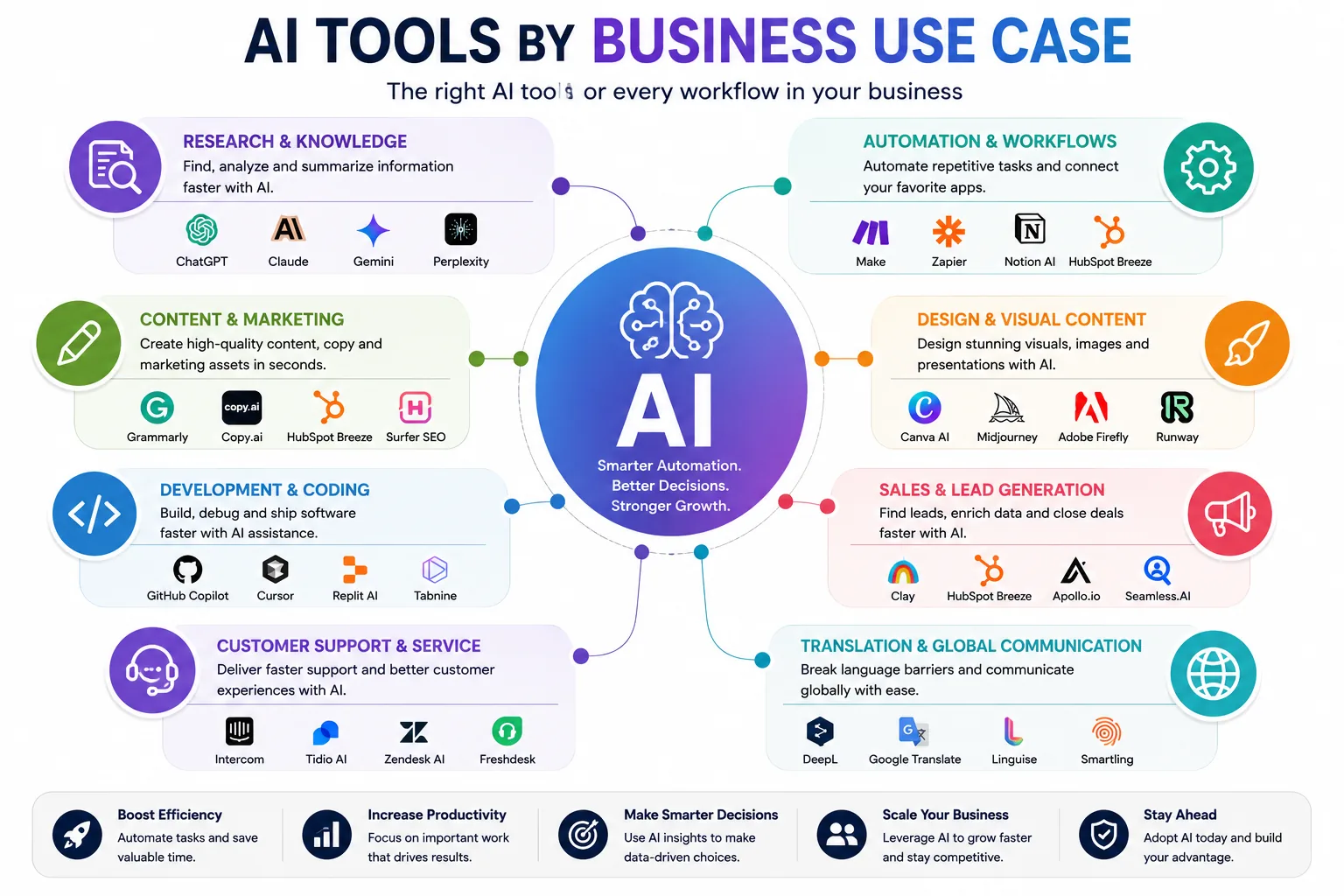
How to Choose the Best AI Tools in 2026
The best AI tools in 2026 are not necessarily the products with the longest feature lists. The right choice depends on the business problem you actually need to solve.
- General AI assistants: ChatGPT, Claude or Gemini.
- Automation: Make or Zapier.
- Workspace productivity: Notion AI.
- Design: Canva AI, Midjourney or Adobe Firefly.
- Development: GitHub Copilot or Cursor.
- Sales and marketing: HubSpot, Clay, Copy.ai or Surfer SEO.
- Research: ChatGPT or Perplexity.
If you operate a smaller company, also read our comparison of the best AI tools for small businesses.
AI Agents and Workflow Automation in 2026
One of the most important developments in artificial intelligence is the movement from standalone AI assistants toward AI that participates in broader workflows.
To understand how these systems differ, read our complete guide to the types of AI agents, including reflex, goal-based, learning, utility-based, hierarchical and multi-agent systems with practical examples.
Instead of simply asking AI to draft an email or summarize a document, businesses can increasingly connect AI with CRM systems, spreadsheets, databases, forms, marketing tools, customer-support platforms and other applications. For operations that depend on immediate sensor, camera or device data, real-time Edge AI can extend this approach by processing AI workloads closer to where the data is generated and supporting faster local decisions.
This is why automation platforms such as Make and Zapier have become increasingly important. They allow AI outputs to become part of repeatable business processes rather than isolated conversations.
For a practical example, see our guide on how to connect ChatGPT to Make.com.
Best AI Tools for Customer-Facing Teams
Customer service is another area where artificial intelligence can create measurable improvements. Businesses can use AI to assist with ticket classification, knowledge retrieval, response drafting, customer routing and repetitive support tasks.
See our dedicated guide to the best AI tools for customer support for more specialized help-desk and customer-service options.
Are Free AI Tools Good Enough?
Free plans are an excellent way to test whether an AI product actually improves your workflow before committing to another monthly subscription.
Professional users may eventually need paid plans for higher usage limits, premium models, collaboration features, integrations or automation capabilities.
- Test the AI tool.
- Identify a measurable business use case.
- Build a repeatable workflow.
- Measure time, quality or revenue impact.
- Upgrade only when the paid features create meaningful additional value.
Frequently Asked Questions About the Best AI Tools in 2026
What are the best AI tools in 2026?
Some of the strongest AI tools in 2026 include ChatGPT, Claude, Gemini, Make, Zapier, Notion AI, Canva AI, GitHub Copilot, HubSpot, Clay and Surfer SEO. The best choice depends on whether you need research, automation, writing, design, coding, sales or productivity.
What is the best AI tool for business?
There is no single best AI tool for every business. ChatGPT is highly versatile, Make and Zapier are strong for workflow automation, HubSpot is useful for CRM-driven marketing and sales, and Notion AI can support knowledge and productivity workflows.
What is the best AI automation tool?
Make and Zapier are two leading automation platforms. Make is particularly suitable for visual and complex automation scenarios, while Zapier is well suited to straightforward business integrations and recurring workflows.
What is the best AI tool for content creators?
ChatGPT, Canva AI, Midjourney, VEED, Adobe Firefly and Runway cover different parts of the content-production workflow, including research, writing, graphics, image generation and video.
What is the best AI tool for coding?
GitHub Copilot and Cursor are strong options. Copilot integrates naturally with established development workflows, while Cursor offers an AI-centered coding environment.
Can small businesses benefit from AI tools?
Yes. Small businesses can use AI for research, content creation, customer support, sales, data analysis, marketing and repetitive workflow automation without requiring a large technical team.
Will AI tools replace employees?
AI can automate individual tasks and parts of multi-step workflows, but businesses still need human judgment, strategy, quality control, accountability and customer understanding. In many practical situations, AI provides the greatest value when it augments people rather than operating entirely without oversight.
Conclusion: Choosing the Right AI Tools for Your Business
The best AI tools in 2026 are becoming more capable, connected and increasingly integrated with real business workflows.
ChatGPT, Claude and Gemini provide broad AI assistance. Make and Zapier connect artificial intelligence with business processes. Canva and other creative platforms accelerate content production. GitHub Copilot and Cursor assist developers, while platforms such as HubSpot, Clay and Surfer SEO bring AI into marketing and sales workflows.
The goal should not be to use every AI tool available. Choose products that solve a real business problem, connect them with repeatable workflows and measure whether they actually save time, improve quality or contribute to revenue.
For XVIFS readers, automation is a natural next step. Once you choose an AI platform, continue with our complete Make.com tutorial for beginners to learn how to connect AI with the applications your business already uses.