15 Best AI Tools for Small Businesses in 2026: Save Time & Grow Faster
Discover the smartest AI solutions for marketing, automation, sales, customer support and productivity to help your small business work faster and grow in 2026.
187Running a small business often means handling marketing, customer service, sales, meetings, admin and operations with a very lean team. The right AI tools for small businesses can reduce repetitive work, speed up everyday tasks and help owners focus more time on customers, strategy and growth.In 2026, the strongest small-business AI stack is not built around one tool. It usually combines a general AI assistant, a work-management platform, meeting automation, customer support, creative tools, sales software and workflow automation.This XVIFS guide compares 15 practical AI tools for small businesses across content creation, productivity, meetings, customer support, design, sales, finance and automation. We focus on real business use cases rather than simply listing the most popular AI brands.Choosing the right AI tools for small businesses can help lean teams automate routine work without adding unnecessary complexity.If you want a broader market overview first, see our guide to the best AI tools in 2026. If you are deciding between two leading general-purpose assistants, our ChatGPT vs Claude comparison explains their different strengths.
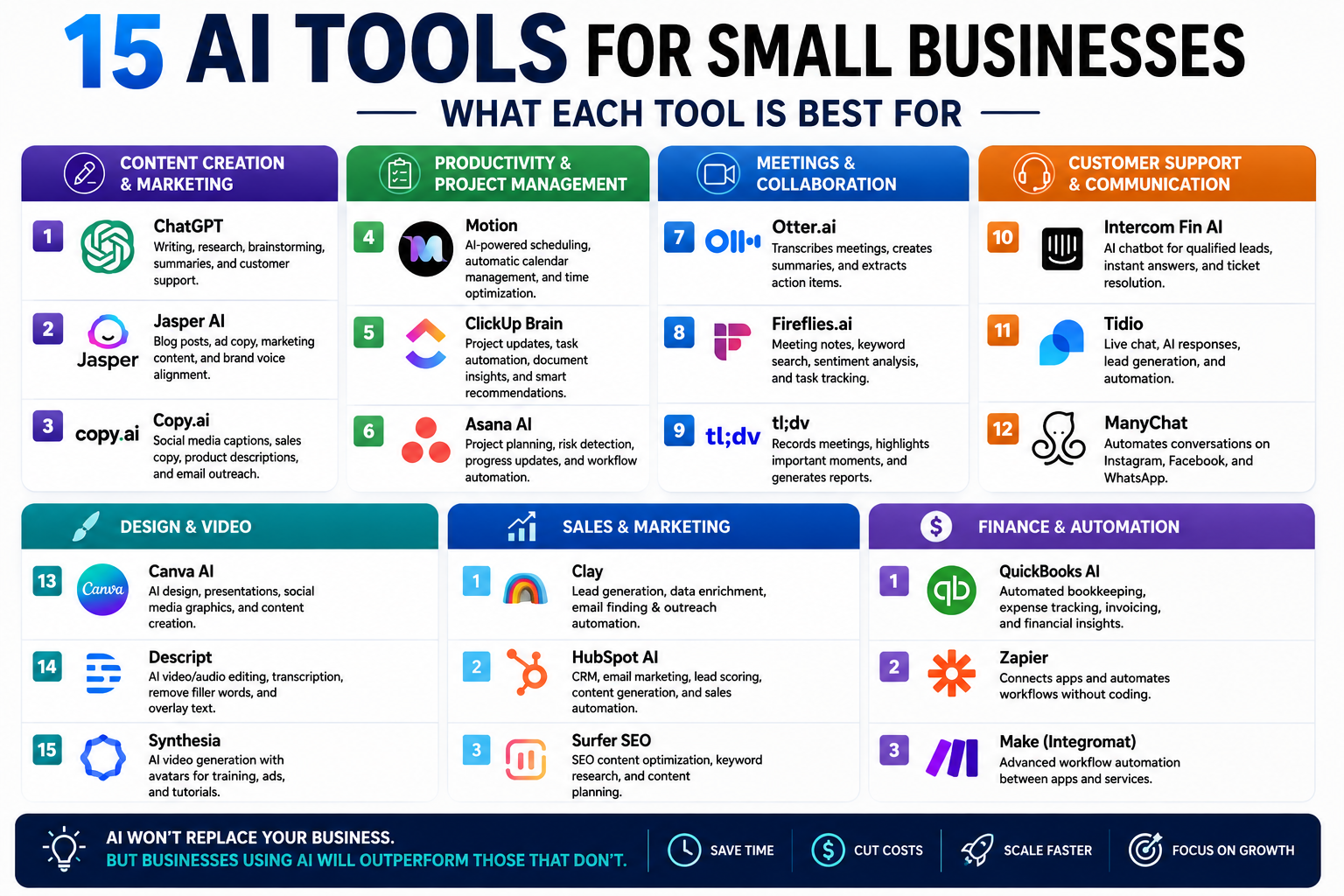
Best AI Tools for Small Businesses: Quick Comparison
AI tools for small businesses grouped by common use cases such as content, productivity, meetings, customer support, design, sales and automation.
#
AI Tool
Best For
1
ChatGPT
General AI assistance, research and productivity
2
Jasper
Brand-controlled marketing content
3
Copy.ai
Sales and marketing workflows
4
ClickUp Brain
Project knowledge, tasks and workplace AI
5
Asana AI
Work management and AI teammates
6
Otter.ai
Meeting transcription, summaries and action items
7
Fireflies.ai
Meeting intelligence and follow-up workflows
8
Intercom Fin
AI-powered customer support
9
ManyChat
Social messaging and lead automation
10
Canva AI
Design, presentations and marketing visuals
11
Descript
AI video, podcast and audio editing
12
Clay
B2B lead research and enrichment
13
HubSpot Breeze
CRM-based AI for marketing, sales and service
14
QuickBooks AI
Bookkeeping and financial workflows
15
Make
No-code AI and workflow automation
How We Selected These AI Tools for Small Businesses
Small businesses rarely need the most complicated enterprise AI platform. They need tools that solve clear operational problems, are practical for small teams and can fit into existing workflows without creating more software overhead.We prioritized products that can help with at least one high-value business function: creating content, managing work, capturing meeting knowledge, serving customers, producing creative assets, improving sales, handling finance or automating repetitive processes.
1. ChatGPT — Best General AI Assistant for Small Businesses
ChatGPT is a strong starting point for small businesses because it can support many different kinds of work from one environment. Owners and employees can use it for research, writing, brainstorming, file analysis, data analysis, planning, customer-response drafts and other knowledge tasks.Best for: founders, freelancers and small teams that want one versatile AI assistant before adding more specialized software.Small-business use case: turn a rough campaign idea into an outline, email draft, FAQ, social-media concepts and a research checklist before passing the work into specialized marketing or automation tools.
2. Jasper — Best for Brand-Controlled Marketing Content
Jasper is designed specifically around marketing workflows. Its value is not simply generating text; it also focuses on brand voice, audience context and governed marketing execution.Best for: small businesses producing a steady volume of campaigns, landing-page copy, email content and branded marketing assets.Jasper may be more specialized than a general chatbot, which can be an advantage for companies that want their marketing output to follow consistent brand guidance.
3. Copy.ai — Best for Sales and Marketing Workflows
Copy.ai has developed beyond simple copy generation into a broader go-to-market AI platform. It can support repeatable sales and marketing workflows rather than only producing one-off captions or product descriptions.Best for: B2B companies, sales-led businesses and marketing teams that want AI inside recurring go-to-market processes.
4. ClickUp Brain — Best for AI-Powered Work Management
ClickUp Brain brings AI into a workspace containing tasks, documents, discussions and company knowledge. This can be especially useful for small teams that already use ClickUp and want AI to work with the context of their projects rather than in a separate chat window.Best for: teams that want project updates, workspace knowledge and AI-assisted task management in one place.
5. Asana AI — Best for Structured Team Workflows
Asana AI adds AI-powered capabilities to Asana’s work-management environment, including AI teammates and automation-oriented features designed to help teams coordinate work.Best for: small companies already using Asana for projects, campaigns, operations or cross-team planning.Choose between ClickUp and Asana based on the project-management environment your team actually prefers. Switching platforms only for AI features can create unnecessary disruption.
6. Otter.ai — Best for Meeting Notes and Action Items
Otter.ai is an AI meeting assistant built around transcription, summaries, insights and action items. For a small business, that can reduce the amount of time spent manually writing meeting notes and chasing decisions after calls.Best for: client calls, internal meetings, sales conversations and teams that need searchable meeting knowledge.
7. Fireflies.ai — Best for Meeting Intelligence and Follow-Up
Fireflies.ai combines meeting capture with searchable conversation intelligence and workflow automation across meetings, email, chat, CRM and other business applications.Best for: businesses that want meeting information to flow into follow-up systems rather than remain trapped inside transcripts.
8. Intercom Fin — Best AI Tool for Customer Support
Intercom Fin is an AI customer-service agent designed to work alongside Intercom’s helpdesk environment. It can answer customer questions and support automated resolution workflows while giving human support teams visibility into conversations.Best for: small businesses receiving enough support volume to justify a dedicated helpdesk and AI customer-service workflow.For a wider comparison of helpdesk options, see our guide to AI tools for customer support.
9. ManyChat — Best for Social Messaging Automation
ManyChat helps businesses automate conversations across social and messaging channels such as Instagram, WhatsApp and Messenger. It is especially useful when customer enquiries and lead generation happen inside social messaging rather than traditional email forms.Best for: creators, ecommerce brands, local businesses and service companies that generate leads through social media.
10. Canva AI — Best for Design and Marketing Visuals
Canva combines an accessible design platform with increasingly advanced AI capabilities. Small businesses can use it for social-media graphics, presentations, marketing materials, brand assets and other visual content without maintaining a full design department.Best for: small teams that regularly need polished visual content but do not have specialist designers available for every task.
11. Descript — Best for AI Video and Audio Editing
Descript combines recording, transcription, audio editing and video editing in a workflow that can feel closer to editing a document than using a traditional timeline-based editor.Best for: podcasts, training videos, social clips, interviews, product explainers and small teams producing regular video or audio content.
12. Clay — Best for B2B Lead Generation and Enrichment
Clay combines data enrichment, research and automation for B2B prospecting. It is particularly useful when a business needs to transform raw lead signals into researched and personalized outreach opportunities.Best for: agencies, B2B service providers, outbound sales teams and founders doing systematic prospecting.Read our Clay AI lead generation guide for a deeper walkthrough, or compare more options in our guide to the best AI sales tools.
13. HubSpot Breeze — Best for CRM-Based Business AI
HubSpot Breeze brings AI into HubSpot’s CRM environment, helping marketing, sales and customer-service teams work with AI that has access to relevant CRM context and customer information.Best for: growing companies already using HubSpot or businesses that want AI closely connected with CRM workflows.
14. QuickBooks AI — Best for Bookkeeping and Financial Workflows
QuickBooks increasingly uses AI to reduce manual work in accounting and bookkeeping. Depending on the product and region, AI-supported workflows can assist with areas such as transaction categorization, anomaly detection and financial administration while keeping human review in the process.Best for: small businesses that already use QuickBooks and want more automation around bookkeeping and financial operations.Financial automation should always include review. AI can reduce repetitive work, but owners and accountants remain responsible for accuracy, tax treatment and compliance.
15. Make — Best for No-Code AI and Workflow Automation
Make is one of the most useful platforms for connecting separate business tools into automated workflows. It supports visual automation, APIs, webhooks, data processing and increasingly AI-driven workflows.Best for: small businesses that want information to move automatically between forms, spreadsheets, CRMs, email, AI models and other applications.If you want to start building automations, use our Make.com tutorial for beginners. You can also compare another major platform in our Zapier workflow automation guide.
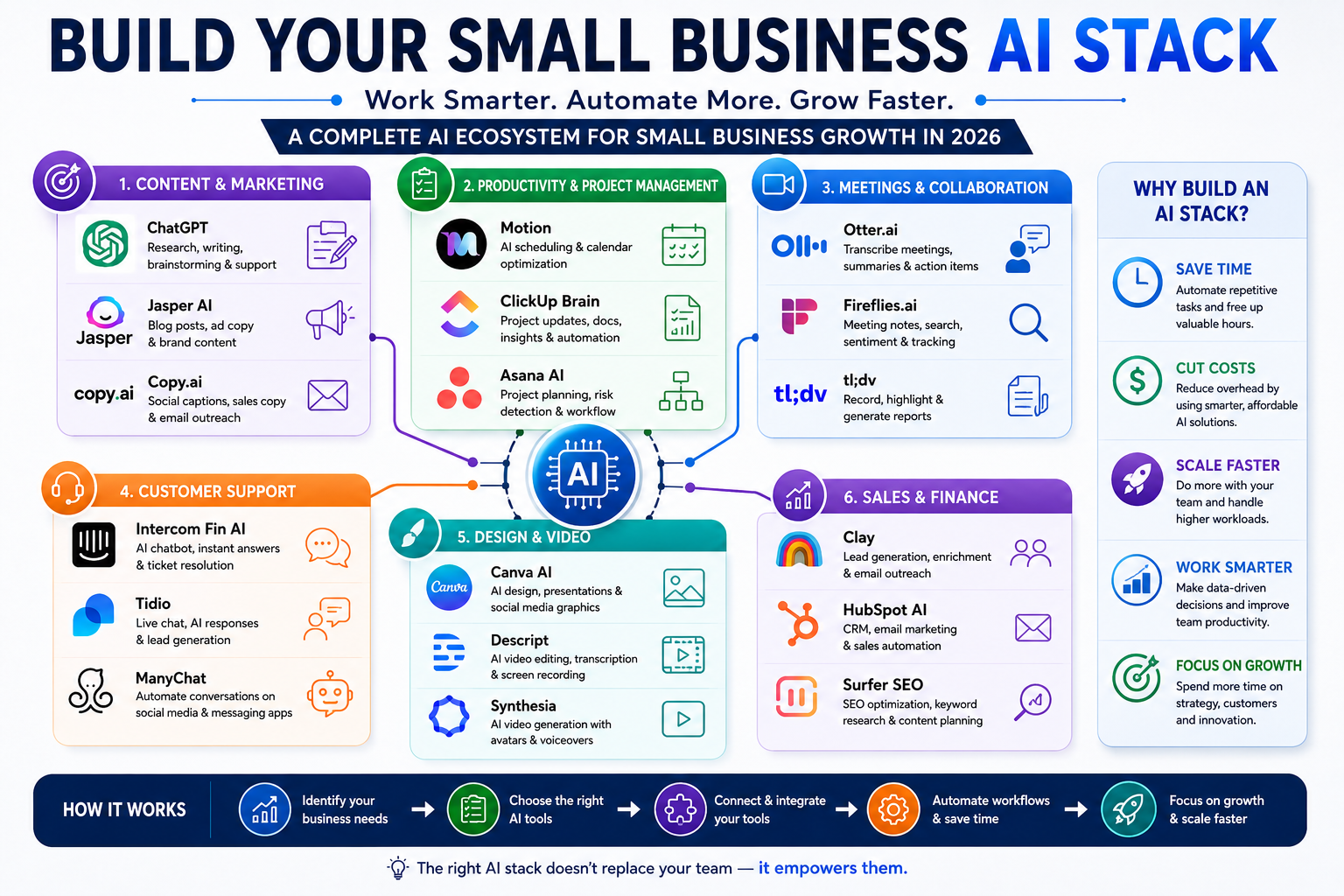
How to Build a Small Business AI Stack in 2026
A practical small-business AI stack connects content, productivity, meetings, customer support, design, sales, finance and automation around real workflows.The most effective approach is not to subscribe to every AI product. Build a small stack around your biggest bottlenecks.
Start with one general AI assistant. Use ChatGPT or another assistant for research, drafting, analysis and everyday problem solving.
Add a work-management layer. Use ClickUp or Asana if coordination, tasks and project visibility are a major pain point.
Capture meeting knowledge. Add Otter or Fireflies if calls generate important decisions, follow-ups or sales information.
Automate your customer channel. Consider Intercom or ManyChat depending on whether your support happens through a helpdesk or social messaging.
Add creative tools only when needed. Canva and Descript can cover a large percentage of common small-business visual and video requirements.
Connect the stack. Use Make or another automation platform to move information between tools instead of relying on repetitive copy-and-paste work.
How Much Should a Small Business Spend on AI Tools?
Before paying for multiple subscriptions, compare AI tools for small businesses based on the specific workflows you actually want to improve.There is no useful universal monthly budget because pricing varies significantly by product, plan, usage and team size. A two-person service business has very different requirements from a growing ecommerce company or a ten-person sales team.A safer approach is to judge each subscription by measurable value. Ask whether the tool saves meaningful staff time, improves conversion, reduces support workload, shortens production time or replaces another piece of software you no longer need.
Data Privacy and AI Tools for Small Businesses
When evaluating AI tools for small businesses, data handling and access controls should be considered alongside features and price.Small companies should not upload sensitive customer, employee, financial or confidential business information into AI tools without understanding the provider’s terms and data controls. Consumer plans and business plans may have different privacy and administrative settings.Before using an AI product for sensitive workflows, review its privacy policy, data-retention settings, business-plan protections, access controls and any compliance requirements relevant to your industry.
How to Choose the Right AI Tools for Your Small Business
The best AI tools for small businesses are the ones employees actually use and that solve a clear problem. Avoid buying software simply because it has an AI label.
Identify the bottleneck first: content, leads, customer support, meetings, projects, finance or repetitive admin.
Check integrations: the tool should fit your existing CRM, email, calendar, spreadsheets and other systems.
Run a small pilot: test one real workflow before rolling the product out across the company.
Measure the result: track time saved, response time, conversion, output or another business metric.
Avoid AI sprawl: remove overlapping subscriptions when two tools solve essentially the same problem.
Other AI Tools Worth Considering
The 15 tools above are not the only useful options. Depending on your workflow, alternatives such as Motion for scheduling, tl;dv for meeting intelligence, Tidio for customer communication, Synthesia for AI-avatar video, Zapier for automation and Surfer SEO for search-focused content optimization may also be worth testing.If content marketing is a priority, see our Surfer SEO content optimization guide and our guide to creating a Surfer SEO Content Brief.
For a broader look at AI-powered search marketing, compare the best AI SEO tools 2026 for keyword research, content optimization, technical SEO and AI search visibility.
Frequently Asked Questions About AI Tools for Small Businesses
What are the best AI tools for small businesses in 2026?
Useful options include ChatGPT for general AI work, Jasper and Copy.ai for marketing, ClickUp Brain and Asana AI for work management, Otter and Fireflies for meetings, Intercom Fin and ManyChat for customer communication, Canva and Descript for creative work, Clay and HubSpot for sales, QuickBooks for finance, and Make for automation.
What AI tool should a small business start with?
A general AI assistant is often the simplest first step because it can help across many everyday tasks. After that, add specialized software only where there is a clear operational bottleneck.
Can AI tools help a small business save money?
They can reduce manual work and help small teams handle more tasks, but savings are not automatic. A tool creates value only when it improves a real workflow enough to justify its subscription, implementation and training costs.
Do small businesses need coding skills to use AI?
No. Many of the tools in this guide are designed for non-technical users. Platforms such as Make also provide visual automation, although more complex integrations may still require technical knowledge.
Are AI tools safe for confidential business data?
It depends on the product, plan, settings and type of data. Businesses should review provider policies and security controls before putting sensitive information into any AI system.
Should a small business use many AI tools at once?
Usually not at the beginning. Start with a small number of tools that address your highest-value problems, then expand only when the additional software has a clear purpose.The most effective AI tools for small businesses are those that solve measurable problems and integrate smoothly with the software your team already uses.
Final Verdict: Building a Practical Small Business AI Stack
The best AI tools for small businesses are not necessarily the most advanced products on the market. They are the tools that remove repetitive work, make important information easier to use and help a small team operate more effectively.Start with a versatile AI assistant, solve one or two major bottlenecks, connect the systems you already use and measure the result. A focused AI stack is usually more valuable than paying for a long list of disconnected subscriptions.For your next step, explore our best AI tools in 2026, compare the best AI sales tools, or start automating your workflows with our Make.com beginner guide.Editor’s note: AI products change quickly. Features, availability and pricing should be confirmed on each provider’s official website before purchasing or deploying a tool in an important business workflow.
XVIFS helps businesses, marketers, creators, and entrepreneurs discover practical AI tools, SaaS platforms, automation solutions, and digital marketing strategies. Explore our tutorials, software reviews, comparisons, and step-by-step guides designed to help you work smarter, automate faster, and grow your business online.