12 Best AI SEO Tools in 2026: Features, Pricing & Use Cases
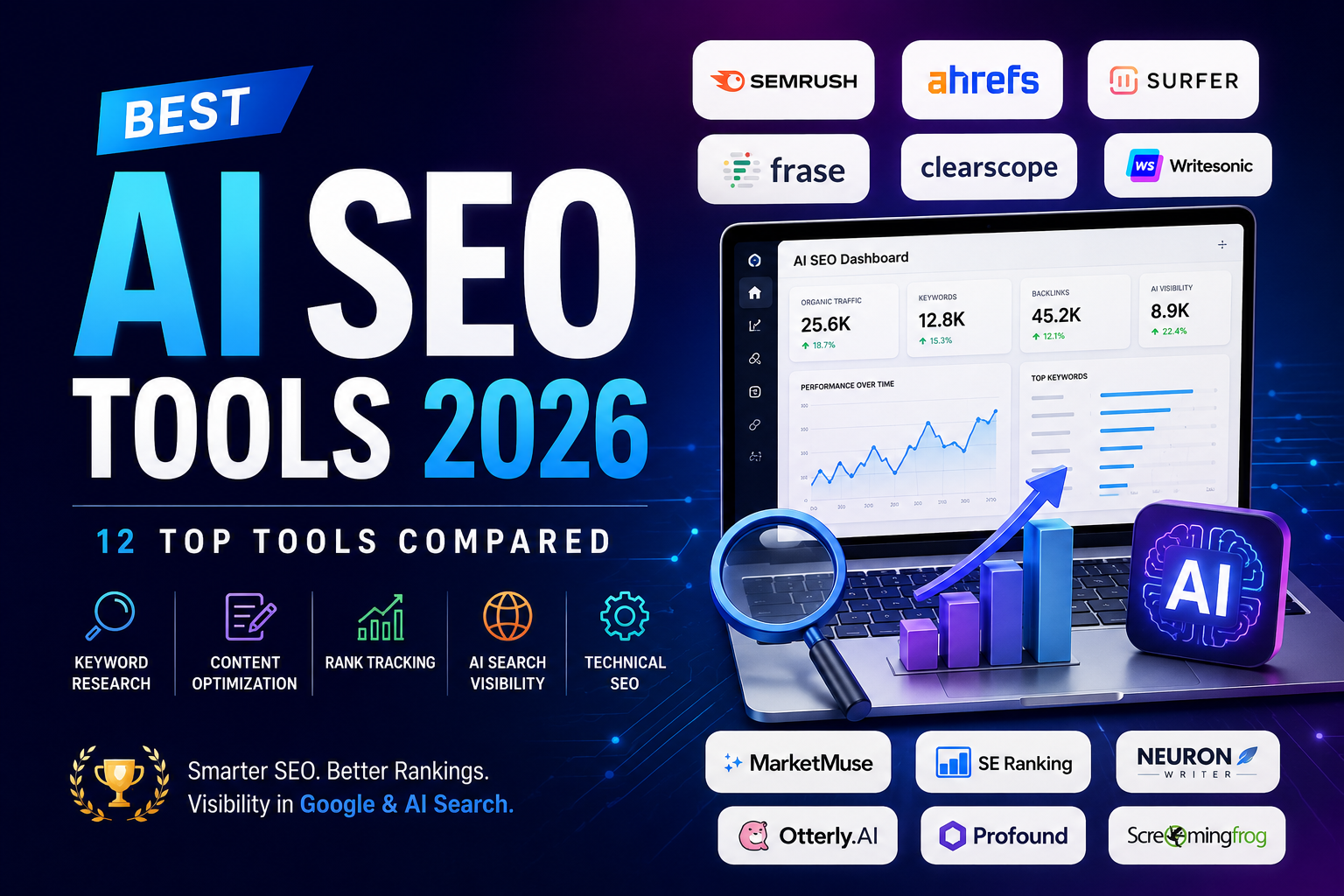
Finding the best AI SEO tools 2026 is no longer just about choosing an AI writer. Search has changed. Businesses now need tools that can improve traditional Google rankings while also helping them understand how their brand appears in AI-powered search experiences such as ChatGPT, Gemini, Google AI Overviews and Perplexity.
The strongest platforms now combine keyword research, competitor analysis, content optimization, technical SEO, rank tracking and increasingly AI search visibility. That makes choosing the right platform more difficult—but also more valuable when the tool matches your real business needs.
In this guide, XVIFS compares 12 leading platforms based on their strongest use cases, core SEO features, AI capabilities, value and suitability for different users. The goal is not to declare that every tool is perfect. It is to help you decide which option deserves a place in your SEO stack.
Quick verdict: Semrush is our strongest all-round choice for businesses that want one broad SEO and AI-search platform. Ahrefs remains excellent for keyword, competitor and backlink research. Surfer SEO is a strong option for content optimization, while Frase, Clearscope and MarketMuse are better suited to specific content workflows. Dedicated platforms such as OtterlyAI and Profound become more relevant when AI-search visibility is the main priority.
Editorial note: XVIFS reviewed public product information, official documentation and current pricing pages. We do not claim hands-on testing of every product in this comparison. Software features and prices can change, so always confirm the latest details on the official provider website before purchasing.
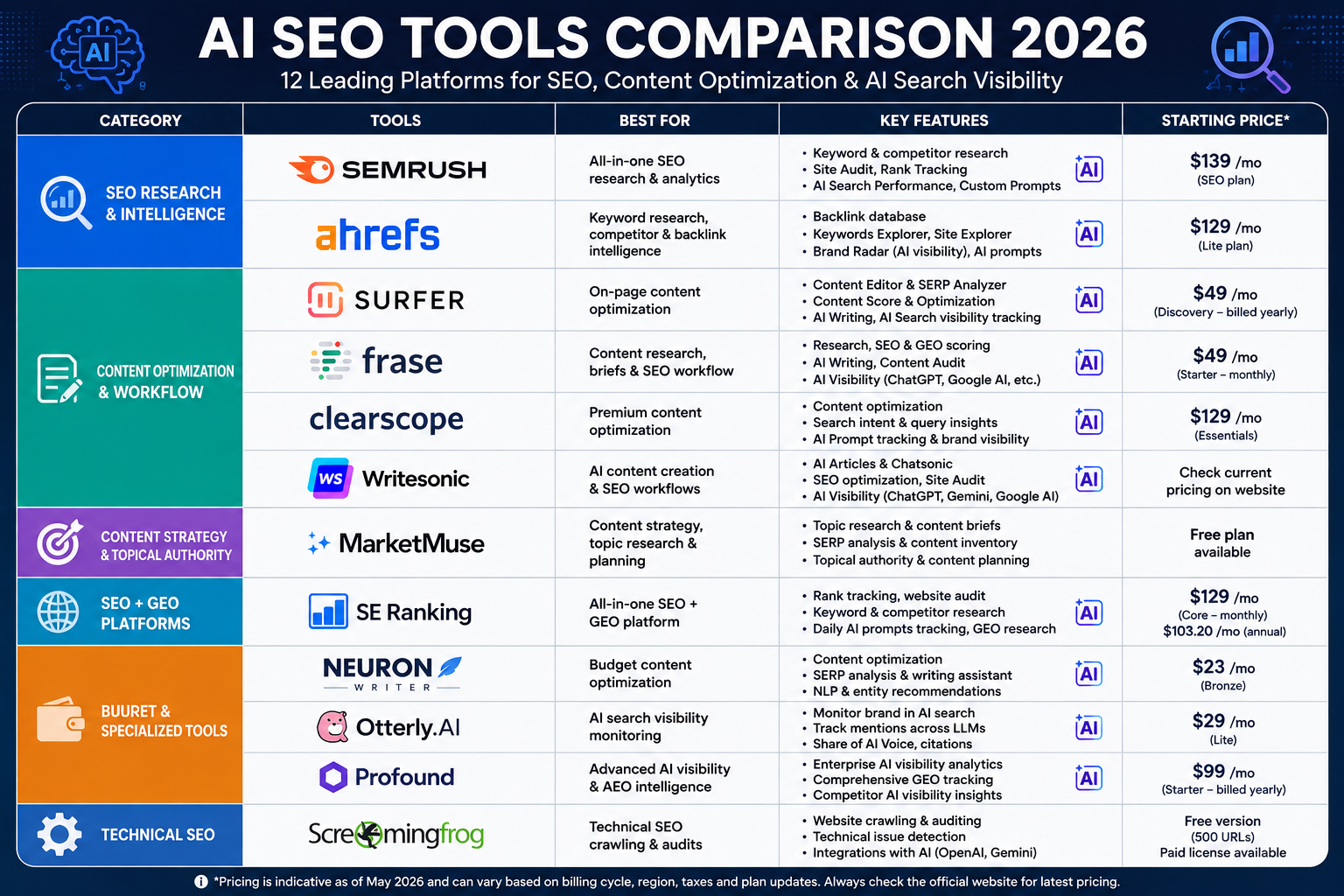
Best AI SEO Tools 2026: Quick Comparison
| Tool | Best For | Main Strength | AI/GEO Capability | Pricing Note |
|---|---|---|---|---|
| Semrush | Best overall | Complete SEO ecosystem | Strong | SEO plan starts at $139/month on monthly billing |
| Ahrefs | Research & backlinks | Competitive intelligence | Strong | Lite pricing varies by region; check the official page |
| Surfer SEO | Content optimization | On-page optimization | Growing | Check current Discovery plan pricing |
| Frase | Content workflows | Research, briefs & optimization | Strong | Check current Starter pricing |
| Clearscope | Premium content teams | Content optimization | Strong | Check current Essentials pricing |
| Writesonic | AI-led content workflows | AI content + search workflows | Strong | Check current official pricing |
| MarketMuse | Topical authority | Content strategy | Moderate | Free plan available |
| SE Ranking | SEO + GEO teams | SEO platform and tracking | Strong | Check current Core plan pricing |
| NEURONwriter | Budget optimization | Content optimization | Moderate | Check current official pricing |
| OtterlyAI | AI visibility monitoring | LLM brand monitoring | Very strong | Check current official pricing |
| Profound | Advanced AI visibility | Enterprise AEO/GEO intelligence | Very strong | Check current official pricing |
| Screaming Frog | Technical SEO | Website crawling | Supporting role | Free version available |
Pricing can vary according to billing cycle, region, taxes, usage limits and future plan changes.
Our Top Picks for the Best AI SEO Tools 2026
- Best overall: Semrush
- Best for keyword and backlink research: Ahrefs
- Best for content optimization: Surfer SEO
- Best for research-to-content workflows: Frase
- Best premium content optimizer: Clearscope
- Best for topical authority: MarketMuse
- Best combined SEO + GEO alternative: SE Ranking
- Best for dedicated AI visibility: OtterlyAI or Profound
- Best technical SEO companion: Screaming Frog SEO Spider
How We Evaluated the Best AI SEO Tools 2026
We did not rank these platforms by the number of AI buttons or marketing claims they have. When comparing the best AI SEO tools 2026, the most important question is whether a platform solves a real search problem.
We considered the following areas:
- Keyword and competitor research: Can the platform help users find realistic opportunities and understand competing websites?
- Content optimization: Does it help improve relevance, structure, search intent coverage and topical depth?
- Technical SEO: Can it identify crawling, indexing or site-quality problems?
- AI usefulness: Do the AI features save meaningful time or provide useful analysis?
- GEO and AI-search visibility: Can it monitor brand visibility in AI-generated answers?
- Ease of use: Is the platform practical for the users it targets?
- Value: Does the feature set justify the cost for the intended audience?
AI can speed up SEO research and execution, but it should not replace sound judgment. Strong search performance still depends on useful content, search intent, technical quality, internal linking, authority and relevant backlinks.
What Is an AI SEO Tool?
An AI SEO tool is software that uses artificial intelligence, machine-assisted analysis or automation to support search engine optimization tasks.
Depending on the product, this can include keyword clustering, SERP analysis, content briefs, content optimization, AI-assisted writing, internal-link suggestions, competitor research, technical audits, rank tracking and visibility monitoring across AI assistants.
In 2026, the category has expanded beyond AI writing. Many of the best AI SEO tools 2026 now combine traditional SEO functions with features designed for generative search and AI answers.
SEO vs GEO: Why AI Search Visibility Matters in 2026
Traditional SEO
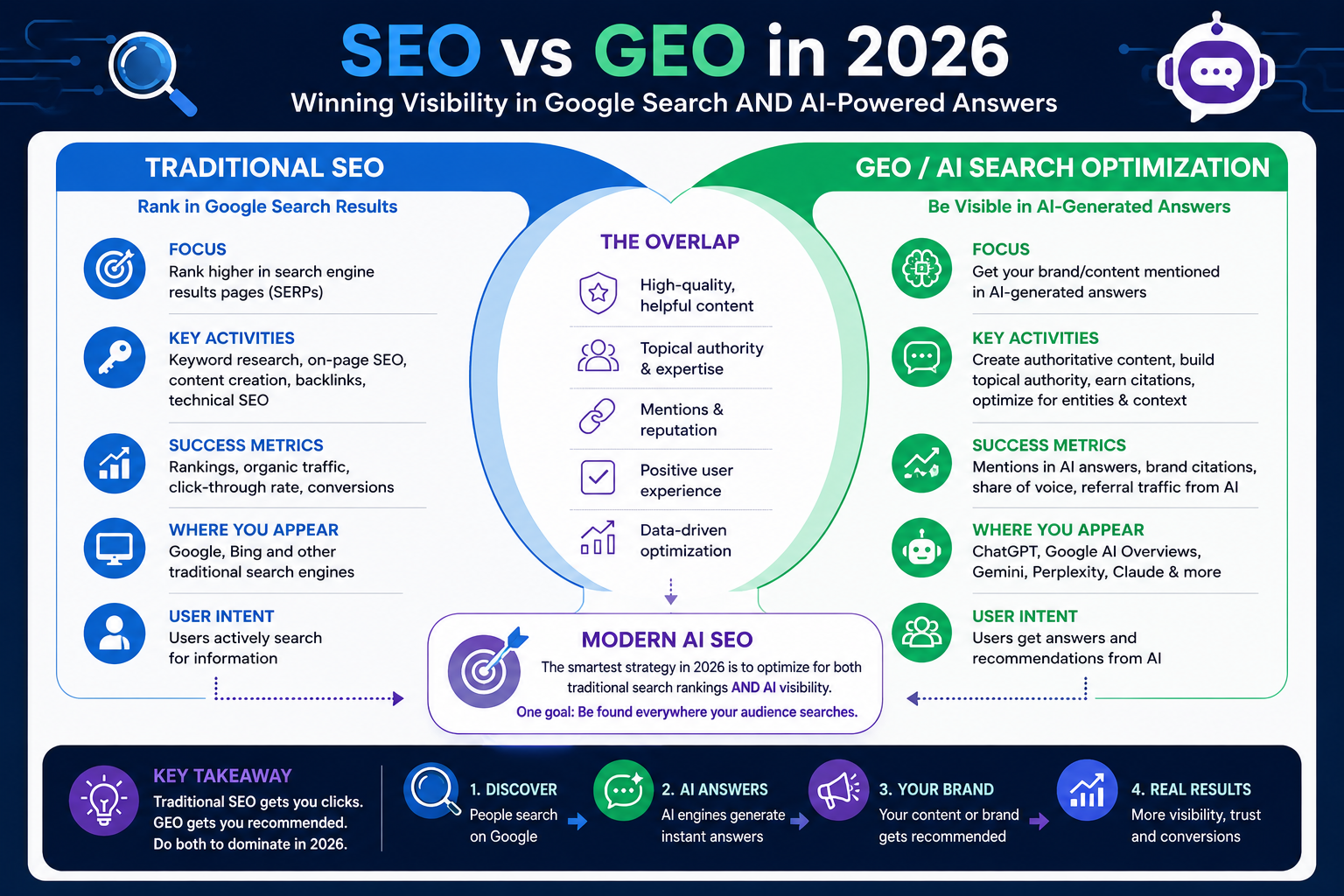
Traditional search engine optimization focuses on improving visibility in search engine result pages. It includes keyword research, content creation, technical SEO, internal linking, backlinks and rank tracking.
AI SEO
AI SEO usually refers to using artificial intelligence to improve or accelerate SEO work. Examples include generating content briefs, clustering keywords, analyzing competitors, identifying missing topics and optimizing existing pages.
GEO and AI Search Optimization
Generative Engine Optimization, commonly called GEO, focuses on improving a brand’s visibility inside AI-generated answers and recommendation systems. Instead of measuring only rankings and clicks, GEO may also measure brand mentions, citations, share of voice and visibility across different AI platforms.
The boundary between SEO and GEO is becoming less clear. This is one reason the best AI SEO tools 2026 increasingly combine traditional SEO features with AI-search or generative-search functionality. Current platforms such as Semrush, Ahrefs, Frase, Clearscope and SE Ranking illustrate that shift.
12 Best AI SEO Tools in 2026
1. Semrush — Best Overall AI SEO Tool
Semrush is our best overall choice because it covers a large part of the SEO workflow inside one ecosystem.
Businesses can use Semrush for keyword research, competitor analysis, rank tracking, site auditing and search visibility. Its current SEO offering also includes features for tracking performance in AI search, monitoring AI sentiment, generating AI visibility reports and monitoring custom prompts.
Best for: Businesses, marketers and agencies that want one broad platform rather than several disconnected tools.
Key strengths:
- Keyword and competitor research
- Position Tracking
- Site Audit
- SEO visibility reporting
- AI-search performance tracking
- Custom prompt monitoring
- Competitive intelligence
Pricing: Semrush currently lists its SEO plan at $139 per month on monthly billing, with a lower effective monthly price when billed annually.
Pros: Broad feature set, strong research capability and increasingly useful integration between traditional SEO and AI search.
Cons: Beginners may find the platform overwhelming, and advanced plans can become expensive.
XVIFS verdict: If you want one serious platform for traditional SEO plus emerging AI-search measurement, Semrush is the strongest all-round option in this comparison.
Check current Semrush pricing and features.
2. Ahrefs — Best for Keyword, Competitor and Backlink Research
Ahrefs remains one of the strongest SEO research platforms for marketers who care about backlinks, competitors and organic search intelligence.
Its toolkit includes Site Explorer, Keywords Explorer, Site Audit, Rank Tracker and competitive analysis. Ahrefs also includes Brand Radar and tracked AI prompts on supported plans, bringing AI-search visibility into the same broader ecosystem.
Best for: SEOs focused on competitive intelligence, backlink research and keyword analysis.
Pros: Strong research data, useful link intelligence and expanding AI visibility capabilities.
Cons: Smaller businesses with simple SEO needs may not use enough of the platform to justify the cost.
XVIFS verdict: Choose Ahrefs when research depth matters more than having an AI-first content-writing environment.
If Ahrefs is on your shortlist, our detailed Ahrefs vs SpyFu comparison explains which platform is better for keyword research, backlinks, competitor analysis, PPC, technical SEO and overall value.
3. Surfer SEO — Best for Content Optimization
Surfer SEO focuses heavily on helping publishers create and improve search-focused content.
Instead of replacing a full SEO suite, Surfer is particularly useful during content production. Its workflow is built around on-page optimization, content scoring and AI-assisted recommendations.
Best for: Bloggers, SEO writers, content teams and agencies producing organic-search content at scale.
Pros: Focused workflow and easier to understand than many large all-in-one platforms.
Cons: It does not replace a dedicated backlink database or full technical SEO suite.
XVIFS verdict: Surfer is one of the best choices when your biggest SEO problem is creating and improving content that matches search intent.
Check current Surfer SEO pricing.
4. Frase — Best for Research, Briefs and Content Workflows
Frase combines research, content briefs, optimization, AI assistance and publishing-oriented workflows.
Its current positioning is particularly interesting because it combines traditional content optimization with SEO and GEO scoring and AI visibility functionality.
Best for: Freelancers, publishers and teams that want a connected research-to-content workflow.
Pros: Strong workflow integration and useful content research features.
Cons: Larger publishing teams should review plan limits carefully.
XVIFS verdict: Frase is a good option for teams that want one environment for researching, planning and improving content rather than using several separate tools.
5. Clearscope — Best Premium Content Optimization Platform
Clearscope is best suited to content teams that prioritize quality, search intent and structured optimization.
Its current product also includes AI-related visibility functionality such as prompt tracking and brand visibility monitoring on supported plans.
Best for: Serious content teams, publishers and organizations where content quality matters more than finding the cheapest subscription.
Pros: Focused interface, strong content recommendations and expanding AI visibility functionality.
Cons: Pricing may be difficult to justify for very small websites or occasional publishers.
XVIFS verdict: Clearscope makes sense when content optimization is a major part of your growth strategy and you want a premium workflow.
Check current Clearscope pricing.
6. Writesonic — Best for AI-Driven SEO Content Workflows
Writesonic has expanded beyond AI writing into broader SEO and AI-search workflows.
It is particularly relevant for marketing teams that want AI-assisted production while also paying attention to discoverability in both traditional and generative search.
Best for: Marketing teams where AI-assisted content production is central to the workflow.
Pros: Strong combination of generative AI and search-focused workflows.
Cons: Teams focused mainly on backlink intelligence or highly technical SEO will still need specialist tools.
XVIFS verdict: Consider Writesonic when content production speed and AI-assisted workflows are major priorities.
Check current Writesonic pricing.
7. MarketMuse — Best for Topical Authority and Content Strategy
MarketMuse is better understood as a content strategy and intelligence platform than a basic AI writer.
It is particularly useful for sites building topic clusters, identifying content gaps and deciding where to invest editorial resources.
Best for: Websites building long-term topical authority rather than publishing isolated articles.
Pros: Strong strategic approach to topic planning and content intelligence.
Cons: It may be more platform than a beginner needs for a small website.
XVIFS verdict: MarketMuse becomes more valuable as your website grows and content planning becomes a portfolio decision rather than a one-article decision.
Check current MarketMuse plans.
8. SE Ranking — Best Alternative for Combined SEO and GEO
SE Ranking is a strong all-in-one alternative for businesses and agencies that want SEO tracking, auditing and competitive research together with AI-search visibility features.
Best for: Marketing teams that want conventional SEO tools plus GEO capabilities in one platform.
Pros: Broad SEO functionality and clear integration between traditional rankings and AI-search monitoring.
Cons: Small websites may not need the full range of features or higher limits.
XVIFS verdict: SE Ranking deserves consideration if you want an all-in-one platform but prefer an alternative to the largest SEO suites.
Check current SE Ranking plans.
9. NEURONwriter — Best Budget Content Optimizer
NEURONwriter is aimed at users who want SERP-driven content optimization without immediately moving to a higher-cost enterprise platform.
Best for: Bloggers, freelancers and smaller businesses that mainly need content optimization.
Pros: Budget-friendly positioning and a focused optimization workflow.
Cons: It does not provide the same breadth of backlink intelligence, technical auditing or AI visibility research as a full SEO suite.
XVIFS verdict: A sensible option for users who mainly need help improving content and do not require a complete enterprise SEO ecosystem.
10. OtterlyAI — Best for Focused AI Search Visibility Monitoring
OtterlyAI belongs to a different category from traditional SEO suites. Its main purpose is helping brands understand whether and how they appear inside AI-generated answers.
Best for: Businesses that already have conventional SEO covered but need dedicated AI visibility monitoring.
Pros: Focused use case and straightforward positioning around AI-search measurement.
Cons: It complements rather than replaces keyword research, technical SEO and backlink tools.
XVIFS verdict: OtterlyAI can make sense as an add-on when AI-search visibility becomes a serious reporting priority.
Check current OtterlyAI pricing.
11. Profound — Best for Advanced AI Visibility Intelligence
Profound focuses specifically on how brands appear across AI-powered discovery environments.
Best for: Larger organizations, advanced marketing teams and brands treating AEO or GEO as a strategic channel.
Pros: Specialized focus on generative search and AI visibility intelligence.
Cons: Traditional SEO teams may still need another platform for backlinks, keyword research and technical audits.
XVIFS verdict: Profound is most compelling when brand representation in AI systems is strategically important enough to justify a dedicated platform.
12. Screaming Frog SEO Spider — Best Technical SEO Companion
Screaming Frog SEO Spider is different from most of the tools in this list because its core strength is technical crawling.
It helps SEO professionals inspect websites for issues involving internal links, redirects, metadata, duplicate elements, status codes and other technical signals.
Best for: Technical SEO audits and website crawling.
Pros: Highly practical crawling capability and a free version for smaller websites.
Cons: It is not a replacement for a content strategy, backlink research or AI visibility platform.
XVIFS verdict: Technical SEO still matters even in an AI-search world. Screaming Frog remains one of the most useful specialist tools to keep alongside a broader SEO platform.
Check current Screaming Frog pricing.
Best AI SEO Tools 2026 by Use Case
| Your Main Need | Tool to Consider First |
|---|---|
| Complete SEO platform | Semrush |
| Backlinks and competitive research | Ahrefs |
| Content optimization | Surfer SEO |
| Research and content briefs | Frase |
| Premium content optimization | Clearscope |
| Topical strategy | MarketMuse |
| Combined SEO + GEO | SE Ranking |
| Budget content optimization | NEURONwriter |
| Focused AI visibility monitoring | OtterlyAI |
| Advanced enterprise AI visibility | Profound |
| Technical website crawling | Screaming Frog |
Best AI SEO Tools for Small Businesses
Small businesses usually do not need five premium subscriptions. The better approach is to identify the biggest bottleneck first.
If you need keyword research, competitor analysis and site auditing in one place, an all-in-one platform such as Semrush or SE Ranking may make sense. When small businesses compare the best AI SEO tools 2026, they should prioritize the problem they need to solve rather than the longest feature list. If your main challenge is producing competitive blog content, a focused content optimizer such as Surfer SEO, Frase or NEURONwriter may deliver better value.
If you already have traditional SEO covered but want to know whether AI assistants mention your business, a dedicated visibility platform may be a better addition than replacing your existing stack.
If you are researching business AI software beyond SEO, see our guide to AI tools for customer support.
Best Free and Budget AI SEO Tools
There is no completely free platform that replaces a professional SEO stack, but budget-conscious users still have useful options.
MarketMuse currently offers a limited free plan, while Screaming Frog provides a free version for smaller technical crawls. Focused content-optimization tools can also cost less than buying a complete all-in-one suite when content is the only problem you need to solve.
The biggest mistake is choosing software solely because it is cheap. A lower-cost tool that does not provide the data or workflow you need can cost more in wasted time than a higher-priced tool that directly solves the problem.
Do You Need One AI SEO Tool or an SEO Stack?
For many businesses, the best answer is a small stack rather than one platform. Even among the best AI SEO tools 2026, no single product is automatically the strongest choice for every SEO task.
No single tool is automatically best at backlink intelligence, technical crawling, content optimization, keyword research, rank tracking and AI visibility monitoring.
A professional setup might combine Semrush or Ahrefs for research, Surfer or Frase for content, Screaming Frog for technical crawling and a specialist AI-visibility solution only when the need is real.
If your marketing team also relies on workflow automation, our guides to Make.com workflows and Make.com templates explain practical ways to automate repetitive business processes.
The goal is not to collect subscriptions. The goal is to remove bottlenecks from your search strategy.
How to Choose the Best AI SEO Tools 2026 for Your Business
1. Start With the Problem
Do not begin with the feature list. Begin with the problem costing you traffic. If you cannot find realistic keywords, invest in research capability. If your content consistently underperforms, investigate content optimization. If Google has trouble crawling your website, technical SEO comes first.
2. Check the Data Behind the AI
AI output is only as useful as the information behind it. For SEO research, reliable keyword, SERP, backlink and site data can matter more than how impressive the writing assistant sounds.
3. Consider Google Search and AI Search Separately
Visibility in ChatGPT or Gemini is not the same metric as ranking number one in Google’s traditional results. Choose software that clearly explains what it measures and how the data should be interpreted.
4. Review Usage Limits
A low headline price can become expensive if your team needs additional websites, tracked keywords, prompts, reports, user seats or content credits.
5. Prefer Tools Your Team Will Actually Use
The best platform is not necessarily the one with the longest feature list. The best AI SEO tools 2026 for your business are the products your team can realistically integrate into a repeatable SEO workflow.
Can AI SEO Tools Actually Improve Google Rankings?
AI SEO tools can improve the process that leads to better rankings, but no tool can guarantee a position in Google.
They can help teams find realistic keyword opportunities, understand search intent, research competitors, identify missing subtopics, improve existing pages, audit technical problems, track performance and find internal-linking opportunities. Used properly, the best AI SEO tools 2026 can improve the quality and speed of these decisions without replacing human editorial judgment.
However, Google does not rank a page simply because it received a high optimization score inside a tool. Your final page still needs to satisfy the searcher better than competing results.
Should You Use AI to Write SEO Content?
AI can be extremely useful for research, outlines, organization, summarization and first drafts. The problem begins when businesses confuse fast generation with valuable publishing.
Before publishing AI-assisted content, verify every factual claim, confirm sources are current, make sure the article adds something useful beyond competing pages and ensure recommendations are genuinely supported.
For commercial comparison articles, never claim that products were “tested” when they were only researched. Transparency is more valuable than manufactured experience.
Frequently Asked Questions About the Best AI SEO Tools 2026
What is the best AI SEO tool in 2026?
Semrush is our strongest overall choice for businesses that want keyword research, competitor analysis, site auditing, rank tracking and growing AI-search visibility features in one ecosystem. Among the best AI SEO tools 2026, however, the right option still depends on whether your priority is research, content optimization, technical SEO or AI visibility.
Which AI tool is best for SEO content?
Surfer SEO, Frase and Clearscope are strong options to investigate when content optimization is the primary requirement. Each has a different workflow and pricing structure.
What is the best AI SEO tool for small businesses?
Small businesses should choose based on their biggest SEO problem and realistic budget. An all-in-one tool can be useful when one person handles several SEO tasks, while a focused content optimizer may offer better value when content is the main priority.
What is the best free AI SEO tool?
No free platform completely replaces professional SEO software. MarketMuse currently has a limited free plan, while Screaming Frog offers a free crawling version. Free tools are generally best for individual SEO tasks rather than complete workflows.
Is ChatGPT an SEO tool?
ChatGPT can help with brainstorming, keyword organization, outlines, content analysis and other SEO-related work, but it does not replace dedicated keyword databases, backlink indexes, technical crawlers or professional rank-tracking platforms.
What does GEO mean in SEO?
GEO stands for Generative Engine Optimization. It generally refers to strategies designed to improve brand or content visibility inside AI-generated answers and generative search experiences.
Are AI SEO tools worth paying for?
They can be worthwhile when the time saved, better decisions or additional organic visibility justify the subscription. The answer depends on your website size, publishing volume, competition and the business value of search traffic.
Can AI-generated content rank on Google?
AI-assisted content can rank, but the important issue is whether the final page is accurate, useful, well-structured and genuinely satisfies search intent. Publishing large volumes of generic content without meaningful editorial work is not a sustainable SEO strategy.
Final Verdict: Which of the Best AI SEO Tools 2026 Should You Choose?
The best AI SEO tools 2026 are becoming broader search-intelligence platforms rather than simple AI writing assistants.
For the broadest workflow, Semrush is our overall choice. Choose Ahrefs if backlink research and competitive intelligence are central to your strategy. Choose Surfer SEO when content optimization is the main priority, and consider Frase when you want research, optimization and AI-assisted workflows in one environment.
MarketMuse is particularly useful for long-term topical strategy, while SE Ranking is an interesting all-in-one alternative for teams that want traditional SEO and GEO capabilities together.
If your existing SEO stack is already strong, adding a specialist platform such as OtterlyAI or Profound may make more sense than replacing everything just to track AI visibility.
Most importantly, do not buy software simply because “AI SEO” is trending. Start with your actual search problem, select the tool designed to solve it, measure the result and expand your stack only when the data supports the decision.
Last reviewed: August 2026
Disclosure: Product features and pricing can change. Always check the official provider website before purchasing. If XVIFS later adds affiliate partnerships to this article, those relationships should be clearly disclosed without changing the editorial conclusions.