Why Small Business Marketing Needs a Focused Strategy in 2026
Small businesses often compete with larger brands that have bigger advertising budgets, larger teams, and stronger brand recognition. The advantage of a smaller business is usually speed, specialization, customer relationships, and the ability to serve a narrow audience extremely well.
A focused strategy can help a small business:
- reach people who are actively searching for its products or services;
- build trust before asking for a sale;
- generate leads without depending on one platform;
- improve repeat business and referrals;
- measure which channels deserve more investment;
- reduce wasted marketing spend.
Google’s own SEO guidance emphasizes creating content primarily for users while helping search engines understand it. That supports a simple principle for small businesses: build useful marketing assets for real customers first, then optimize how those assets are discovered. See the Google SEO Starter Guide for official best-practice guidance.
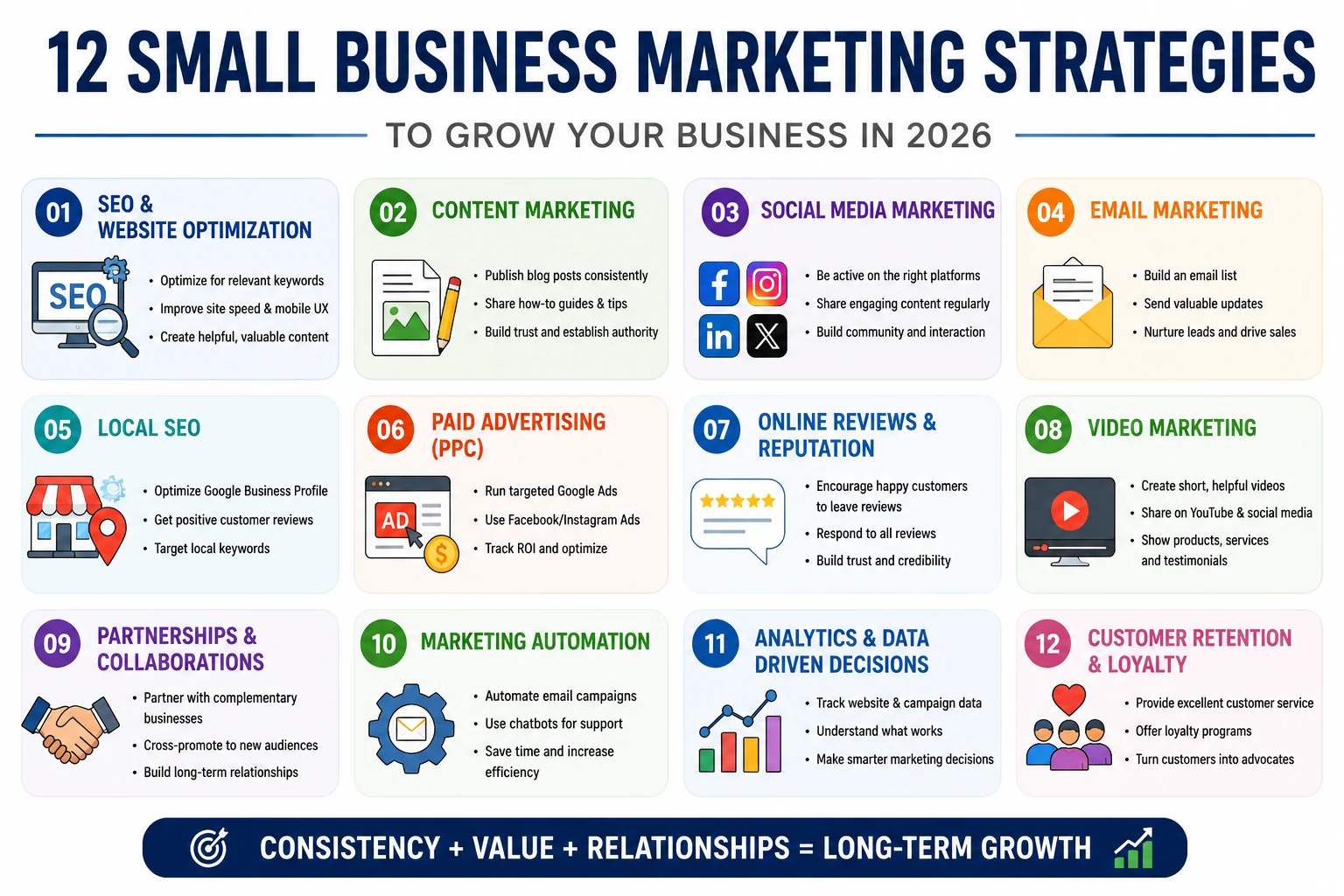
12 Effective Marketing Strategies for Small Businesses in 2026
1. Improve SEO and Website Performance
Your website is one of the few digital assets you fully control. Search engine optimization can help potential customers discover your pages when they search for relevant problems, products, services, or local providers.
Start with the basics:
- create clear pages for your core services or products;
- use descriptive page titles and headings;
- answer specific customer questions;
- improve mobile usability;
- keep pages fast and technically accessible;
- add useful internal links;
- update outdated content;
- track search performance in Google Search Console.
SEO works best when pages solve a real searcher’s problem rather than simply repeating keywords. Google’s current Search Central guidance specifically recommends people-first content and warns against publishing mainly to manipulate rankings.
2. Build a Consistent Content Marketing System
Content marketing helps a business demonstrate expertise before a prospect is ready to buy. Useful content can answer questions, reduce uncertainty, support sales conversations, earn search visibility, and give social or email campaigns something valuable to share.
Examples include:
- how-to articles;
- buying guides;
- checklists;
- case studies;
- comparison pages;
- FAQs;
- short videos;
- customer education resources.
Do not measure content only by how many pieces you publish. Measure whether it attracts the right audience and supports meaningful actions. The XVIFS guide to Content Analytics explains how marketers can evaluate traffic, engagement, conversions, and audience behavior.
3. Use Social Media Selectively
A small business rarely needs to maintain an active presence on every social platform. Choose the channels where your target customers actually spend time and where your format fits naturally.
For example:
- LinkedIn can suit B2B services and professional audiences;
- Instagram can work well for visual products, food, design, lifestyle, and local businesses;
- YouTube can support tutorials, demonstrations, reviews, and long-term search discovery;
- short-form video can help with awareness and personality-driven marketing.
A useful social strategy mixes educational content, proof, personality, offers, and customer stories instead of posting constant sales messages.
4. Build and Use an Email List
Email remains valuable because a business can communicate directly with people who have chosen to hear from it.
Useful email campaigns include:
- welcome sequences;
- product or service updates;
- educational newsletters;
- abandoned enquiry follow-ups;
- customer reminders;
- renewal or reactivation campaigns;
- special offers for existing customers.
The goal is not to send more email. It is to send relevant email to the right segment at the right time.
5. Strengthen Local SEO
Local SEO is especially important for businesses that serve customers in a city, neighborhood, or service area.
Start by claiming and maintaining a complete Google Business Profile. Google states that local results are mainly influenced by relevance, distance, and prominence. Complete business information, accurate hours, appropriate categories, photos, and customer reviews can all support visibility. See Google’s official local ranking guidance.
Local businesses should also:
- keep name, address, phone, and website information consistent;
- create useful location or service-area pages where appropriate;
- ask genuine customers for reviews;
- reply professionally to reviews;
- publish locally relevant content;
- earn mentions and links from relevant local organizations.
6. Use Paid Advertising With Clear Goals
Paid advertising can produce faster visibility than organic channels, but it can also waste money quickly if campaigns do not have clear targeting and conversion tracking.
Before launching ads, define:
- the audience;
- the offer;
- the landing page;
- the conversion action;
- the maximum acceptable cost per lead or sale;
- how results will be measured.
Google Ads, Meta Ads, LinkedIn Ads, Microsoft Advertising, TikTok Ads, and other networks serve different audiences and campaign goals. Our guide to Internet Advertising Platforms compares major channels and when businesses may use them.
Start small, collect data, and scale only the campaigns that demonstrate a reasonable return.
7. Turn Customer Reviews Into a Marketing Asset
Reviews influence trust, especially when buyers are comparing unfamiliar businesses.
A simple review process can include:
- asking satisfied customers at an appropriate moment;
- making the review process easy;
- responding to positive and negative reviews professionally;
- using genuine testimonials on relevant pages;
- monitoring repeated complaints for operational problems.
Do not purchase fake reviews or manipulate ratings. Real customer feedback is more useful for both trust and business improvement.
8. Add Video to Your Marketing Mix
Video can explain products and services quickly while giving potential customers a better sense of the business.
Small businesses can create:
- short tips;
- product demonstrations;
- before-and-after content;
- customer stories;
- FAQ videos;
- behind-the-scenes clips;
- tutorials;
- service explanations.
Production quality matters less than clarity and usefulness. A clear mobile video that answers a real question can outperform a polished video with no useful message.
9. Build Strategic Partnerships
Partnership marketing allows businesses with complementary audiences to help each other grow.
Examples include:
- referral agreements;
- joint webinars;
- co-created guides;
- local events;
- cross-promotions;
- bundle offers;
- guest articles;
- industry collaborations.
The best partnerships create clear value for both audiences rather than existing only for promotion.
10. Use Marketing Automation Carefully
Automation can help small teams handle repetitive work without adding more manual administration.
Useful examples include:
- lead capture and routing;
- welcome emails;
- appointment reminders;
- follow-up sequences;
- CRM updates;
- review requests;
- customer-support notifications;
- campaign reporting.
Automation should simplify a good process rather than make a poor process faster. Businesses exploring broader AI-enabled workflows can also review the XVIFS guide to AI Business Solutions.
11. Measure Marketing With Analytics
Without measurement, it is difficult to know whether growth came from SEO, advertising, email, referrals, partnerships, or something else.
Useful small business marketing metrics include:
- website traffic;
- organic impressions and clicks;
- lead volume;
- cost per lead;
- conversion rate;
- customer acquisition cost;
- email engagement;
- repeat purchases;
- customer retention;
- revenue by channel.
Do not optimize isolated metrics without context. A campaign with a high click-through rate but no qualified leads is not automatically successful.
12. Prioritize Customer Retention
Many small businesses focus heavily on acquiring new customers while underinvesting in existing ones.
Retention strategies can include:
- excellent customer service;
- follow-up after purchase;
- loyalty programs;
- renewal reminders;
- personalized offers;
- customer education;
- referral programs;
- regular product or service improvements.
Existing customers can become repeat buyers, reviewers, referral sources, and advocates, which makes retention a marketing strategy as well as a customer-service strategy.
How These Marketing Strategies Work Together
The strongest results often come when several channels support the same customer journey.
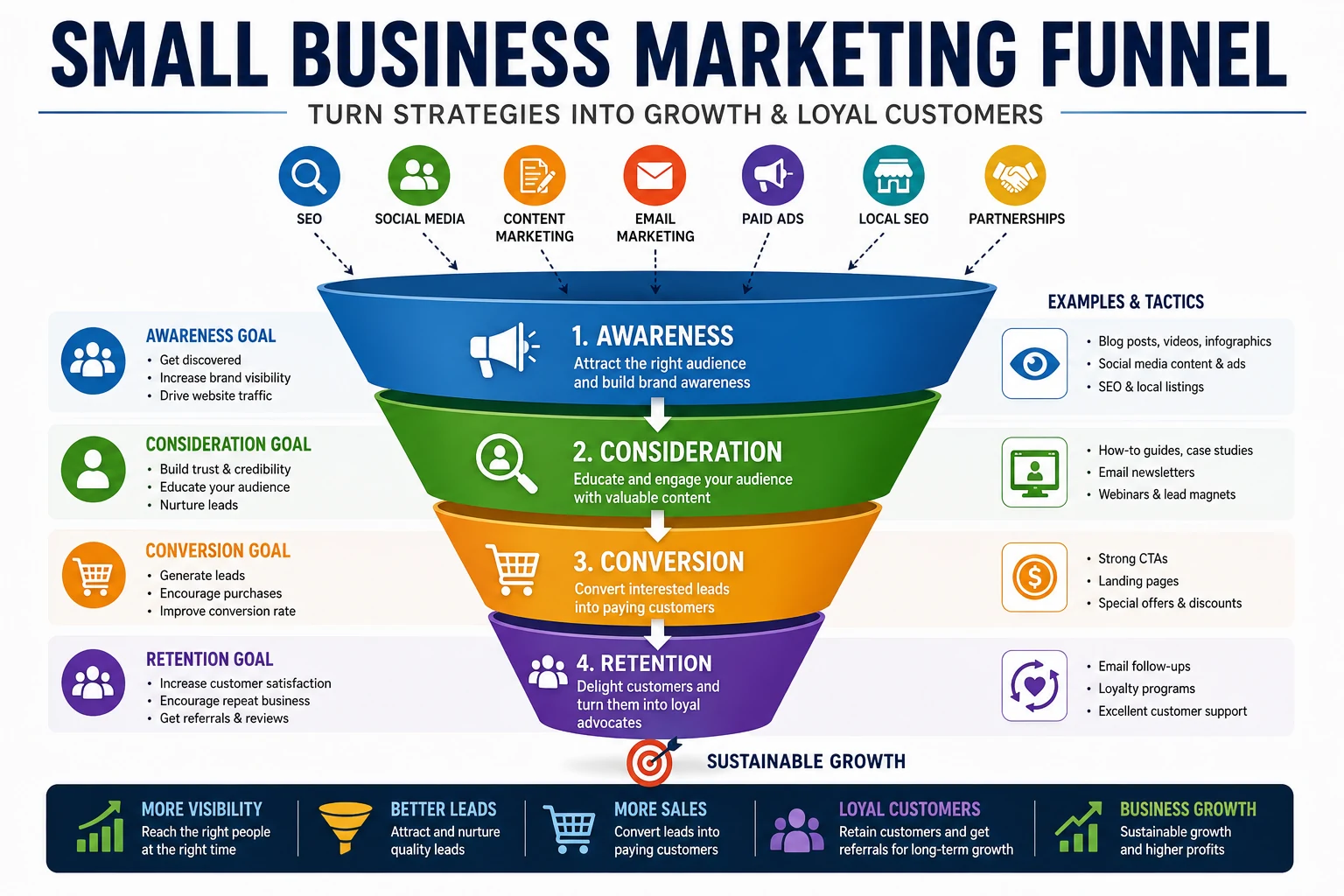
Awareness
The goal is to help the right people discover the business.
Useful channels include:
- SEO;
- social media;
- video;
- paid advertising;
- local search;
- partnerships.
Consideration
Potential customers now need reasons to trust the business and understand the offer.
Useful assets include:
- guides;
- case studies;
- reviews;
- email nurturing;
- comparison content;
- webinars;
- FAQs.
Conversion
The business needs a clear path to action.
This may involve:
- strong landing pages;
- simple enquiry forms;
- clear pricing or offers;
- calls to action;
- sales follow-up;
- checkout optimization.
Retention
After the first purchase, communication and service quality influence whether the customer returns or recommends the business.
How to Choose the Right Marketing Channels
Do not choose channels only because they are popular. Evaluate them against your audience, resources, offer, and buying journey.
| Business Goal | Useful Channels |
|---|---|
| Local visibility | Google Business Profile, local SEO, reviews, local ads |
| Long-term search traffic | SEO, content marketing, YouTube |
| Fast lead generation | Paid search, paid social, partnerships |
| Customer nurturing | Email, CRM, remarketing, educational content |
| B2B authority | LinkedIn, SEO, case studies, webinars, partnerships |
| Repeat sales | Email, loyalty programs, customer service, automation |
A Simple Small Business Marketing Budget Framework
There is no single correct marketing budget for every company. The right amount depends on margins, growth goals, competition, maturity, and customer acquisition economics.
Instead of beginning with a fixed percentage, divide the budget into purposes:
- Foundation: website, tracking, branding, CRM, essential content.
- Organic growth: SEO, content, video, local search.
- Paid acquisition: search ads, social ads, retargeting.
- Retention: email, loyalty, customer communication.
- Testing: new channels, offers, creative formats.
Measure each channel and move more budget toward activities that consistently produce qualified outcomes.
How to Measure Whether Your Marketing Is Working
Start with the business outcome and work backward.
If the goal is leads, track:
- lead volume;
- lead quality;
- cost per lead;
- sales conversion rate;
- revenue generated.
If the goal is ecommerce sales, track:
- conversion rate;
- average order value;
- customer acquisition cost;
- repeat purchase rate;
- revenue by source.
If the goal is awareness, track reach and traffic but also monitor whether those audiences eventually take meaningful actions.
Google Analytics 4 can help businesses measure engagement and key events. Google defines an engaged session as one that lasts longer than 10 seconds, has a key event, or includes at least two page or screen views. See the official GA4 engagement-rate documentation.
Common Small Business Marketing Mistakes
Trying Every Channel at Once
Spreading a small budget across too many platforms makes it hard to build momentum or learn what works.
Marketing Without a Clear Offer
Even excellent promotion cannot fix an offer customers do not understand or value.
Ignoring Existing Customers
Acquisition matters, but repeat customers and referrals can become important sources of sustainable growth.
Running Ads Without Conversion Tracking
Clicks and impressions do not tell you whether the campaign produces business results.
Publishing Content Without Distribution
Good content still needs internal links, search optimization, email, social distribution, partnerships, or other discovery channels.
Copying Competitors Without Understanding Their Strategy
A competitor’s visible marketing does not reveal its margins, conversion rates, audience quality, or profitability.
Changing Strategy Too Quickly
Some channels need time to produce useful data. SEO and content often take longer than paid advertising, while email and retention improve as the audience grows.
90-Day Marketing Plan for a Small Business
Days 1–30: Build the Foundation
- define the target audience;
- clarify the main offer;
- fix major website issues;
- set up analytics and conversion tracking;
- complete the Google Business Profile if relevant;
- choose two or three priority channels;
- create a simple content calendar.
Days 31–60: Publish and Test
- publish useful search-focused content;
- start consistent social posting;
- build or improve the email list;
- ask genuine customers for reviews;
- test a small paid campaign if the economics make sense;
- start one partnership or referral activity.
Days 61–90: Measure and Improve
- compare traffic and lead sources;
- identify the best-performing content;
- review paid campaign costs;
- improve weak landing pages;
- expand successful topics;
- automate repetitive follow-up;
- increase investment only where results justify it.
Frequently Asked Questions
What are the most effective marketing strategies for small businesses in 2026?
Strong options include SEO, content marketing, social media, email, local SEO, paid advertising, customer reviews, video, partnerships, automation, analytics, and retention. The best mix depends on the audience and business model.
What is the cheapest marketing strategy for a small business?
Referral marketing, customer reviews, local optimization, email to an existing audience, and helpful organic content can have relatively low direct media costs, although they still require time and consistent execution.
Should a small business use paid advertising?
Paid advertising can be useful when the business has a clear offer, a suitable landing page, conversion tracking, and enough margin to support customer-acquisition costs. Start with a controlled budget and measure results.
Is SEO still useful for small businesses?
Yes. SEO can help businesses earn long-term visibility for relevant searches, especially when they publish useful content, maintain technically accessible websites, and target realistic queries.
How important is Google Business Profile?
For local businesses, it can be extremely important because it affects how the business appears in Google Search and Maps. Accurate information, relevant categories, reviews, photos, and activity all support a stronger local presence.
How often should a small business review its marketing strategy?
Basic performance should be monitored regularly, while deeper strategic reviews can be done monthly or quarterly. Avoid changing long-term channels based on a few days of data.
What is the biggest marketing mistake small businesses make?
One of the biggest mistakes is spending time and money on tactics without defining the customer, offer, conversion goal, and measurement process first.
Final Thoughts
The best effective marketing strategies for small businesses in 2026 are not based on chasing every new platform. They are based on understanding the customer, creating genuine value, choosing a manageable set of channels, and measuring what happens next.
Start with a strong website and offer, build search and local visibility, create useful content, maintain direct customer communication, test paid promotion carefully, and invest in retention. Then use analytics to determine which activities deserve more attention.
Small businesses do not need the largest marketing budget to compete. They need focus, consistency, strong customer relationships, and a process for turning what they learn into better decisions.