For companies planning a new software product, the challenge is not simply writing code. The real goal is to create a reliable service that can support multiple customers, protect data, scale with demand, integrate with other tools, and continue improving after launch.
What Are SaaS Development Services?
SaaS development services cover the technical and product work required to turn an idea into a functioning Software-as-a-Service product. Depending on the project, a development team may handle:
- market and product discovery;
- feature planning and product roadmaps;
- UI and UX design;
- multi-tenant SaaS architecture;
- frontend and backend development;
- API development and integrations;
- database design;
- authentication and user management;
- subscription billing;
- cloud infrastructure and deployment;
- security testing;
- performance optimization;
- monitoring and analytics;
- maintenance and scaling.
Some companies build SaaS products with an internal engineering team. Others work with a SaaS development company or specialist provider when they need additional technical expertise, faster delivery, or support for a specific phase of the project.
Why SaaS Development Is Different From Traditional Software Development
SaaS products are usually delivered continuously over the internet rather than installed once on a customer’s computer. That changes the way the product must be designed and operated.
| Area | SaaS Product | Traditional Installed Software |
|---|---|---|
| Delivery | Accessed online | Installed locally |
| Updates | Continuous or frequent | Often version-based |
| Infrastructure | Cloud-hosted | May run mainly on customer devices |
| Users | Often many customers on shared infrastructure | Usually separate installations |
| Billing | Frequently subscription-based | May use one-time licensing |
| Operations | Requires monitoring, uptime, support, scaling | More responsibility may sit with customer environment |
This means SaaS development teams must think about product engineering and ongoing operations at the same time.
SaaS Architecture: How It Works
A typical SaaS platform connects users to an application layer that communicates with APIs, business services, databases, cloud infrastructure, and third-party systems.
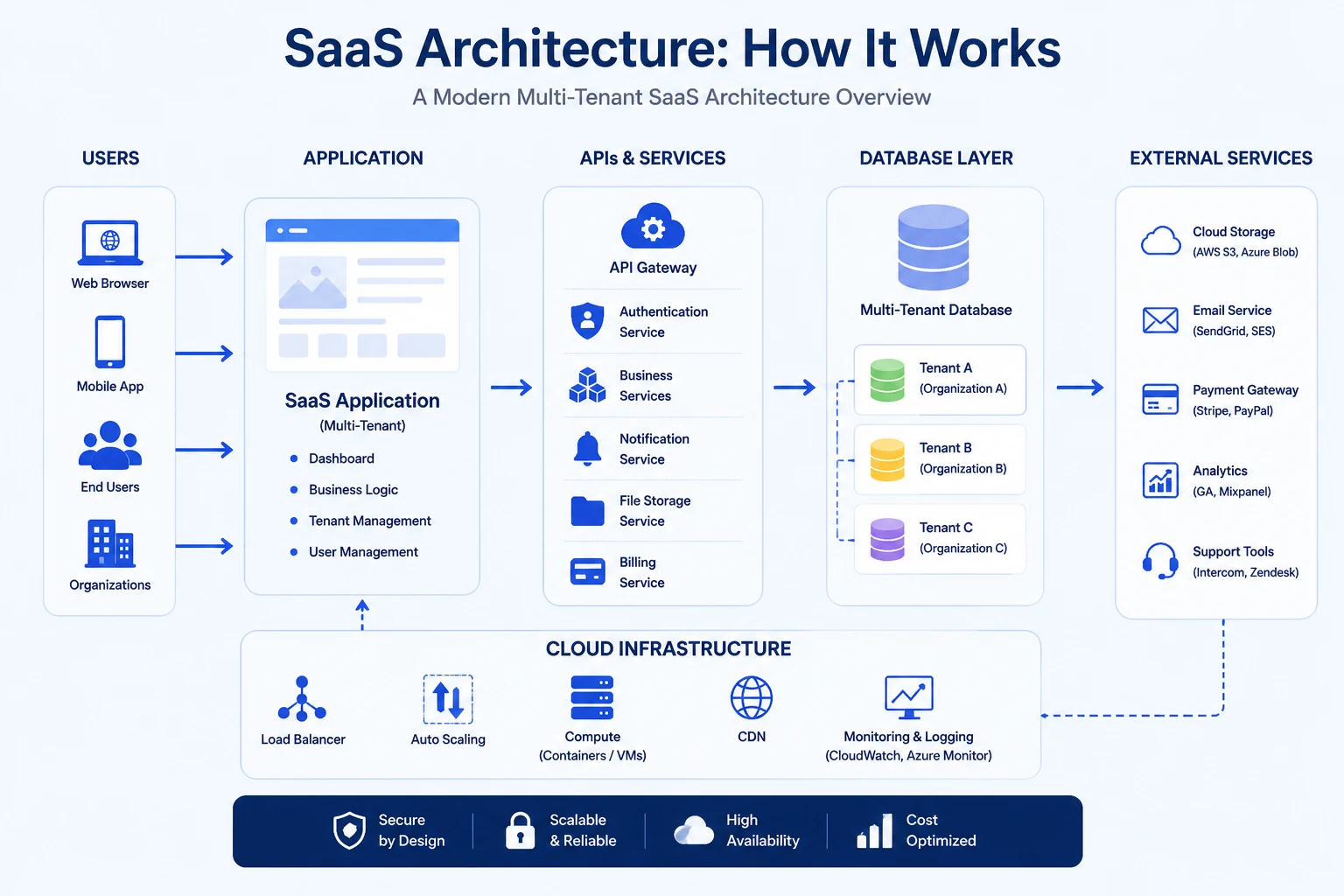
Users and Client Applications
Customers may access the SaaS product through a web browser, mobile app, desktop client, or another connected interface.
Application Layer
The application contains the user interface, business logic, tenant management, permissions, workflows, and product features.
APIs and Services
APIs connect internal components and external systems. A SaaS application may use separate services for authentication, notifications, files, billing, analytics, search, AI functions, and integrations.
Database Layer
SaaS products need a clear strategy for storing customer data. Some platforms use shared multi-tenant databases, while others separate data by customer, workload, or compliance requirement.
Cloud Infrastructure
Cloud infrastructure may include compute resources, containers, load balancing, object storage, CDNs, monitoring, logging, backups, and auto-scaling.
Businesses planning custom cloud products can also review the XVIFS guide to Cloud Application Development for broader architecture and deployment considerations.
9 Key Steps in the SaaS Development Process
A successful SaaS product is usually built through a sequence of product, design, engineering, testing, and operational decisions.
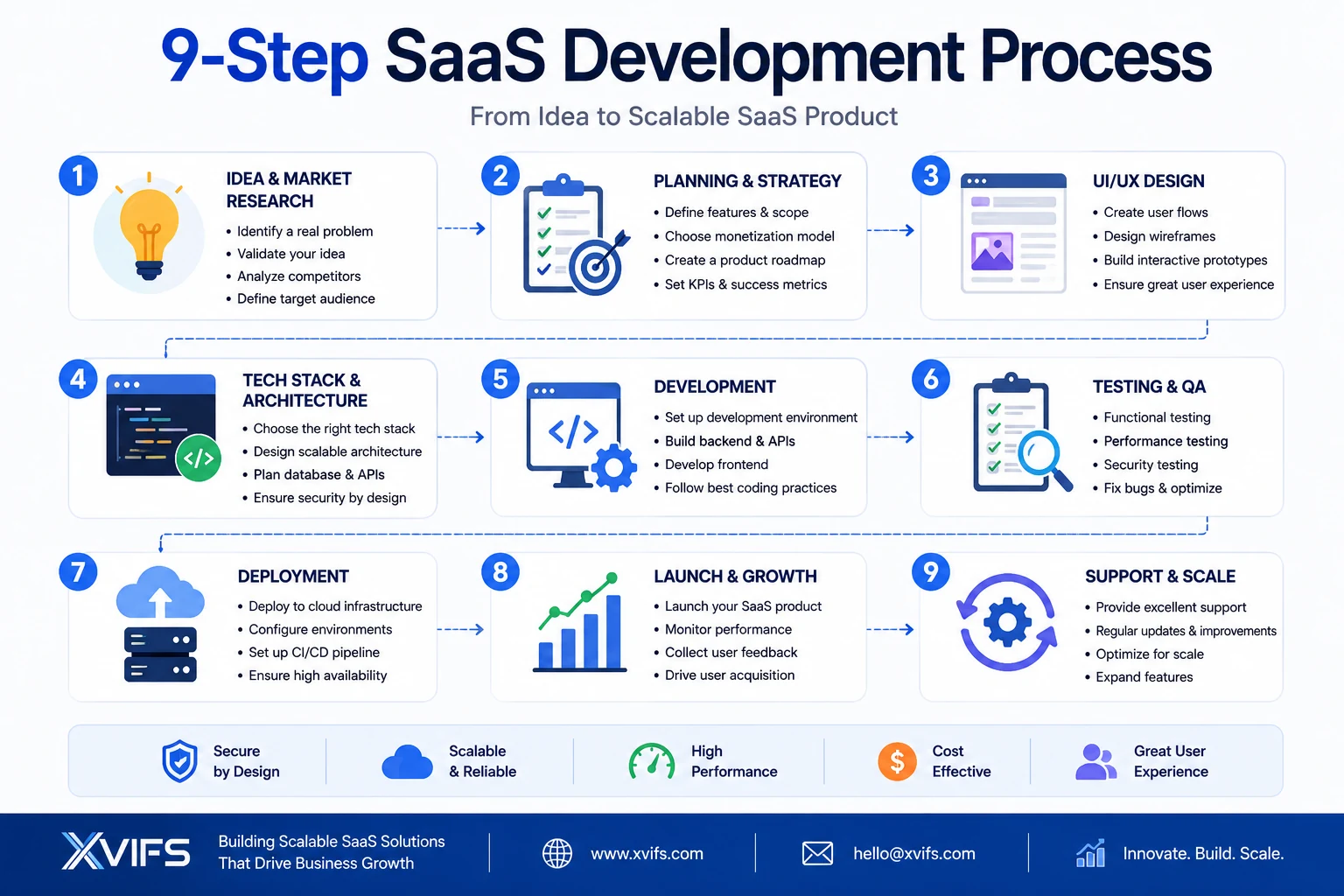
1. Validate the Problem and Market
Before development starts, confirm that the product solves a real problem for a specific audience.
Research should cover:
- target users;
- pain points;
- competitors;
- existing alternatives;
- pricing expectations;
- market size;
- distribution channels.
This stage reduces the risk of building a technically strong product that customers do not actually need.
2. Define the Product Strategy
Once the problem is clear, define the minimum useful version of the product and the roadmap that follows it.
Important questions include:
- What problem does version one solve?
- Which features are essential?
- Which features can wait?
- How will the product make money?
- What metrics will define success?
- Which integrations are required at launch?
A focused MVP is usually easier to test, improve, and scale than an oversized first release.
3. Design the User Experience
SaaS products often succeed or fail based on usability. A product may have strong technical capabilities but still struggle if users cannot understand the interface or complete important tasks quickly.
UI and UX work commonly includes:
- user journeys;
- wireframes;
- navigation;
- design systems;
- interactive prototypes;
- onboarding flows;
- mobile responsiveness;
- accessibility considerations.
4. Choose the Technology Stack and Architecture
The technology stack should match the product’s performance, security, integration, team, and scaling requirements.
Architecture decisions may cover:
- single application vs microservices;
- multi-tenant data design;
- frontend framework;
- backend technologies;
- database type;
- API strategy;
- cloud provider;
- authentication;
- storage;
- monitoring;
- backup and recovery.
Good architecture should support the current product without creating unnecessary complexity.
5. Build the Product
Development usually includes frontend, backend, APIs, database work, integrations, user management, and core product functionality.
Modern teams often work in short development cycles so features can be tested and reviewed continuously instead of waiting until the entire product is complete.
During development, teams should also plan:
- coding standards;
- source control;
- automated tests;
- CI/CD pipelines;
- logging;
- error handling;
- feature flags;
- secrets management.
6. Test Functionality, Security, and Performance
Testing should go beyond checking whether buttons work.
A production SaaS platform may need:
- functional testing;
- integration testing;
- API testing;
- security testing;
- performance testing;
- load testing;
- mobile testing;
- browser compatibility testing;
- backup and recovery testing.
Security should be part of the design and development process rather than a final checklist before launch.
7. Deploy to Cloud Infrastructure
Deployment turns the product into a live service. The team may configure production environments, DNS, TLS certificates, databases, storage, monitoring, backups, scaling rules, and deployment pipelines.
Where possible, infrastructure should be reproducible and documented so environments can be created or restored consistently.
8. Launch and Measure
After launch, the team should monitor product usage and operational performance.
Useful metrics may include:
- signups;
- activation rate;
- trial-to-paid conversion;
- churn;
- monthly recurring revenue;
- retention;
- feature usage;
- support tickets;
- uptime;
- response time;
- error rates.
Early user feedback is particularly valuable because it shows where expectations and actual product behavior differ.
9. Support, Improve, and Scale
SaaS development does not end at launch. Successful products need ongoing support, security updates, bug fixes, performance improvements, infrastructure changes, and new features.
As usage grows, the team may need to improve:
- database performance;
- caching;
- load balancing;
- background processing;
- CDN usage;
- tenant isolation;
- monitoring;
- support workflows.
Core Features Many SaaS Products Need
Every product is different, but many SaaS applications require a similar set of platform capabilities.
User Authentication
Users need secure registration, login, password recovery, and account management. Enterprise products may also require SSO, MFA, and identity-provider integrations.
Tenant Management
Multi-tenant SaaS platforms need a way to separate organizations, users, permissions, settings, billing, and data.
Subscription Billing
Subscription products may need plans, trials, upgrades, downgrades, invoices, taxes, usage-based billing, or payment-failure handling.
Role-Based Access Control
Different users may require different permissions. Clear access-control design helps protect sensitive features and data.
Notifications
Email, in-app notifications, push notifications, and alerts help users stay informed about important activity.
Analytics
Product analytics can help teams understand activation, engagement, retention, and feature usage.
Integrations
Modern SaaS products often connect with CRMs, accounting tools, payment systems, messaging platforms, cloud storage, marketing tools, and other business software.
SaaS Security Best Practices
Security is one of the most important areas in SaaS development services because a single application may store information for many customers.
Key controls include:
- strong authentication;
- multi-factor authentication;
- role-based permissions;
- encryption in transit and at rest;
- secure secrets management;
- audit logging;
- regular software updates;
- vulnerability management;
- backups;
- incident-response procedures;
- secure APIs;
- tenant isolation.
NIST’s Cybersecurity Framework provides a structured way for organizations to think about identifying, protecting against, detecting, responding to, and recovering from cybersecurity risks.
For cloud-hosted products, the XVIFS guide to Cloud Security Policy can also help teams think through access, data protection, monitoring, vendor risk, and incident-response requirements.
How Much Do SaaS Development Services Cost?
There is no reliable single price for SaaS development because project scope can vary dramatically.
Cost is influenced by:
- number of features;
- product complexity;
- UI and UX requirements;
- number of integrations;
- mobile apps;
- security and compliance requirements;
- data migration;
- AI features;
- cloud infrastructure;
- testing requirements;
- development team location and experience;
- ongoing support.
A focused MVP with a narrow feature set may cost far less than an enterprise SaaS platform with advanced permissions, complex integrations, analytics, multi-region infrastructure, and compliance requirements.
How to Choose a SaaS Development Company
If you plan to outsource development, evaluate the provider on more than portfolio design.
Relevant SaaS Experience
Ask whether the team has built subscription products, multi-tenant applications, cloud systems, APIs, and scalable platforms.
Product Thinking
A good development partner should challenge weak assumptions and help prioritize features rather than simply build every requested idea.
Security Practices
Ask how the team handles authentication, secrets, code review, dependency updates, testing, access control, and production credentials.
Communication and Transparency
You should understand what is being built, what has been completed, what is blocked, and what decisions are required.
Ownership
Clarify ownership of source code, cloud accounts, domains, documentation, design files, and intellectual property before the project begins.
Post-Launch Support
Ask how bugs, upgrades, scaling issues, and infrastructure changes will be handled after release.
In-House Team vs SaaS Development Services
| Factor | In-House Team | External SaaS Development Services |
|---|---|---|
| Control | High direct control | Requires clear coordination |
| Hiring speed | Can be slow | Often faster to start |
| Specialist skills | Must be hired internally | May be available immediately |
| Long-term product knowledge | Strong internal continuity | Depends on documentation and relationship |
| Cost structure | Salaries and benefits | Project or service fees |
Some companies use a hybrid model, keeping product ownership internally while using external specialists for architecture, development, testing, DevOps, or specific integrations.
When Should a Business Use SaaS Development Services?
External SaaS development services can make sense when a business:
- needs to launch quickly;
- does not yet have a full engineering team;
- needs specialist cloud or SaaS architecture skills;
- is modernizing an older application;
- needs help with integrations;
- needs a temporary product team;
- wants to validate an MVP before hiring internally;
- needs DevOps, security, or scaling expertise.
Common SaaS Development Mistakes
Building Too Many Features Before Validation
Large feature lists increase cost and delay feedback. Validate the core problem first.
Ignoring Multi-Tenant Design
Poor tenant architecture can create data-isolation, permission, performance, and scaling problems later.
Underestimating Security
Security issues become more expensive to fix after the product and customer base grow.
Choosing Architecture for Prestige
Microservices, event-driven systems, and complex cloud designs are not automatically better. Architecture should match actual requirements.
Ignoring Operational Costs
Cloud infrastructure, monitoring, third-party APIs, email, storage, support, and logging all affect the long-term economics of a SaaS product.
Failing to Measure Retention
Signups alone do not prove product-market fit. Retention and repeat usage often provide stronger signals.
How AI Is Changing SaaS Development
AI is increasingly used in software planning, coding, testing, documentation, customer support, analytics, search, and product features.
Development teams may use AI assistants to speed up repetitive tasks, while SaaS products may integrate generative AI, machine learning, or intelligent automation directly into customer workflows.
Businesses exploring AI-enabled products can also read our guide to AI Business Solutions.
Frequently Asked Questions About SaaS Development Services
What are SaaS development services?
SaaS development services are professional services used to plan, design, build, test, deploy, maintain, and scale cloud-based subscription software products.
What is a SaaS development company?
A SaaS development company is a software provider that specializes in building cloud-hosted applications, often including multi-tenant architecture, APIs, databases, billing, cloud infrastructure, and ongoing maintenance.
How long does SaaS development take?
Timelines depend on scope, complexity, integrations, team size, and product maturity. A focused MVP may take months, while a large enterprise platform can require much longer.
What is multi-tenant SaaS?
Multi-tenant SaaS allows one software platform to serve multiple customers or organizations while keeping their users, settings, and data logically separated.
Which cloud platform is best for SaaS?
AWS, Microsoft Azure, Google Cloud, and other providers can all support SaaS products. The best choice depends on technical requirements, team experience, region, compliance, integrations, pricing, and operational needs.
Do SaaS products need APIs?
Many do. APIs help connect internal services, mobile applications, third-party tools, integrations, automation platforms, and customer systems.
What happens after a SaaS product launches?
The team should monitor reliability, security, customer behavior, support issues, costs, and performance while continuing to fix bugs, improve features, and scale infrastructure.
Final Thoughts
SaaS development services are most valuable when they combine product thinking with strong engineering and operational discipline.
A successful SaaS product needs more than a polished interface. It requires a validated problem, focused product scope, usable design, scalable architecture, secure development, reliable cloud infrastructure, thoughtful testing, measurable launch goals, and continuous improvement.
Whether the product is built in-house, outsourced, or developed through a hybrid team, the same principle applies: build the simplest reliable system that solves a real customer problem, then improve it using evidence from actual usage.