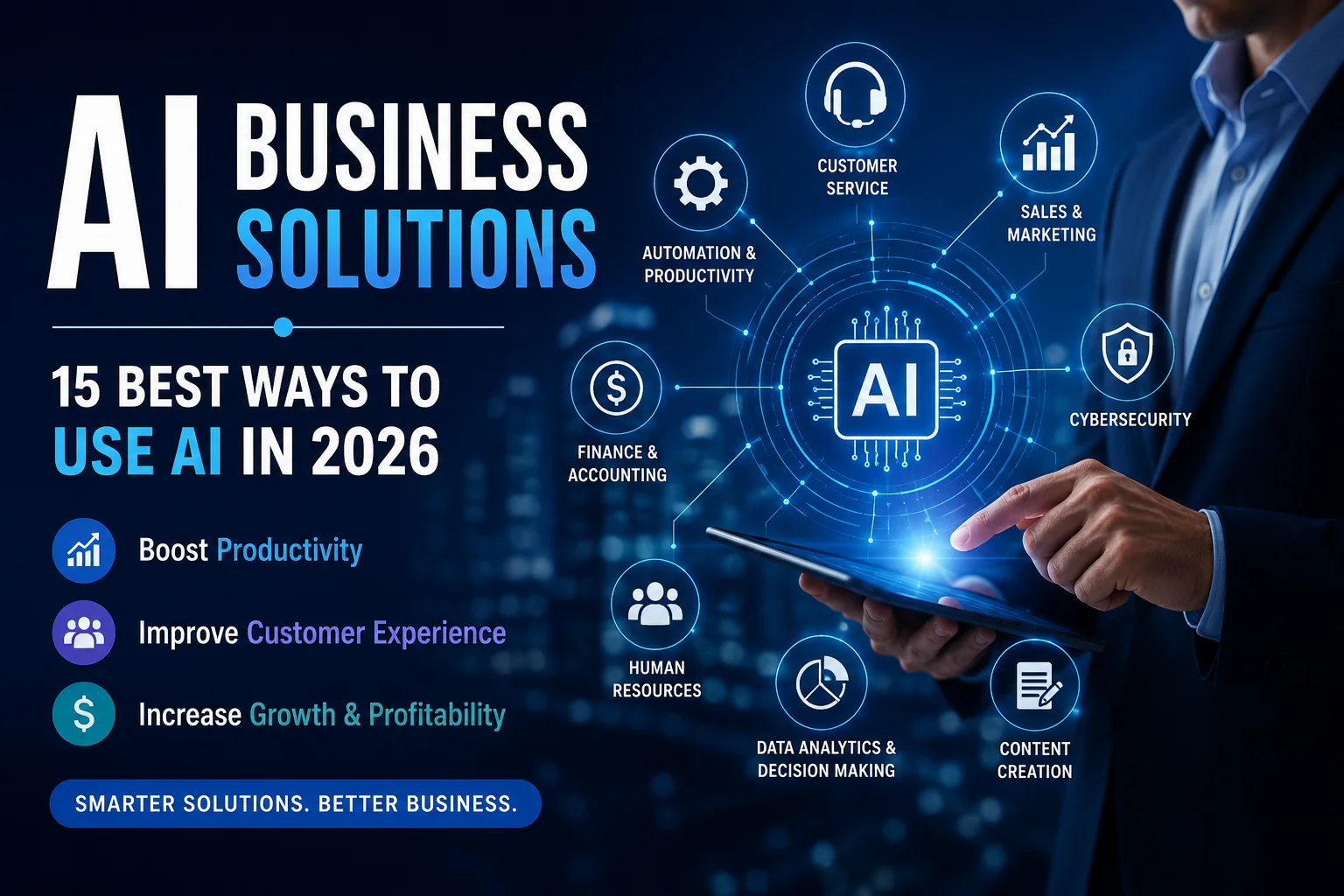
This XVIFS guide explains 15 practical ways businesses can use AI in 2026, along with benefits, implementation considerations, examples, risks, and a simple roadmap for getting started.
Table of Contents
- What Are AI Business Solutions?
- Why Businesses Are Using AI
- 15 Best Ways to Use AI in Business
- Benefits of AI Business Solutions
- AI Solutions for Small Businesses
- AI Solutions for Enterprises
- How to Implement AI Business Solutions
- How Much Does Business AI Cost?
- Measuring AI ROI
- Risks and Challenges
- Future of AI in Business
- Frequently Asked Questions
What Are AI Business Solutions?
AI Business Solutions are software systems, platforms, and workflows that use technologies such as machine learning, generative AI, natural language processing, computer vision, and predictive analytics to solve business problems.
Instead of treating AI as a standalone technology, businesses can integrate it into existing processes.
For example, an organization might use AI to:
- answer routine customer questions automatically;
- summarize meetings and documents;
- identify promising sales leads;
- personalize marketing campaigns;
- detect suspicious financial activity;
- forecast demand;
- analyze large datasets;
- automate repetitive administrative tasks;
- assist employees with research and content creation.
The most effective AI implementation therefore begins with a business problem rather than simply selecting the newest AI tool.
Why Are Businesses Investing in AI?
Businesses generate enormous amounts of information through emails, customer interactions, financial transactions, websites, CRM systems, support tickets, operational platforms, and analytics tools.
AI can help organizations process this information faster and turn it into useful actions.
According to IBM’s artificial intelligence resources, AI technologies can support capabilities ranging from automation and natural language processing to machine learning and enterprise decision-making.
The business case generally comes down to several objectives:
- increase employee productivity;
- reduce repetitive manual work;
- improve customer service;
- extract more value from business data;
- make faster decisions;
- improve personalization;
- control operational costs;
- identify new growth opportunities.
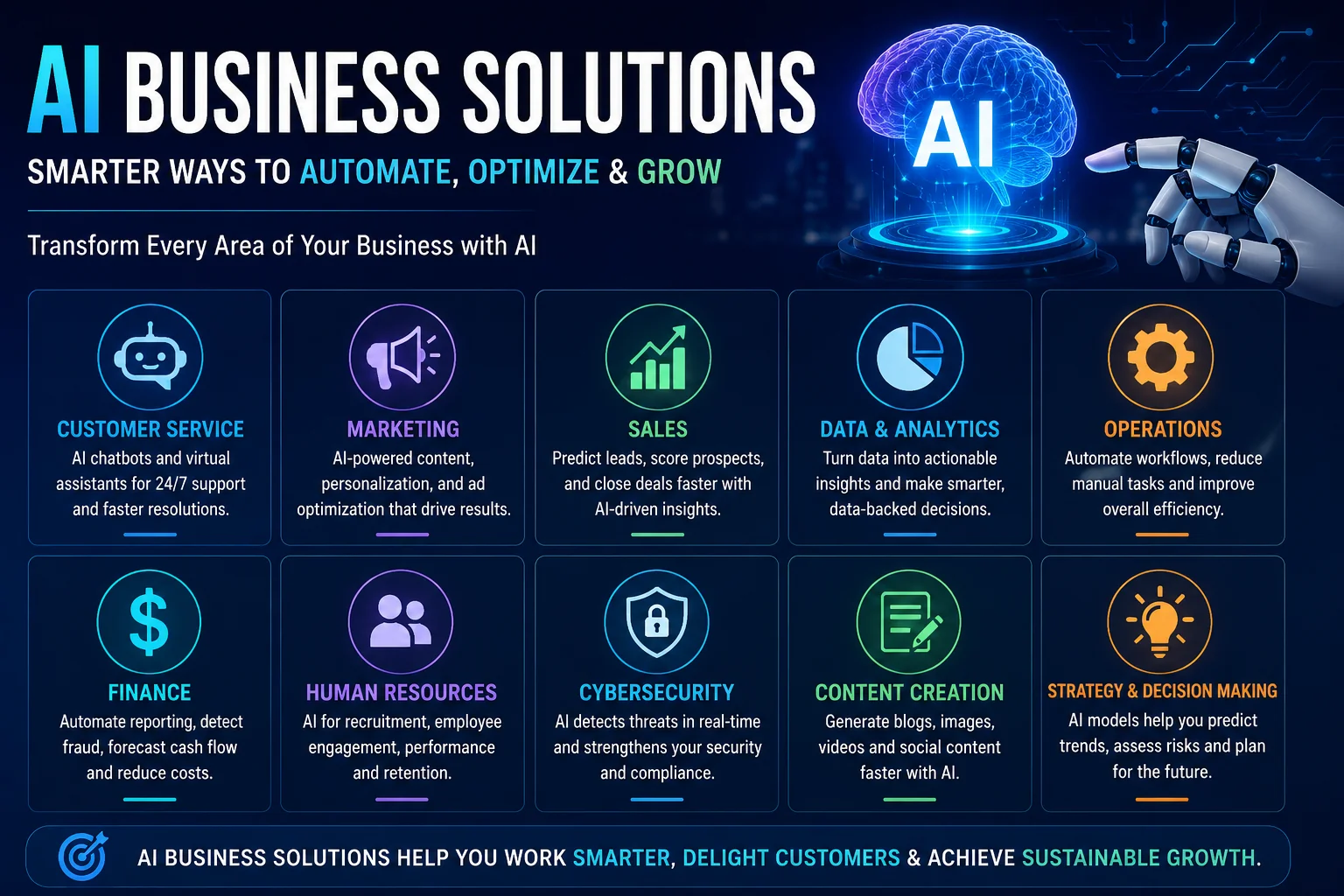
15 Best Ways to Use AI Business Solutions in 2026
1. AI Customer Service
Customer support is one of the most practical applications of business AI.
AI assistants can answer common questions, classify tickets, summarize conversations, recommend responses, and route complex cases to human agents.
The objective should not necessarily be to eliminate human support. A stronger approach is to let AI handle repetitive requests while human representatives concentrate on complicated or sensitive customer problems.
Businesses exploring this area can also read the XVIFS guide to AI tools for customer support.
2. Marketing Automation
Marketing teams can use AI for audience research, campaign planning, personalization, content assistance, advertising analysis, and performance optimization. For paid-media planning, see the XVIFS comparison of Internet Advertising Platforms.
AI can examine customer behavior and help marketers determine which messages, channels, or offers are more relevant to particular audience segments.
However, marketers should still review AI-generated material for accuracy, originality, brand consistency, and customer relevance.
3. Sales Intelligence
AI-powered sales systems can analyze CRM information, engagement history, buying signals, and previous conversions to help sales teams prioritize opportunities.
Potential applications include:
- lead scoring;
- sales forecasting;
- account research;
- meeting summaries;
- follow-up recommendations;
- pipeline analysis.
This allows sales professionals to spend more time communicating with qualified prospects instead of manually processing information.
4. Workflow Automation
Combining artificial intelligence with workflow automation can produce significant productivity gains. Organizations that need more advanced implementation support may also evaluate an Artificial Intelligence Automation Agency to design AI-enabled workflows and integrations.
Traditional automation works particularly well when processes follow predictable rules. AI extends this capability by helping systems understand unstructured information such as emails, documents, messages, images, and natural-language requests.
For example, a workflow could receive an inquiry, use AI to classify its intent, extract important information, update a database, and send the request to the appropriate department.
XVIFS readers interested in practical workflow automation can explore our Make.com workflows guide.
5. Business Data Analytics
Many businesses possess valuable data but lack the time or expertise required to analyze it effectively.
AI-assisted analytics can help users summarize datasets, identify unusual patterns, generate explanations, and explore trends through natural-language questions.
Managers can potentially ask questions such as:
“Which product category experienced the largest decline this quarter?”
Instead of manually reviewing multiple reports, an AI-supported analytics environment may help surface the relevant information much faster.
6. Predictive Analytics and Forecasting
Predictive models analyze historical information to estimate future outcomes.
Businesses can apply these techniques to:
- demand forecasting;
- inventory planning;
- customer churn prediction;
- revenue forecasting;
- maintenance planning;
- risk analysis.
Forecasts should still be treated as probabilities rather than guaranteed outcomes. Poor or incomplete historical data can produce unreliable predictions.
7. AI Content Creation
Generative AI can assist businesses with drafting articles, emails, product descriptions, presentations, social posts, summaries, and marketing concepts. If you want to understand exactly which activities qualify as generative AI rather than predictive or traditional automation, see our guide to which task is a generative AI task.
Tools such as ChatGPT can accelerate ideation and drafting, but businesses should maintain human review processes for factual accuracy, brand voice, originality, and compliance.
The strongest workflow usually treats AI as an assistant rather than an unquestioned publisher.
8. Financial Analysis and Accounting Assistance
Finance departments can use AI-supported systems to organize financial information, categorize transactions, identify anomalies, assist forecasting, and automate repetitive reporting tasks.
Potential use cases include expense classification, cash-flow forecasting, invoice processing, fraud detection, and financial report summaries.
Financial decisions involving material risk should continue to receive appropriate professional and human oversight.
9. Human Resources and Recruitment
AI can help HR teams process large volumes of administrative information.
Possible applications include drafting job descriptions, organizing candidate information, answering internal HR questions, analyzing employee surveys, and assisting onboarding.
Organizations should be especially careful when AI affects employment decisions. Automated systems can inherit biases from training data or historical processes, making human oversight and appropriate governance essential.
10. Cybersecurity
AI can help security teams analyze large quantities of activity and identify unusual patterns more quickly.
Applications can include threat detection, anomaly identification, phishing analysis, security-event prioritization, and incident investigation assistance.
AI should complement—not replace—strong security fundamentals such as access control, employee awareness, patching, backups, monitoring, and incident-response planning.
11. Document Processing
Businesses still spend significant amounts of time manually processing invoices, forms, contracts, reports, applications, and other documents.
AI-powered document systems can extract information, classify documents, summarize long files, and route information into appropriate workflows.
This can be particularly valuable for organizations handling large volumes of repetitive paperwork.
12. Personalized Customer Experiences
AI can analyze customer behavior and preferences to help businesses provide more relevant recommendations, messages, and experiences.
E-commerce businesses, for example, can use recommendation systems to surface products that are more likely to interest individual shoppers.
Personalization should still respect privacy requirements and avoid collecting unnecessary customer information.
13. Inventory and Supply Chain Optimization
AI can support inventory decisions by analyzing historical sales, seasonality, supplier performance, and other operational signals. Businesses improving stock control can also use the XVIFS guide to Small Business Inventory Management for practical inventory methods and processes.
Businesses can use these insights to improve stock planning and potentially reduce both excess inventory and stock shortages.
AI can also assist logistics planning, supplier analysis, and demand forecasting.
14. Internal AI Knowledge Assistants
Employees often waste time searching across manuals, policies, shared drives, documentation, and internal knowledge bases.
An internal AI assistant can provide a conversational interface for retrieving relevant company information.
For example, an employee could ask:
“What is our process for approving a new supplier?”
The assistant could retrieve information from approved internal documentation rather than requiring the employee to manually search multiple systems.
15. Strategic Decision Support
AI can help executives and managers evaluate complex information by summarizing reports, comparing scenarios, highlighting trends, and organizing research.
Decision-support systems should not be confused with autonomous decision-makers. Leadership remains responsible for evaluating context, uncertainty, financial consequences, legal obligations, and human impact.
Key Benefits of AI Business Solutions
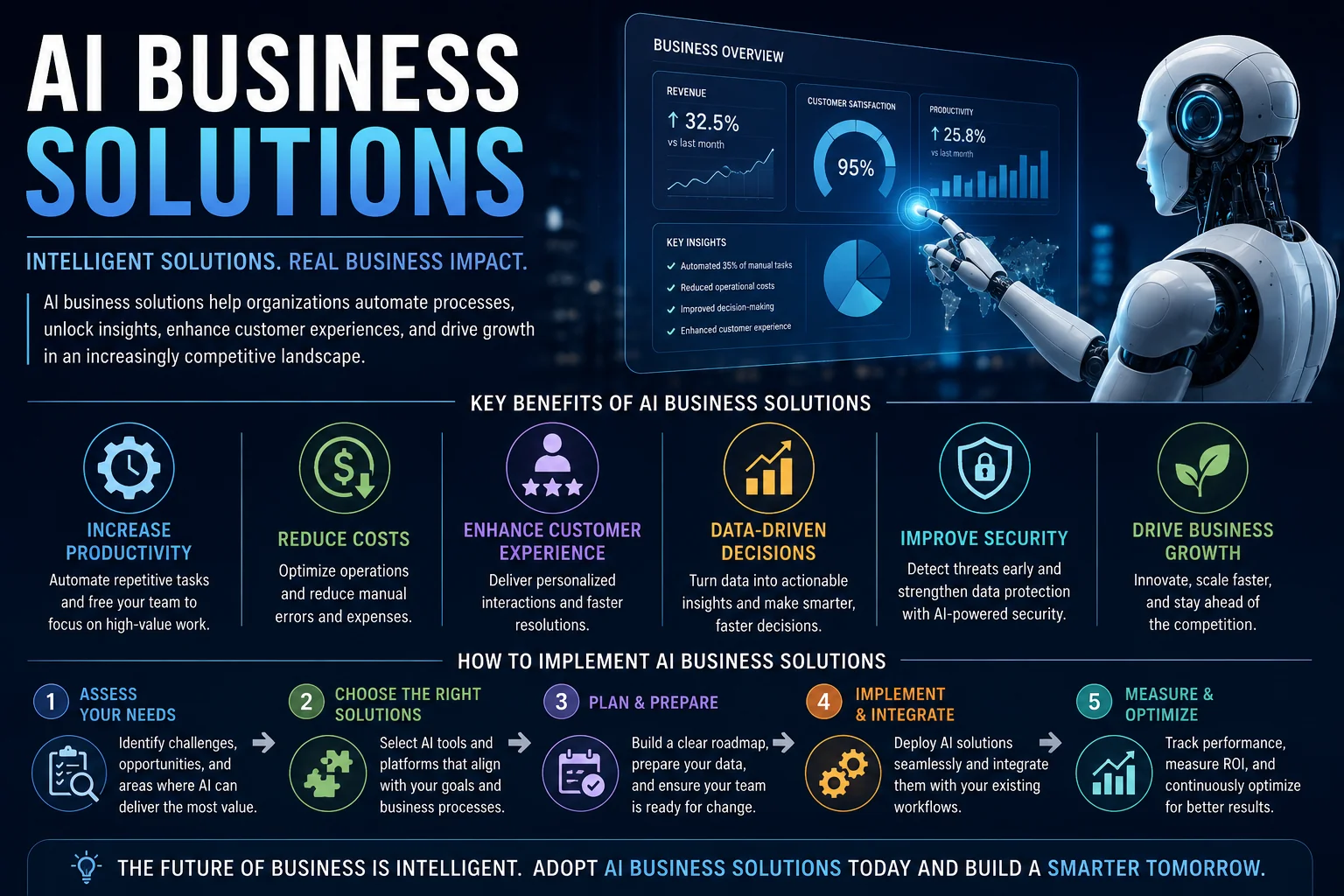
Higher Productivity
AI can reduce the amount of time employees spend performing repetitive administrative work, allowing them to concentrate on activities requiring judgment, creativity, expertise, and customer interaction.
Lower Operating Costs
Automation can reduce manual processing and improve resource utilization. However, savings should be measured against software subscriptions, integration costs, training, monitoring, and governance requirements.
Better Customer Experiences
AI can provide faster responses, improved personalization, and round-the-clock assistance for appropriate customer requests.
Faster Data-Driven Decisions
AI can process large datasets rapidly and surface patterns that might otherwise take teams much longer to identify.
Scalability
Once a well-designed AI workflow is established, businesses may be able to process significantly larger workloads without increasing manual effort at the same rate.
Business Growth
AI can help organizations discover opportunities, serve customers more efficiently, personalize experiences, and launch new AI-enabled products or services.
AI Business Solutions for Small Businesses
Small businesses do not need expensive custom AI infrastructure to benefit from artificial intelligence.
For many small organizations, the strongest opportunities are available through existing SaaS products that already include AI functionality.
A small company might start with:
- an AI writing assistant;
- customer-support automation;
- CRM intelligence;
- meeting transcription and summaries;
- marketing automation;
- invoice or document processing;
- workflow automation.
The key is to select one measurable problem rather than attempting a company-wide AI transformation immediately.
AI Business Solutions for Enterprises
Large organizations typically face different challenges.
Enterprise AI implementation may involve integration with existing CRM, ERP, analytics, identity, security, data warehouse, and collaboration systems. When these solutions are deployed through custom cloud software, a sound cloud application development approach can help teams plan architecture, deployment, scalability, and integrations.
Enterprises also need stronger governance around security and data access. A documented cloud security policy can help define consistent controls for cloud-hosted AI systems and connected services.
Enterprises also need stronger governance around:
- data access;
- security;
- privacy;
- regulatory requirements;
- model evaluation;
- vendor management;
- employee permissions;
- human oversight.
Platforms from companies such as Microsoft, Google Cloud, Amazon Web Services, and IBM provide enterprise AI technologies across cloud, data, development, productivity, and machine-learning environments.
How to Implement AI Business Solutions
Step 1: Identify the Business Problem
Start with a specific operational problem.
For example:
- customer response times are too slow;
- employees spend hours entering data;
- sales representatives cannot prioritize leads;
- management reports take days to prepare.
Step 2: Establish a Baseline
Measure current performance before introducing AI.
If customer support currently takes an average of eight minutes per ticket, record that number. Without a baseline, it becomes difficult to determine whether the AI implementation produced meaningful improvement.
Step 3: Choose the Right Solution
Evaluate solutions based on the actual problem rather than popularity.
Consider:
- features;
- integration capabilities;
- security;
- data handling;
- pricing;
- ease of use;
- vendor reliability;
- scalability.
Step 4: Start With a Controlled Pilot
Deploy the solution in a limited environment before expanding it throughout the organization.
A pilot allows teams to identify problems, measure results, collect feedback, and improve processes with lower risk.
Step 5: Prepare Your Data
AI systems depend heavily on the information available to them.
Incomplete, outdated, duplicated, or inaccurate data can reduce output quality. Businesses should therefore establish appropriate data-quality and access-control processes.
Step 6: Keep Humans in the Workflow
Human oversight is especially important for high-impact decisions involving customers, employees, financial transactions, security, or compliance.
Step 7: Measure and Optimize
After implementation, compare actual results against the original baseline.
Continue improving prompts, workflows, data quality, integrations, permissions, and employee training.
How Much Do AI Business Solutions Cost?
There is no universal price because business AI ranges from inexpensive SaaS subscriptions to complex enterprise implementations.
Costs can include:
- software subscriptions;
- API usage;
- cloud infrastructure;
- implementation;
- system integration;
- data preparation;
- employee training;
- security and governance;
- ongoing monitoring.
Businesses should therefore evaluate total cost of ownership rather than looking only at the advertised monthly subscription price.
How to Measure ROI From AI Business Solutions
AI projects should connect to measurable business outcomes.
Useful metrics may include:
- hours of manual work saved;
- cost per customer-support ticket;
- average response time;
- sales conversion rate;
- revenue per employee;
- customer satisfaction;
- forecast accuracy;
- processing errors;
- operational cost reductions.
A simple conceptual calculation is:
AI ROI = (Financial Benefit − Total AI Cost) ÷ Total AI Cost × 100
However, not every benefit is immediately financial. Faster decision-making, employee capacity, improved customer experience, and reduced operational risk can also create meaningful value.
Risks and Challenges of AI Business Solutions
Artificial intelligence creates opportunities, but businesses should not deploy it without controls.
Incorrect Outputs
Generative AI can produce convincing but inaccurate information. Important outputs should therefore be verified.
Data Privacy
Employees should understand what information can and cannot be entered into external AI systems.
Cybersecurity
Poorly configured AI integrations may create new access or data-exposure risks.
Bias
AI systems can reproduce patterns and biases present in their data or design.
Over-Automation
Not every process should be automated. Some situations require empathy, professional judgment, accountability, or nuanced human understanding.
Vendor Dependence
Businesses should understand pricing structures, data portability, integration dependencies, and what happens if a provider changes its product or terms.
The Future of AI Business Solutions
The next phase of business AI is likely to move beyond isolated assistants toward increasingly connected AI systems capable of interacting with business applications and workflows.
AI agents, multimodal systems, automated workflows, enterprise knowledge assistants, and real-time analytics are likely to become increasingly integrated into everyday software.
At the same time, successful organizations will need strong governance.
The competitive advantage will not simply come from having access to artificial intelligence. Many businesses will have access to similar models and tools.
The advantage will come from how effectively an organization combines AI with its proprietary knowledge, workflows, people, customer understanding, and operational expertise.
Final Thoughts
AI Business Solutions can create significant value when they solve clearly defined business problems.
Customer service, marketing, sales, analytics, workflow automation, finance, cybersecurity, HR, document processing, forecasting, and internal knowledge management all provide practical opportunities for AI adoption.
But organizations do not need to implement everything simultaneously.
Start with one high-value process. Establish the current performance baseline. Select an appropriate AI solution. Test it in a controlled environment. Measure the results. Then expand only when the business case is proven.
That approach turns AI from an interesting technology into a measurable business capability.
Frequently Asked Questions About AI Business Solutions
What are AI Business Solutions?
AI Business Solutions are software tools and systems that use artificial intelligence to improve business processes such as customer service, sales, marketing, analytics, automation, finance, security, and decision-making.
What is the best AI solution for a business?
The best solution depends on the problem being solved. A customer-service team may benefit from an AI support platform, while a sales organization may gain more value from CRM intelligence or lead-scoring technology.
Can small businesses use AI?
Yes. Small businesses can access many AI capabilities through affordable SaaS platforms without building their own machine-learning infrastructure.
Can AI completely automate a business?
AI can automate many repetitive processes, but complete automation is rarely appropriate. Human oversight remains important for strategy, complex decisions, customer relationships, compliance, and high-impact activities.
How can a company start using AI?
Identify one measurable business problem, establish current performance, evaluate suitable AI tools, run a controlled pilot, measure the results, and expand successful implementations gradually.
What are the main risks of business AI?
Important risks include inaccurate outputs, privacy problems, cybersecurity vulnerabilities, bias, poor-quality data, inappropriate automation, regulatory concerns, and excessive dependence on individual vendors.
Are AI Business Solutions worth the investment?
They can be when they solve a genuine business problem and produce measurable benefits. Companies should compare productivity gains, revenue improvements, cost savings, or service improvements against the full cost of implementation and operation.