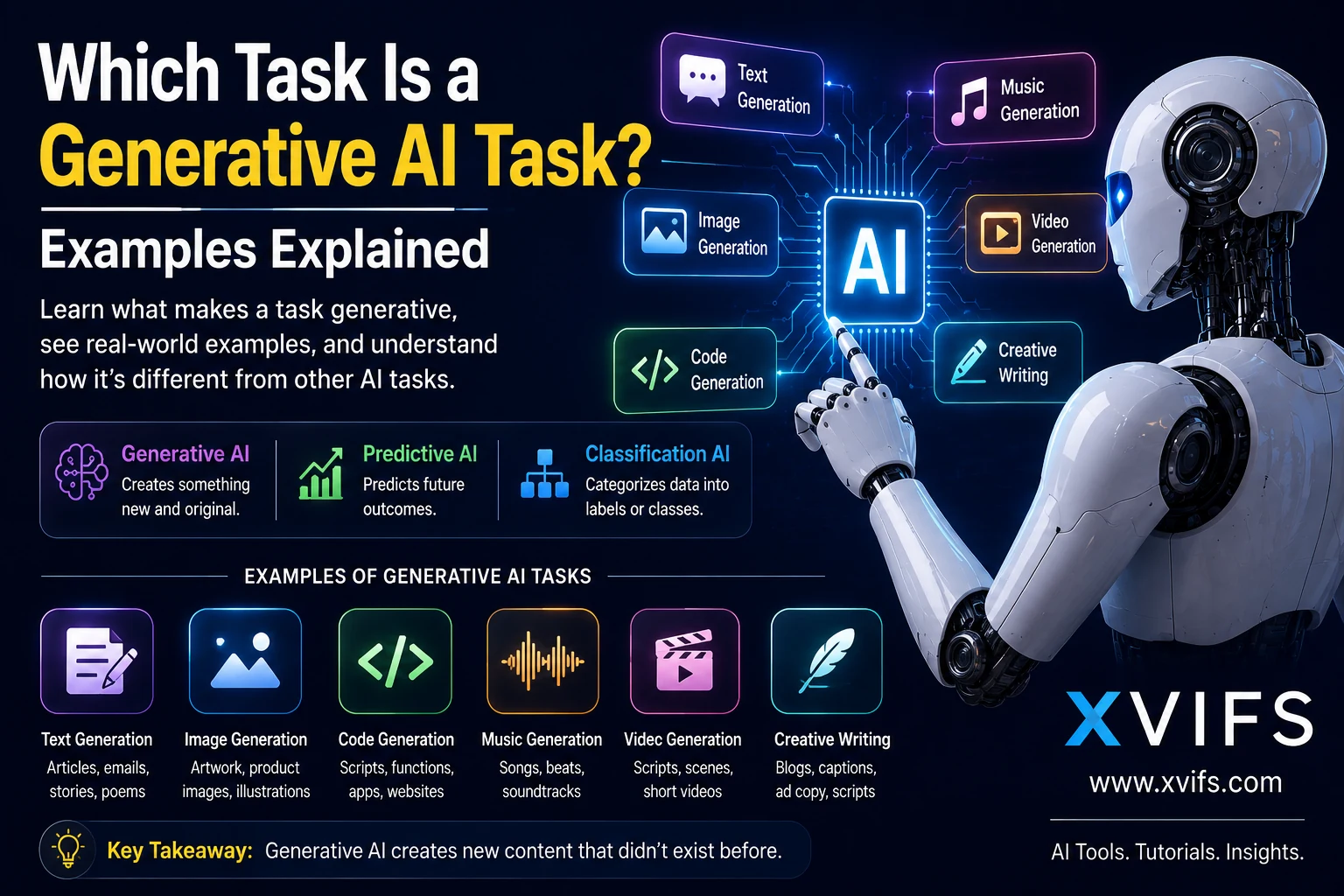
73Which task is a generative AI task? A task is generative when an AI system creates new content from a prompt or other input. Writing an email, generating an image, creating software code, producing audio, and drafting a product description are all examples of generative AI tasks. By contrast, simply classifying an email as spam or predicting next month’s sales is primarily a classification or predictive AI task.The easiest way to recognize generative AI is to look at the output. If the system is being asked to create something new—such as text, an image, code, audio, video, or another content artifact—you are probably looking at a generative AI task.Examples of generative AI tasks include creating text, images, code, audio, and other new content.
Which Task Is a Generative AI Task? Quick Answer
Consider these examples:
Task
AI Type
Why?
Write a product description
Generative AI
Creates new text
Create an image from a prompt
Generative AI
Creates new visual content
Generate software code
Generative AI
Produces new code
Compose background music
Generative AI
Creates new audio
Classify an email as spam
Classification AI
Assigns an existing input to a category
Predict next month’s demand
Predictive AI
Estimates a future outcome from patterns in data
Detect whether an image contains a car
Classification / Computer Vision
Recognizes an existing object rather than creating content
So, if a quiz asks which task is a generative AI task, look for the option where the AI must produce new content rather than merely categorize, detect, retrieve, or predict something.
What Makes a Task Generative?
Generative AI is designed to produce new outputs based on patterns learned from training data. According to IBM’s explanation of generative AI, these systems can create content such as text, images, video, audio, and software code in response to prompts.This means the important distinction is not simply whether artificial intelligence is involved. The question is what the AI is being asked to do.
Generative tasks produce new outputs
Suppose you give an AI system this instruction:
Write a short welcome email for a new customer who has just created an account.
The system must construct a new piece of text. That makes it a generative task.Now compare it with:
Determine whether this customer email is positive, neutral, or negative.
The second task asks the system to assign the existing content to a category. That is fundamentally a classification task, even though modern generative models can also perform classification.
Examples of Generative AI Tasks
Generative AI is no longer limited to chatbots. Modern models can work with several types of content, sometimes within the same system.
1. Text generation
Generating text is one of the most familiar generative AI tasks. An AI system might create:
Emails
Blog outlines
Product descriptions
Marketing copy
Reports
Social media captions
Customer-service responses
Summaries written in a requested format
Businesses can combine these capabilities with broader AI business solutions to support marketing, customer service, research, and everyday operations.
2. Image generation
If you ask an AI model to create an illustration of a futuristic office, design a concept image for a product, or produce artwork from a written prompt, the system is performing a generative AI task.The model is not simply identifying what already exists in an image. It is producing a new visual output based on the instructions it receives.
3. Code generation
Software development provides another clear example. Generative AI can create functions, SQL queries, scripts, test cases, documentation, and code suggestions from natural-language instructions.For example, asking an AI assistant to “write a Python function that removes duplicate values from a list” requires the system to generate new code.
4. Audio and music generation
Generative models can also create speech, sound effects, music, and other forms of audio. A request to compose a short instrumental track for a promotional video is therefore another example of a generative task.
5. Video generation
Video-generation systems can turn text or other inputs into new sequences of moving images. Depending on the system, users may describe a scene, provide reference material, or specify how a generated clip should look and move.
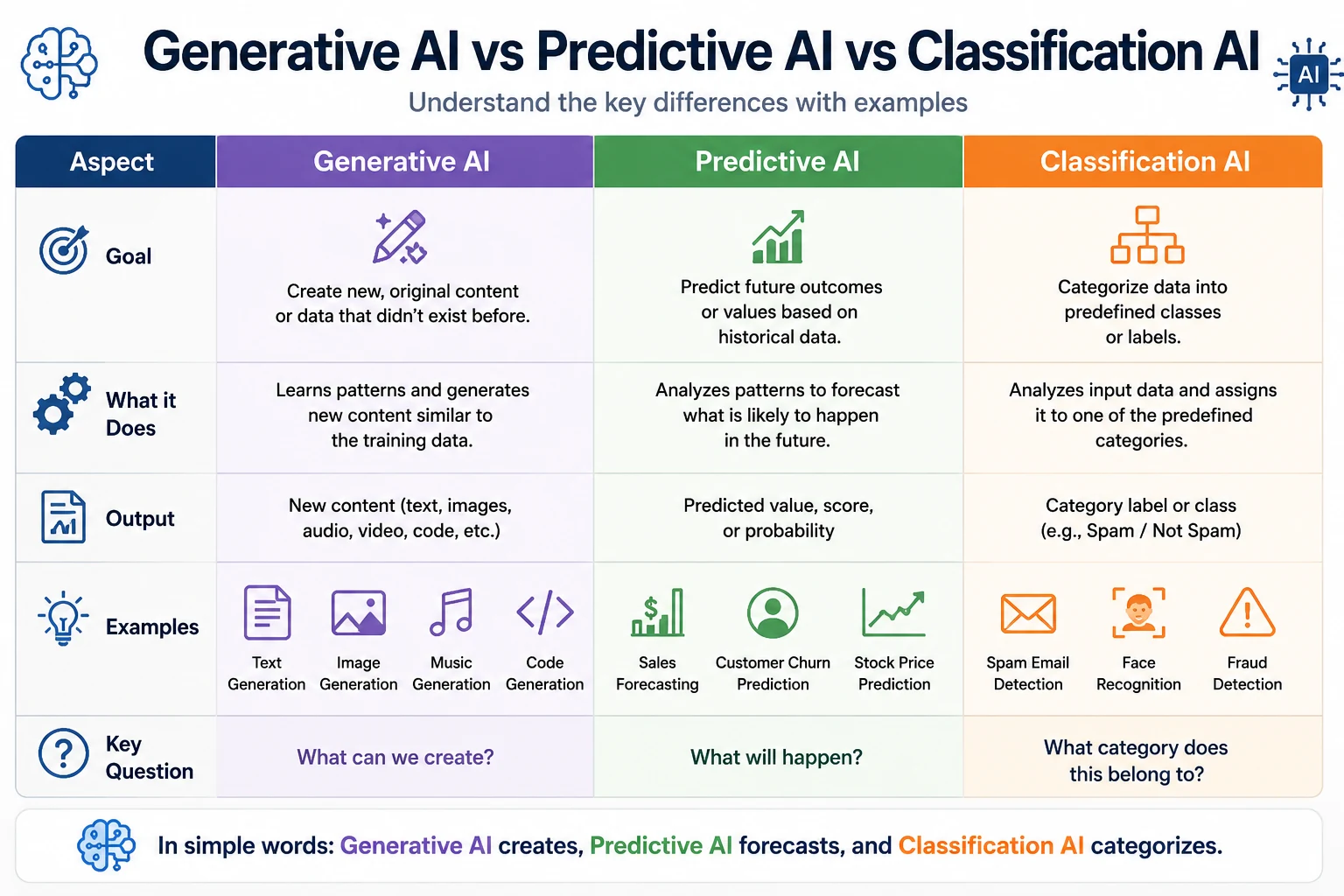
Generative AI vs Predictive AI vs Classification AI
Understanding the differences between these categories makes it much easier to identify the correct answer when you are given several AI tasks to choose from.Generative, predictive, and classification AI can solve different types of problems.
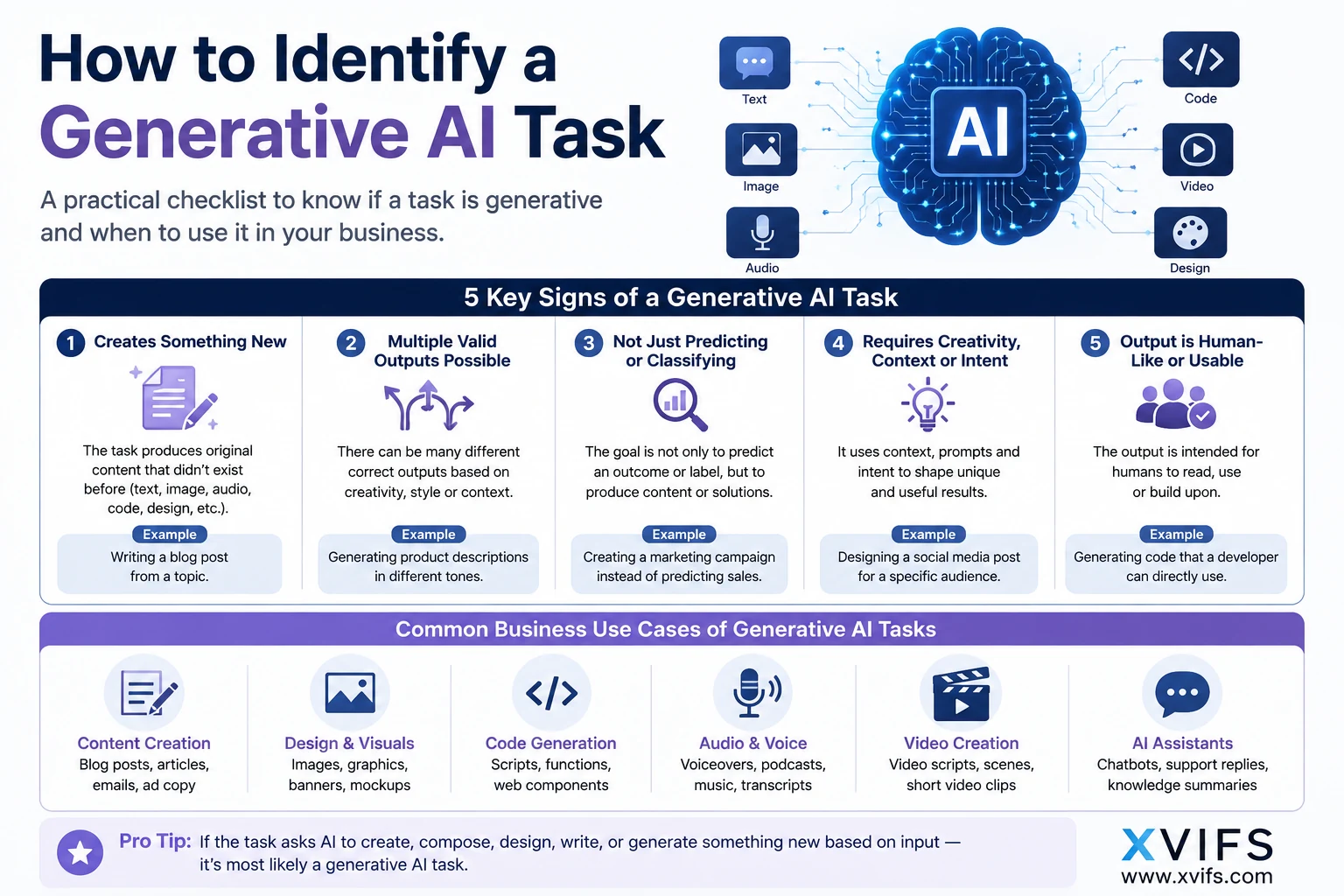
How to Identify Which Task Is a Generative AI Task
You can use a simple three-step test when deciding whether a task is generative.Look at the requested output to determine whether an AI task is genuinely generative.
Step 1: Look at the requested output
Ask what the user expects the AI to return.If the requested result is a newly created paragraph, image, program, voice recording, design, or video, there is a strong generative component.
Step 2: Ask whether new content must be created
This is the most useful test. Is the AI primarily generating an output, or is it identifying, sorting, detecting, retrieving, or forecasting?For example:
Generate a logo concept: generative.
Detect a logo in an uploaded image: recognition/detection.
Write a sales email: generative.
Predict whether a lead will convert: predictive.
Create product descriptions: generative.
Classify products into existing categories: classification.
Step 3: Do not judge only by the AI tool being used
A common mistake is assuming every task performed by a generative AI model must itself be generative.Modern foundation models can handle many tasks. IBM notes that foundation models can support activities including generation, classification, conversation, and other applications. Therefore, the task and requested output matter more than the product name or underlying model alone.
Generative AI Task Examples in Business
The distinction becomes particularly useful when companies evaluate where AI can actually improve their workflows.
Marketing
A marketing team might use generative AI to draft ad variations, create campaign concepts, generate social media copy, summarize research, or produce first drafts of landing-page content.
Customer support
Generative AI can draft personalized responses, summarize long support conversations, convert technical explanations into simpler language, or create knowledge-base drafts. Companies exploring this area can also review our guide to AI tools for customer support.
Software development
Developers can use generative AI to create code snippets, test cases, documentation, regular expressions, database queries, and initial debugging suggestions.
Business automation
Generative AI becomes even more useful when connected with automation. A workflow could receive customer information, ask an AI model to generate a personalized response, and then pass that output to another application automatically.This differs from conventional rule-based automation because part of the workflow is creating a new context-sensitive output rather than simply moving predefined data from one system to another.
Is Summarization a Generative AI Task?
Yes, summarization is commonly treated as a generative AI use case because the model produces a new condensed representation of the source material rather than merely assigning it to a predefined category.However, summarization illustrates why AI categories can sometimes overlap. A generative model processes existing information but generates new text as its output. The important factor is what the system produces.
Is Translation a Generative AI Task?
Modern generative models can perform translation by producing new text in another language. Translation therefore can be handled as a generative task, although machine translation existed long before today’s large generative models and can be implemented using other approaches.This is another reason not to classify an AI task solely according to the name of the application performing it.
What Is Not a Generative AI Task?
Tasks that only identify, categorize, retrieve, calculate, or predict information are not necessarily generative.
Detecting fraudulent transactions
Classifying an email as spam
Predicting tomorrow’s demand
Recognizing an object in an image
Assigning a customer to an existing segment
Calculating a fixed mathematical formula
Retrieving an unchanged record from a database
Some modern AI systems combine several techniques, so a real-world application may contain both generative and non-generative components.
Why Understanding Generative AI Tasks Matters
Knowing whether a problem actually requires generation helps businesses select the right technology. A company that needs to forecast inventory may benefit from predictive models, while a company that needs thousands of personalized product descriptions has a clear content-generation use case.Using generative AI simply because it is popular can add unnecessary complexity. The better approach is to begin with the business problem, determine the required output, and then choose the AI technique that fits it.
Generative AI Still Requires Human Review
The ability to generate new content does not guarantee that every output is accurate, safe, original, or appropriate for its intended purpose.Organizations should establish review processes appropriate to the risk of the application. The NIST AI Risk Management Framework provides organizations with a broader framework for managing AI risks and trustworthiness considerations.Human review becomes especially important when generated material affects customers, financial decisions, legal matters, security, healthcare, or other high-impact activities.
Frequently Asked Questions
Which task is a generative AI task?
A task that asks AI to create new content is a generative AI task. Examples include writing an email, generating an image, producing software code, composing audio, or creating a video from a prompt.
What is a simple example of a generative AI task?
Asking an AI system to “write a product description for a wireless keyboard” is a simple example because the system must generate new text in response to the prompt.
Is image creation a generative AI task?
Yes. Creating a new image from a text prompt, reference image, or other input is a clear generative AI task because the system produces new visual content.
Is predicting sales a generative AI task?
Not usually. Forecasting future sales from historical data is primarily a predictive AI task. Generative AI could still be used elsewhere in the same workflow, such as creating a written explanation of the forecast.
Is spam detection generative AI?
Traditional spam detection is primarily a classification task because the system determines whether an existing message belongs to a category such as spam or not spam. A generative model may be capable of performing the classification, but that does not make the underlying task content generation.
Can one AI system perform generative and non-generative tasks?
Yes. Modern foundation models can perform multiple kinds of tasks. A single system might summarize text, generate an answer, classify sentiment, extract information, and help with other operations depending on its design and instructions.
Final Answer: How to Recognize a Generative AI Task
If you are still wondering which task is a generative AI task, remember one simple rule: look for creation.Writing new text, creating images, generating code, composing audio, and producing video are clear examples because the AI creates a new output based on its instructions and learned patterns.Classification and prediction are different. They primarily analyze information to categorize inputs or estimate outcomes. Modern AI systems can combine these capabilities, but understanding the requested output makes it much easier to identify the core task correctly.As generative AI becomes part of more business workflows, this distinction will help organizations choose the right technology instead of treating every AI problem as the same type of problem.
XVIFS helps businesses, marketers, creators, and entrepreneurs discover practical AI tools, SaaS platforms, automation solutions, and digital marketing strategies. Explore our tutorials, software reviews, comparisons, and step-by-step guides designed to help you work smarter, automate faster, and grow your business online.