The best AI Tools for Customer Support are no longer simple chatbots that answer a few frequently asked questions. In 2026, leading platforms can search company knowledge, understand customer intent, summarize conversations, assist human agents, route tickets and—in supported workflows—complete actions or resolve customer requests autonomously.
That makes AI increasingly useful for businesses trying to improve response times without scaling support headcount at the same rate as ticket volume. The challenge is choosing the right platform: an ecommerce brand, a SaaS company and a large enterprise often need very different customer-service technology.
This XVIFS comparison reviews 10 leading options, including Zendesk, Fin, Freshdesk, Gorgias, Help Scout, HubSpot Service Hub, Zoho Desk, Salesforce, Kustomer and Ada. We compare their strongest use cases, AI capabilities and practical limitations so you can build a shortlist that fits your support operation.
Best AI Tools for Customer Support: Quick Comparison
| Tool | Best For | AI Strength | Consider Before Choosing |
|---|---|---|---|
| Zendesk | Established and enterprise support teams | AI agents, agent assistance and automation | Advanced deployments can become complex |
| Fin | SaaS and digital-first support | Outcome-focused AI customer agent | Usage-based AI costs need forecasting |
| Freshdesk | SMBs and mid-market teams | Freddy AI Agent and Copilot | Some AI capabilities depend on plan/add-ons |
| Gorgias | Shopify ecommerce | AI Agent with ecommerce actions | Best fit is strongly Shopify-centric |
| Help Scout | Customer-focused small teams | AI assistance, summaries and self-service | Less enterprise-heavy than some rivals |
| HubSpot Service Hub | Teams already using HubSpot CRM | Breeze Customer Agent plus CRM context | Best value often comes from the wider HubSpot stack |
| Zoho Desk | Budget-conscious and Zoho-centric teams | Zia AI, generative assistance and AI agents | Feature availability varies by edition/region |
| Salesforce | Large CRM-centric organizations | Agentforce and enterprise service AI | Higher cost and implementation complexity |
| Kustomer | High-volume omnichannel teams | AI integrated with customer context | May be more platform than a small team needs |
| Ada | Automation-first service organizations | AI-first automated customer conversations | Evaluate integrations and total usage cost carefully |
Choosing the right AI Tools for Customer Support depends on your team size, channels, integrations and automation goals.
Pricing note: AI support vendors increasingly mix seat pricing, usage charges, AI outcomes, resolutions, sessions and enterprise contracts. Pricing changes frequently, so the comparison below focuses on product fit and verified capabilities rather than treating a single sticker price as the total cost of ownership.
How AI-Powered Customer Support Works
Modern AI support typically begins when a customer contacts a business through chat, email, a help center, messaging channel or another connected touchpoint. The system interprets the request, searches approved knowledge and customer context, then decides whether to answer, take an allowed action or hand the conversation to a human.
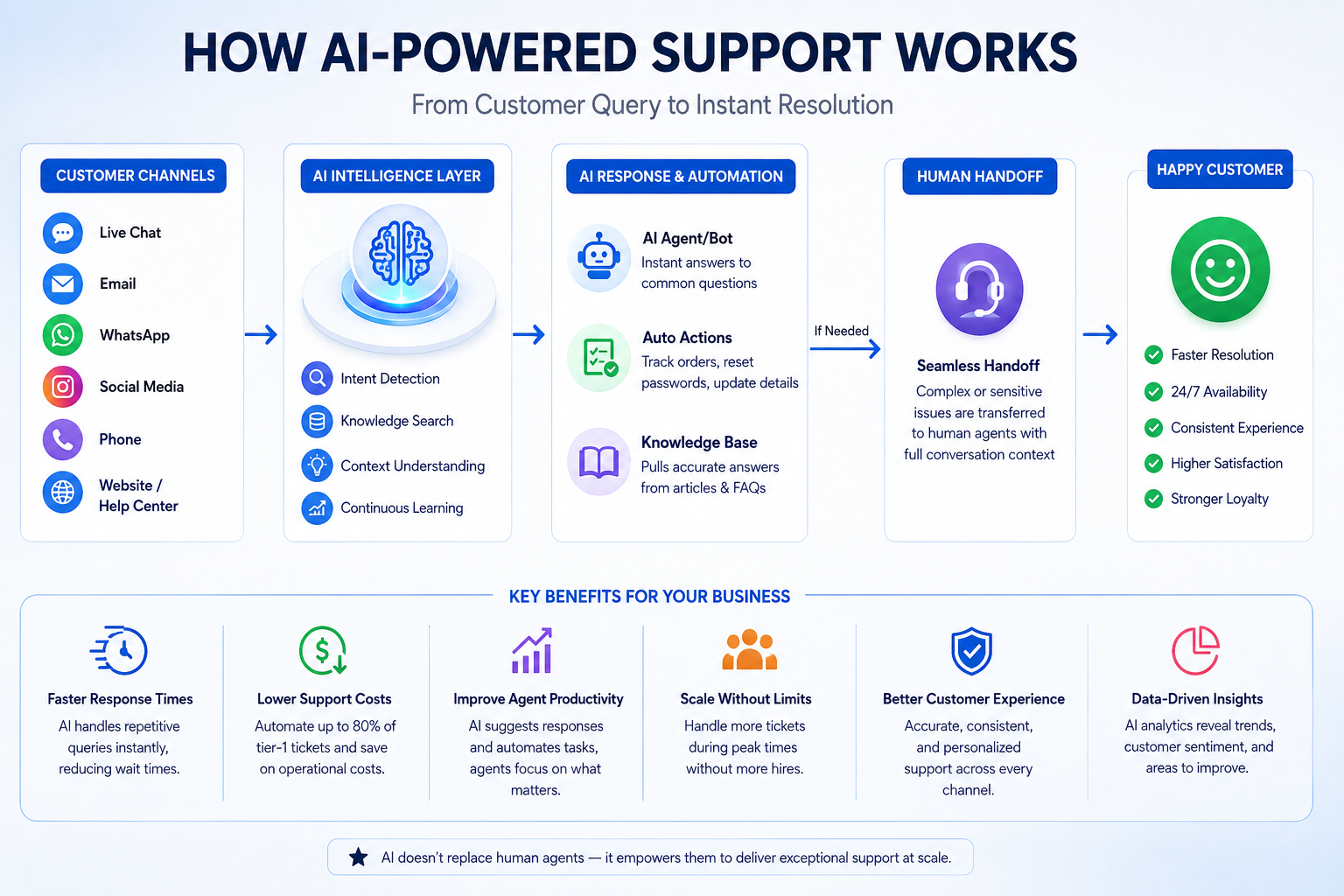
The strongest systems do more than generate text. Depending on the product and permissions, an AI agent may authenticate a user, check an order, update information, follow a procedure or trigger another workflow. Human agents remain essential when judgment, empathy, negotiation, exceptions or sensitive decisions are involved.
1. Zendesk AI — Best for Mature Support Operations
Among enterprise-focused AI Tools for Customer Support, Zendesk stands out for its mature ticketing, workflow and automation ecosystem. Zendesk is one of the most established customer-service platforms, and its current AI strategy combines autonomous AI agents with tools that assist human support teams. Zendesk documents AI agents that can interact with customers through supported messaging and email-related channels and resolve issues without human intervention.
Zendesk now measures AI-agent usage through automated resolutions and introduced resolution tiers in 2026. This makes it important for buyers to evaluate both their core Zendesk plan and expected AI-resolution volume rather than comparing only agent-seat prices.
- Best for: established support teams and enterprises.
- Strengths: mature ticketing, AI agents, routing, knowledge and agent productivity.
- Watch for: configuration complexity and usage-based AI economics at scale.
Official resource: Zendesk AI for customer service.
2. Fin — Best AI Customer Agent for SaaS Teams
Fin has evolved well beyond the older description of “Intercom’s AI copilot.” In 2026, Fin is positioned as an AI customer agent that can deliver customer-service outcomes and work alongside Intercom’s customer-service platform.
Fin’s pricing model is also important to understand. Current Intercom documentation describes outcome-based pricing, with qualifying outcomes charged according to the value delivered. That means businesses should estimate realistic conversation and outcome volume before comparing Fin with seat-based competitors.
- Best for: SaaS and digital-first support organizations.
- Strengths: natural conversations, knowledge-grounded answers, procedures and human handoff.
- Watch for: usage economics can change as AI volume grows.
Official resource: Fin AI customer agent.
3. Freshdesk with Freddy AI — Best for Growing Teams
Freshworks combines its Freshdesk help desk with Freddy AI Agent, Freddy AI Copilot and AI-driven insights. Freddy AI Agent can automate customer-facing support, while Copilot is designed to help human agents draft, summarize and work more efficiently.
Freshworks currently includes an initial allocation of AI Agent sessions with eligible Freshdesk plans and sells additional sessions separately. Freddy AI Copilot is also available as an add-on on eligible plans, so buyers should distinguish between the base help desk, customer-facing AI Agent usage and agent-assistance costs.
- Best for: small and mid-market teams wanting a familiar help-desk model.
- Strengths: ticketing, AI Agent, Copilot, summaries, routing and analytics.
- Watch for: AI Agent sessions and Copilot can have separate pricing mechanics.
Official resource: Freshdesk.
4. Gorgias — Best for Shopify Ecommerce Support
Gorgias is built around ecommerce customer service and is especially compelling for Shopify merchants. Its AI Agent can use store context to answer questions and, in supported workflows, perform ecommerce-related actions rather than functioning only as a generic FAQ chatbot.
This is also where our older XVIFS article needed correction: Gorgias supports multiple ecommerce help-desk integrations, but its current AI Agent availability and capabilities should not be assumed to work identically across Shopify, Magento, BigCommerce and WooCommerce. Businesses should verify AI Agent support for their specific store platform before buying.
- Best for: Shopify-focused ecommerce brands.
- Strengths: order context, ecommerce workflows and support automation.
- Watch for: verify AI Agent availability for your exact commerce platform.
Official resource: Gorgias AI Agent.
5. Help Scout — Best for Human-Centered Small Teams
Help Scout is attractive to teams that want the efficiency of AI without turning every customer interaction into a bot-first experience. Its product combines a shared inbox, knowledge tools and AI assistance designed to reduce repetitive agent work.
For smaller organizations, simplicity can be a major advantage. A platform that agents actually adopt may deliver more value than a larger enterprise suite with dozens of features the team never configures.
- Best for: small and medium customer-focused businesses.
- Strengths: straightforward inbox experience, knowledge and AI assistance.
- Watch for: organizations needing highly complex enterprise orchestration may prefer a broader platform.
Official resource: Help Scout.
6. HubSpot Service Hub — Best for HubSpot CRM Users
HubSpot Service Hub becomes particularly attractive when customer service already lives alongside HubSpot CRM, marketing and sales data. Its Breeze Customer Agent can use connected customer context while Service Hub provides ticketing, help-desk workspaces, knowledge and routing capabilities.
HubSpot’s 2026 product updates emphasize automated customer resolution with Customer Agent, including a usage model based on resolutions. The main buying question is therefore not simply “Is the AI good?” but whether consolidating service with the rest of the HubSpot customer platform creates enough operational value.
- Best for: companies already committed to HubSpot CRM.
- Strengths: unified CRM context, help desk, knowledge and Breeze Customer Agent.
- Watch for: total platform cost as requirements expand across hubs and seats.
Official resource: HubSpot Service Hub.
7. Zoho Desk with Zia — Best for Value and Zoho Ecosystem Users
Zoho Desk combines traditional help-desk automation with Zia, Zoho’s AI layer. Current capabilities include AI-assisted replies, summaries, sentiment and topic insights, field predictions, answer-bot functionality and newer agentic AI options depending on edition and data center.
Zoho also allows businesses to choose between native Zia generative AI and supported external-model configurations in certain workflows. This flexibility can be useful for organizations already standardized on the wider Zoho ecosystem.
- Best for: cost-conscious teams and existing Zoho customers.
- Strengths: broad help-desk feature set, Zia AI and ecosystem integration.
- Watch for: AI features can vary by edition, region and data center.
Official resource: Zoho Desk.
8. Salesforce Agentforce for Service — Best for Large CRM-Centric Enterprises
Salesforce brings customer-service AI into its broader CRM and data environment through Agentforce and Service Cloud. Its service AI capabilities include generative replies, summaries, knowledge creation, employee assistance and autonomous-agent experiences, depending on the product and edition selected.
The advantage is depth: organizations already running customer operations on Salesforce can connect AI to a rich CRM environment. The trade-off is that licensing, implementation and governance are generally more involved than adopting a lightweight help desk.
- Best for: enterprises already invested in Salesforce.
- Strengths: CRM data, Agentforce, enterprise workflows and omnichannel service.
- Watch for: higher implementation complexity and total platform cost.
Official resource: Salesforce AI for customer service.
9. Kustomer — Best for High-Volume Omnichannel Customer Context
Kustomer is designed around a unified view of the customer rather than treating every support request as an isolated ticket. That approach can be valuable for businesses with high conversation volume across multiple channels, where AI needs access to customer history and context.
- Best for: high-volume consumer and omnichannel support teams.
- Strengths: customer context, automation and AI-assisted service workflows.
- Watch for: smaller teams should confirm they need the platform depth before committing.
Official resource: Kustomer.
10. Ada — Best for Automation-First Customer Service
Ada is an AI-first customer-service platform built around automated conversations and resolution. It is worth considering when the organization’s primary goal is to automate a meaningful share of customer interactions rather than simply add writing assistance to an existing ticketing system.
- Best for: organizations prioritizing AI-led customer-service automation.
- Strengths: automation-first design, conversational AI and enterprise use cases.
- Watch for: confirm integrations, governance requirements and total usage economics during evaluation.
Official resource: Ada.
AI Tools for Customer Support: Visual Comparison
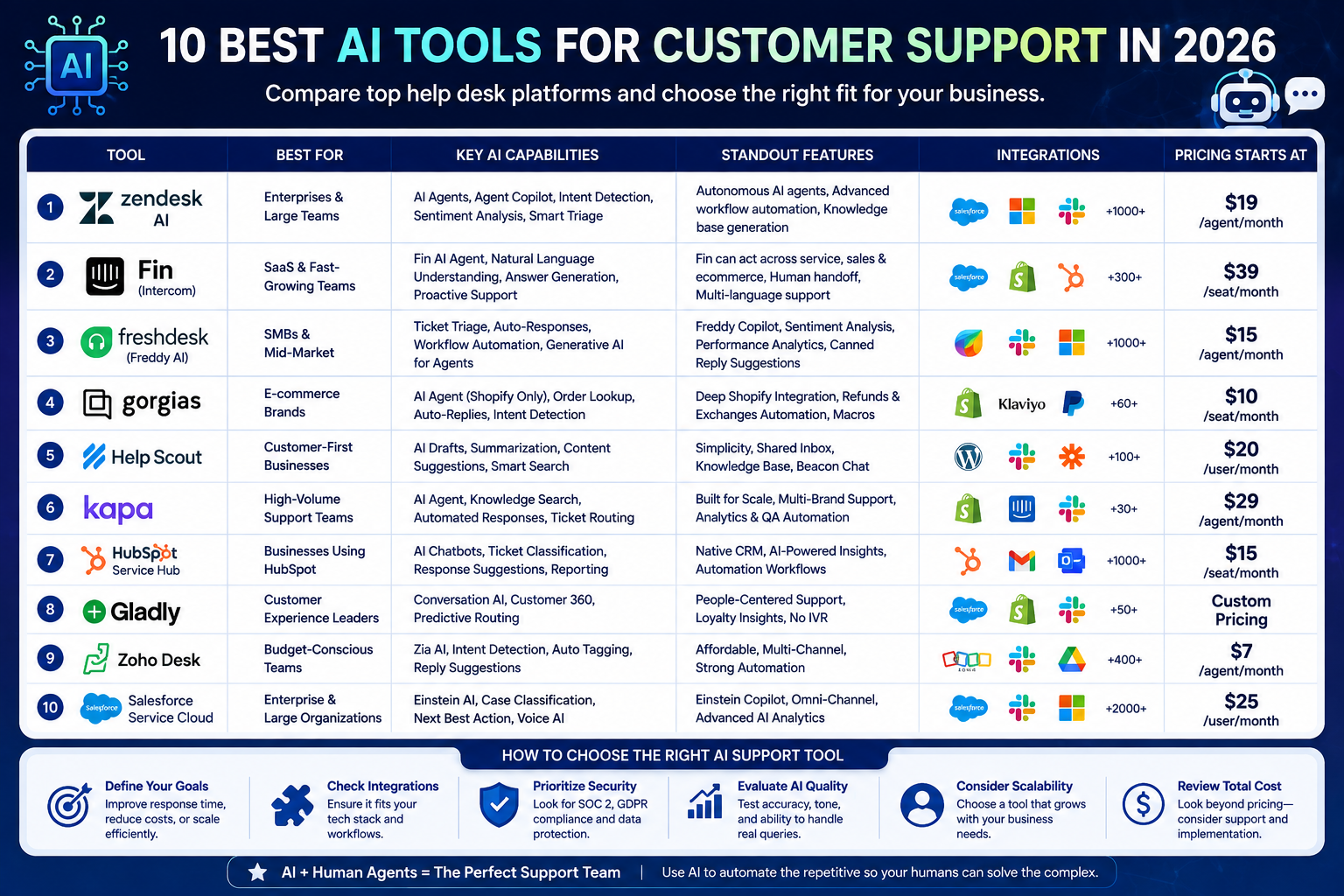
Important: the pricing figures shown in the comparison graphic are illustrative snapshot information and should not be treated as a live quote. Several vendors changed AI packaging and usage models during 2026. Use the official vendor pricing page for the final purchasing decision.
AI Agent vs AI Copilot: What’s the Difference?
An AI agent is designed to interact directly with customers and, when properly configured, resolve requests or perform approved actions. An AI copilot primarily assists the human support agent by summarizing conversations, suggesting replies, searching knowledge or recommending next steps.
AI agents can also differ significantly in how they make decisions, learn and interact with their environment. For a deeper explanation, read our complete guide to the types of AI agents with practical examples and use cases.
Many businesses need both. AI agents can absorb repetitive volume, while copilots can make human agents faster on the conversations that require judgment. When comparing AI Tools for Customer Support, check whether a vendor’s “AI” feature is customer-facing automation, employee assistance or both.
How to Choose the Best AI Customer Support Tool
Before choosing AI Tools for Customer Support, evaluate real ticket volume, integrations, knowledge quality, escalation requirements and total AI usage costs.
- Define the problem first. Decide whether you need ticket deflection, faster agent replies, 24/7 support, ecommerce actions, better routing or a complete help-desk replacement.
- Audit your channels. Confirm support for the email, chat, WhatsApp, social, voice or help-center channels your customers actually use.
- Check knowledge quality. AI cannot consistently deliver strong answers from outdated or contradictory source material.
- Test real integrations. Verify connections with your CRM, ecommerce platform, billing system and internal tools.
- Evaluate human handoff. Customers should be able to reach an appropriate person when automation cannot safely resolve the issue.
- Review security and permissions. Understand what customer data the AI can access and what actions it is allowed to perform.
- Model total cost. Include seats, AI resolutions/outcomes/sessions, add-ons, onboarding and implementation—not just the advertised entry plan.
- Run a controlled pilot. Test accuracy, containment, escalation quality and customer satisfaction before expanding automation.
Key Benefits of AI Tools for Customer Support
The best AI Tools for Customer Support can reduce repetitive workloads while improving response speed, consistency and agent productivity.
- Faster first response: common questions can receive immediate assistance.
- 24/7 availability: automated service can continue outside normal agent hours.
- Higher agent productivity: summaries, suggested replies and knowledge retrieval reduce repetitive work.
- Scalability: businesses can absorb spikes in support volume without matching every increase with new headcount.
- Consistency: approved knowledge and procedures can make routine responses more standardized.
- Better insight: AI can help surface recurring customer issues, intent and sentiment patterns.
Risks and Limitations You Should Consider
AI support is not automatically accurate simply because it sounds confident. Poor source material, unclear permissions or weak escalation design can create incorrect answers and frustrating customer experiences.
- Incorrect or invented answers can damage trust.
- Sensitive workflows require strong access controls and governance.
- Usage-based AI pricing can become expensive at high volume.
- Automation can frustrate customers if human escalation is difficult.
- Integrations may support different actions on different plans or platforms.
- Teams still need to maintain their knowledge base and monitor AI performance.
How to Measure AI Customer Support Performance
Do not judge an AI deployment only by how many conversations it touches. Track whether it actually improves the customer experience and support economics.
- First-response time
- Resolution time
- AI resolution or containment rate
- Escalation rate
- Reopen rate
- Customer satisfaction (CSAT)
- Agent handling time
- Cost per successful resolution
- Accuracy and quality-review results
A high automation percentage is not a victory if customers repeatedly reopen tickets or contact a human because the AI answer was incomplete.
Which AI Customer Support Tool Should You Choose?
There is no universal winner. Zendesk is a strong option for mature service organizations; Fin deserves serious consideration for SaaS and digital-first teams; Freshdesk provides an approachable combination of help desk and Freddy AI; and Gorgias is particularly relevant to Shopify ecommerce.
HubSpot Service Hub makes sense when customer service should live beside HubSpot CRM data, while Zoho Desk can offer strong value for businesses in the Zoho ecosystem. Large Salesforce environments should evaluate Agentforce for Service, while automation-first teams may shortlist Ada.
For smaller companies evaluating AI beyond the help desk, read our best AI tools for small businesses. Sales teams can also explore our best AI sales tools guide, while teams interested in workflow automation can start with our Make.com tutorial for beginners.
Frequently Asked Questions
What are the best AI Tools for Customer Support in 2026?
Strong options include Zendesk, Fin, Freshdesk with Freddy AI, Gorgias, Help Scout, HubSpot Service Hub, Zoho Desk, Salesforce Agentforce, Kustomer and Ada. The best choice depends on your channels, integrations, ticket volume, business model and budget.
Can AI customer support tools replace human agents?
AI can automate a meaningful share of repetitive support, but human agents remain important for exceptions, emotionally sensitive conversations, negotiation, complex troubleshooting and situations requiring judgment. The strongest operating model usually combines automation with clear human escalation.
Are AI customer support tools difficult to implement?
Basic knowledge-based AI can often be launched relatively quickly, but reliable production automation requires more work. Teams need clean knowledge, integrations, permissions, escalation rules, testing and ongoing quality monitoring.
Which AI help desk is best for small businesses?
Freshdesk, Help Scout, Zoho Desk and HubSpot can all be worth evaluating for smaller teams. The right option depends on whether your priority is affordability, simplicity, CRM integration or customer-facing AI automation.
Which AI customer support platform is best for ecommerce?
Gorgias is particularly focused on ecommerce and is a strong candidate for Shopify-based brands because support can be connected with store and order workflows. Merchants on other ecommerce platforms should verify current AI Agent compatibility before purchasing.
How much do AI customer support tools cost?
There is no single pricing model. Vendors may charge per support seat, AI session, outcome, automated resolution, credit or enterprise contract. Calculate expected monthly AI usage and required add-ons before comparing total cost.
Final Verdict: Best AI Tools for Customer Support in 2026
The market for AI Tools for Customer Support has moved from simple chatbots toward AI agents capable of handling increasingly complete support workflows. At the same time, human-agent copilots are reducing administrative work and helping support teams respond with more context.
When comparing AI Tools for Customer Support, prioritize reliable resolutions, secure actions and smooth human escalation over headline automation percentages. Choose based on your actual operating model rather than the longest feature list. Start with two or three platforms that match your business type, test them against real support scenarios, measure successful resolutions and escalation quality, and compare the total cost at your expected volume.
For most buyers, the best AI support platform will be the one that combines reliable answers, safe actions, strong integrations and effortless human handoff—not simply the tool that promises the highest automation percentage.
Editor’s note: AI features, packaging, pricing and supported integrations change frequently. XVIFS recommends verifying current capabilities and pricing on each vendor’s official website before purchasing.