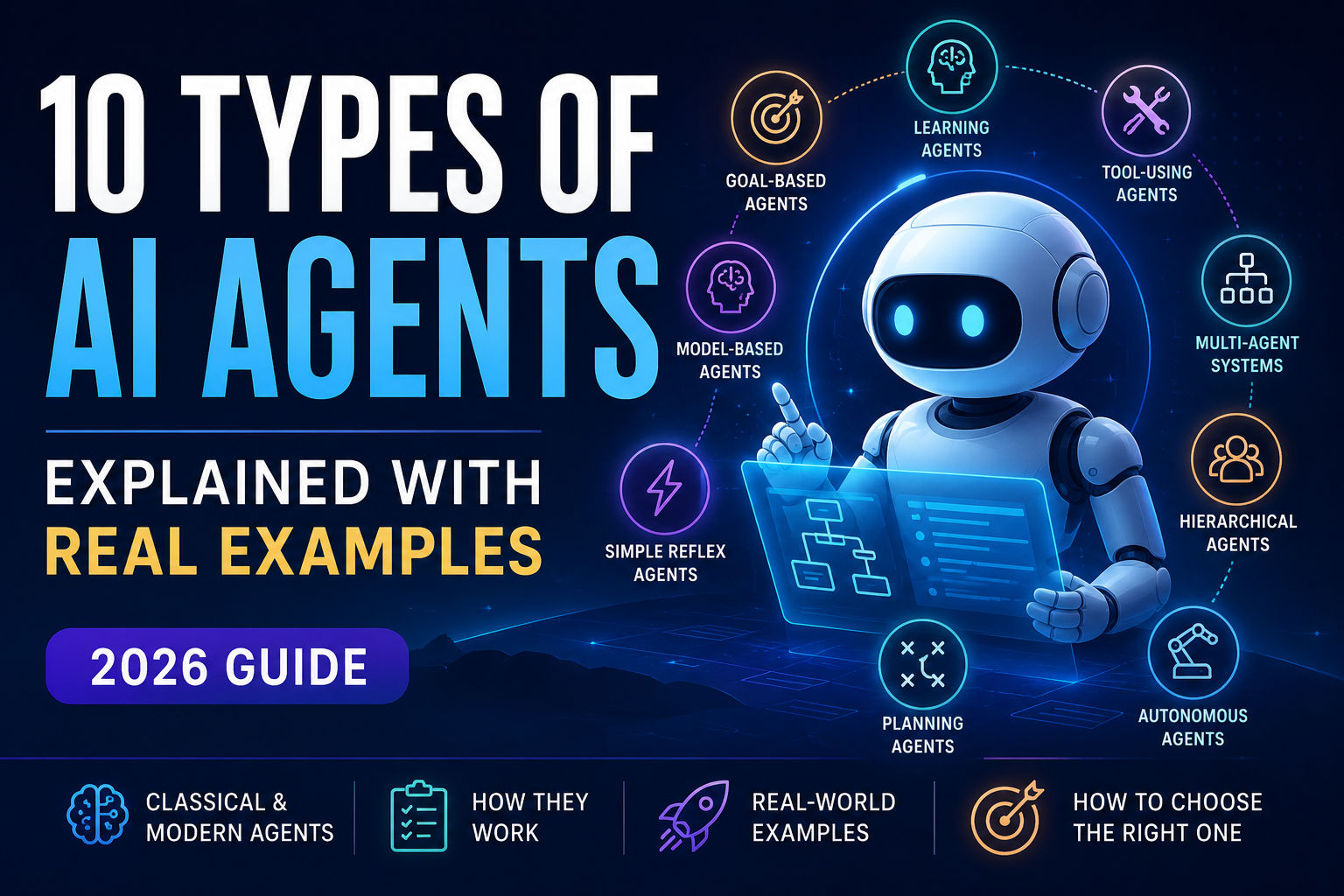
Types of AI Agents range from simple systems that follow fixed rules to advanced autonomous agents that plan, use tools, learn from experience, and collaborate with other agents. Understanding these differences is becoming increasingly important as AI agents move from experimental technology into real business workflows.
In this guide, we’ll explain 10 important Types of AI Agents, how they work, their strengths and limitations, and practical examples of where each type can be used in 2026.
There is one important distinction before we begin. Traditional AI literature commonly identifies five core agent types: simple reflex, model-based reflex, goal-based, utility-based, and learning agents. Modern agentic AI systems also use architectural patterns such as tool-using, planning, hierarchical, multi-agent, and highly autonomous agents. We cover both groups so you can understand classical AI agents as well as the systems being built today.
What Are AI Agents?
An AI agent is a software system capable of perceiving information, making decisions and taking actions to accomplish an objective. Modern agents may also reason through a problem, remember information, call external tools and APIs, and coordinate multiple steps with limited human intervention.
Unlike a basic chatbot that mainly generates responses, an AI agent can potentially do something with the information it receives. For example, an agent might analyze a customer request, retrieve account information, decide what action is required, call a business application and then report the result.
Understanding the different Types of AI Agents makes it easier to select the right architecture for a specific task.
This combination of reasoning and action is why AI agents are becoming increasingly relevant to automation, customer service, software development, research and business operations.
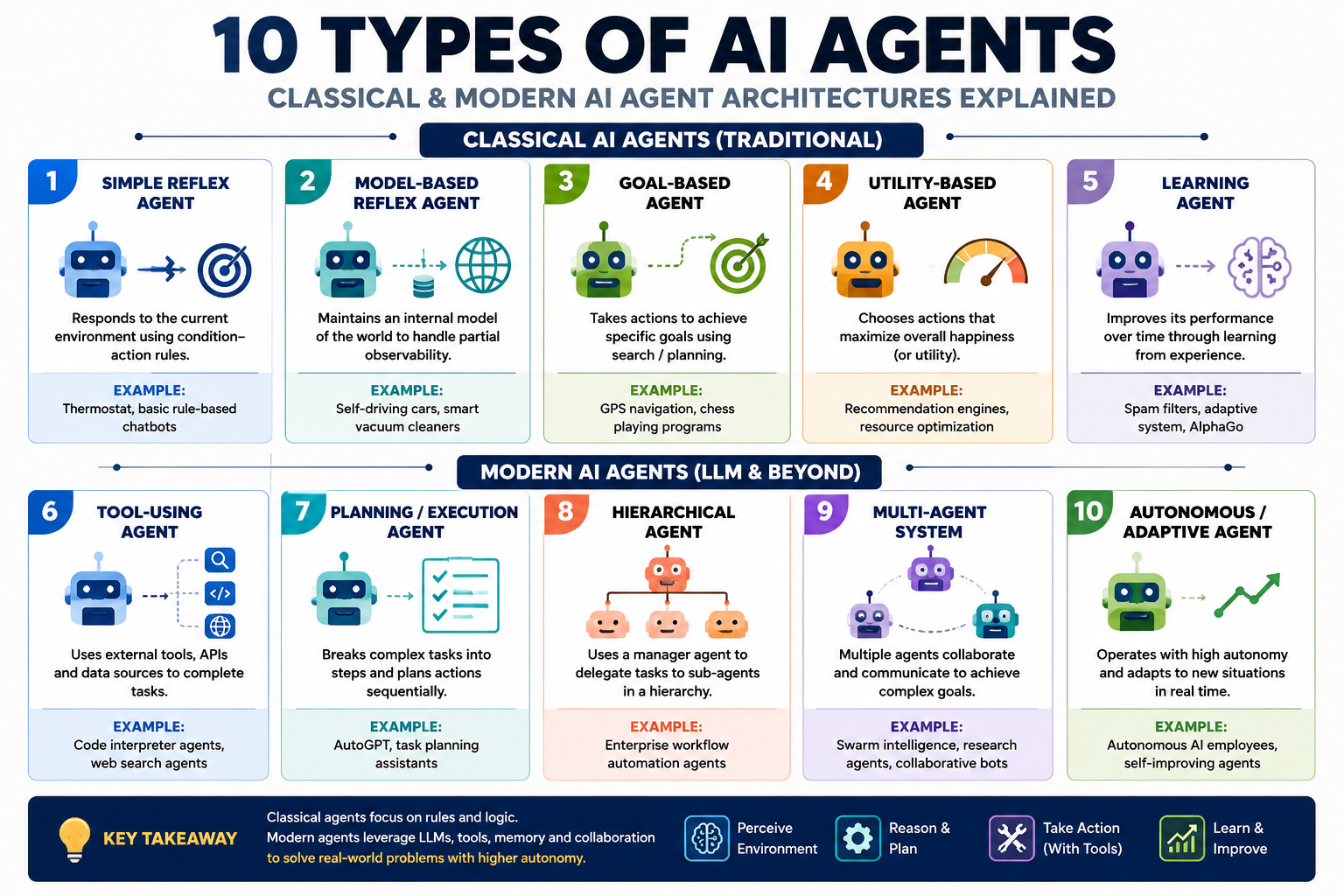
10 Types of AI Agents Explained
The easiest way to understand the different Types of AI Agents is to start with classical agents and gradually move toward modern agentic architectures.
1. Simple Reflex Agents
A simple reflex agent responds to the current situation using predefined condition-action rules. It does not normally consider previous events or predict what might happen next.
The basic logic is straightforward: if a particular condition occurs, perform a particular action.
- Memory: No meaningful historical memory
- Decision method: Fixed rules
- Best for: Predictable environments
- Example: A thermostat turning heating on when the temperature falls below a defined level
The advantage is speed and simplicity. The disadvantage is that a reflex agent cannot handle unfamiliar situations well when its predefined rules do not cover them.
2. Model-Based Reflex Agents
A model-based reflex agent improves on the simple reflex model by maintaining an internal representation of its environment.
This allows the agent to consider information that may no longer be directly visible. A robot navigating a building, for example, can remember previously encountered obstacles rather than reacting only to whatever is immediately in front of it.
- Memory: Maintains an internal state
- Decision method: Rules plus an environmental model
- Best for: Partially observable environments
- Example: A navigation robot remembering obstacles and previous movements
This makes model-based agents more flexible, although they still lack the sophisticated planning and learning capabilities found in more advanced systems.
3. Goal-Based Agents
Goal-based agents choose actions according to whether those actions help achieve a defined objective.
Instead of simply responding to an event, the agent can evaluate possible future states and select a path that moves it toward its goal.
Imagine an autonomous warehouse robot instructed to deliver a package to Station B. Several routes may exist. A goal-based agent evaluates its available actions and chooses a route capable of reaching the destination.
- Primary focus: Achieving a specific objective
- Capability: Reasoning about possible actions
- Best for: Planning and navigation
- Example: Route planning for autonomous systems
4. Utility-Based Agents
A goal-based agent asks, “Will this achieve the goal?” A utility-based agent goes further and asks, “Which successful outcome is best?”
The agent assigns values to possible outcomes using a utility function and selects an action expected to produce the greatest overall benefit.
Consider a delivery system choosing between several routes. All might reach the destination, but one may offer the best combination of travel time, fuel consumption, cost and risk.
- Primary focus: Optimizing outcomes
- Decision method: Utility scoring
- Best for: Problems involving trade-offs
- Example: Dynamic routing or pricing optimization
5. Learning Agents
Learning agents can improve their performance using data, experience or feedback from their environment.
Rather than relying entirely on fixed behavior, a learning agent adjusts its knowledge or strategy as it encounters new situations.
A typical learning-agent design can contain a performance element that selects actions, a learning element that improves knowledge, a critic that evaluates results and a problem generator that encourages useful exploration.
- Primary focus: Continuous improvement
- Capability: Adaptation from feedback
- Best for: Dynamic environments
- Example: Systems that improve recommendations or strategies from previous outcomes
These Types of AI Agents vary significantly in their ability to reason, learn, plan and interact with external systems.
Modern Types and Architectures of AI Agents
The first five categories describe the classical types of agents in AI. Modern LLM-based systems introduce additional patterns centered around tools, planning, orchestration and collaboration. These categories can overlap with the five classical agent types rather than replacing them.
6. Tool-Using AI Agents
A tool-using AI agent can interact with external capabilities instead of relying exclusively on information contained inside its underlying model.
Tools can include APIs, databases, search systems, calculators, business applications and automation platforms. Tool calling dramatically expands what an agent can accomplish.
For example, a customer-service agent might understand a request, retrieve an order from a database, check shipping status through an API and provide the customer with the latest information.
This resembles the wider automation principle covered in our Make.com HTTP Module tutorial, where APIs allow separate applications to exchange information and trigger actions.
7. Planning Agents
Planning agents break complex objectives into a sequence of smaller tasks before or during execution.
For example, an AI research agent asked to evaluate a software market could divide the objective into several stages: identify products, collect information, compare features, analyze results and prepare a final report.
Planning becomes particularly useful when tasks have dependencies. The agent must understand which step needs to happen first and what information later steps require.
8. Hierarchical Agents
A hierarchical agent architecture organizes decision-making into different levels. A higher-level agent can supervise the overall objective while lower-level agents or processes handle specific subtasks.
Think of it like a business team. A manager focuses on the final outcome while specialists handle research, analysis, writing or technical execution.
This structure is useful when a complex objective can be decomposed into clearly defined responsibilities.
9. Multi-Agent Systems
A multi-agent system uses multiple autonomous agents that interact, coordinate or collaborate to achieve individual or shared goals.
Instead of asking one agent to perform every task, organizations can assign specialized roles. A research agent might collect information, an analysis agent could evaluate it, and another agent could turn the findings into a report.
The agents need effective communication and orchestration so information moves between them correctly. This can make multi-agent systems more flexible and scalable for complex workflows, but also more difficult to design, monitor and control.
10. Autonomous AI Agents
Autonomous AI agents represent systems designed to perform extended tasks with comparatively limited human intervention.
A capable autonomous agent may combine several technologies discussed above: reasoning, planning, memory, tool calling, environmental feedback and goal management.
Autonomy should not be confused with unlimited freedom. Production systems still require permissions, security controls, monitoring, evaluation and clearly defined boundaries—especially when agents can change data, spend money or interact with critical business systems.
Types of AI Agents Comparison
Businesses should compare different Types of AI Agents before deciding how much autonomy their workflows actually require.
| Agent Type | Main Capability | Memory | Planning | Typical Use |
|---|---|---|---|---|
| Simple Reflex | Rule-based reactions | Low/None | No | Basic automation |
| Model-Based Reflex | Tracks environmental state | Yes | Limited | Navigation and control |
| Goal-Based | Pursues objectives | Possible | Yes | Goal-oriented tasks |
| Utility-Based | Optimizes outcomes | Possible | Yes | Optimization |
| Learning | Improves from experience | Yes | Varies | Adaptive systems |
| Tool-Using | Calls external tools/APIs | Varies | Varies | Business workflows |
| Planning | Breaks goals into steps | Usually | Strong | Complex workflows |
| Hierarchical | Delegates subtasks by level | Varies | Strong | Large workflows |
| Multi-Agent | Agents collaborate | Varies | Strong | Complex distributed tasks |
| Autonomous | Extended independent execution | Often | Strong | End-to-end processes |
How Do AI Agents Work?
Although architectures vary, modern AI agents generally combine several building blocks: input or perception, reasoning, memory, planning, tools and actions.
- Receive information: The agent receives a prompt, event, API response, database record or sensor input.
- Interpret the objective: It determines what the user or system wants accomplished.
- Reason and plan: More advanced agents determine the steps required to reach the objective.
- Use memory or context: Relevant information from the current or previous interactions may inform decisions.
- Call tools: The agent can interact with APIs, databases, software or other agents when permitted.
- Take action: It executes the selected action or produces an output.
- Evaluate results: Some systems check whether the action succeeded and decide whether another step is necessary.
This creates an agentic loop rather than a single prompt-and-response interaction.
Which Type of AI Agent Should You Use?
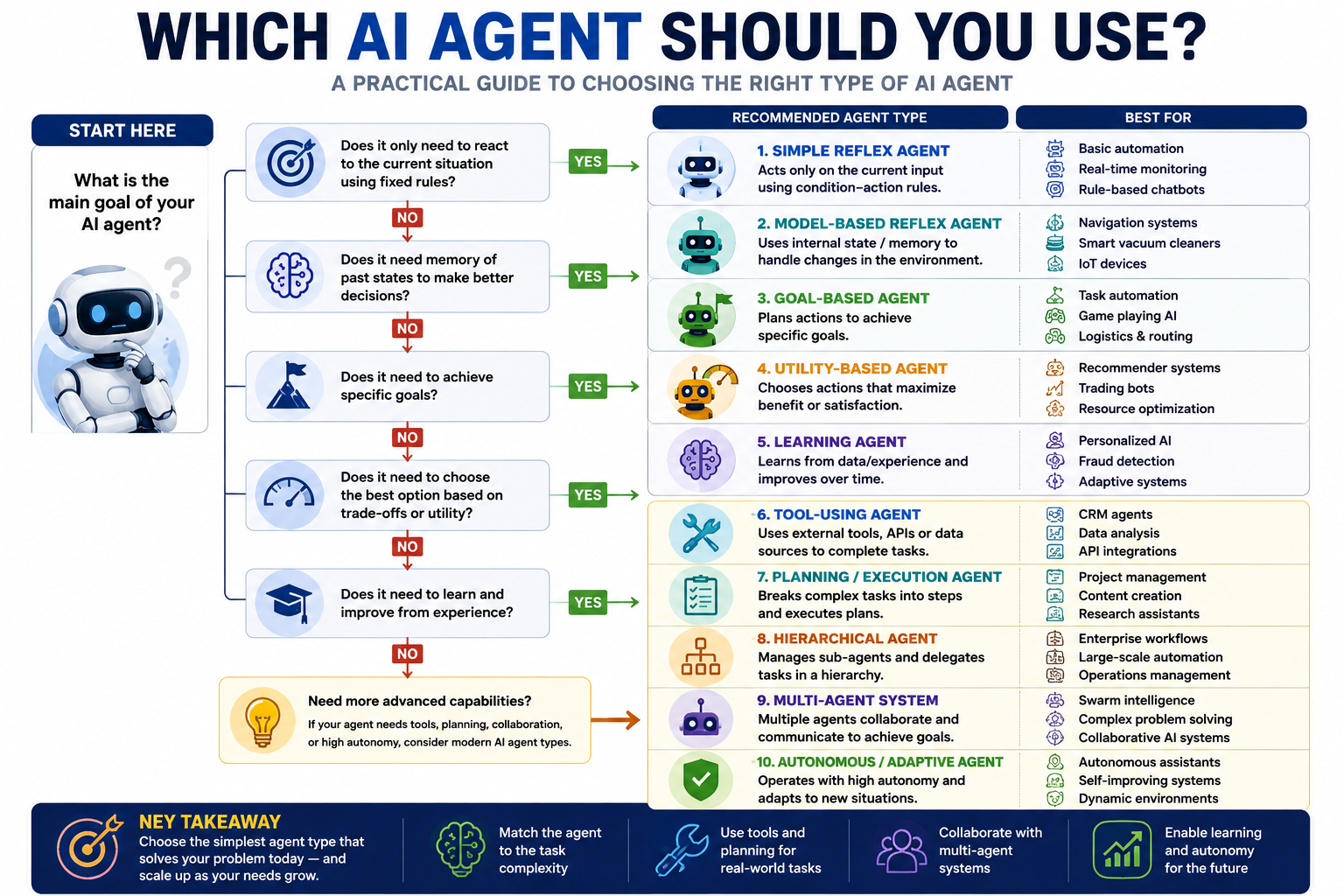
The best AI agent is not automatically the most sophisticated one. Choosing between the Types of AI Agents depends on the complexity, risk and objectives of the workflow.
- Choose a reflex-style system when rules are simple and predictable.
- Choose a goal-based agent when the system must determine how to reach a specific objective.
- Choose a utility-based approach when several valid outcomes exist and you need to optimize between them.
- Choose a learning agent when performance should adapt based on new data or feedback.
- Add tool access when the agent must retrieve live information or perform actions in external systems.
- Use multi-agent architecture when a complex workflow benefits from multiple specialized roles.
- Increase autonomy carefully when the workflow is sufficiently controlled, observable and reversible.
AI Agents vs Traditional Automation
Traditional automation generally follows explicitly designed workflows. If A happens, the automation executes B and then C according to predefined logic.
AI agents can introduce a reasoning layer into this process. Instead of every decision path being manually specified, an agent can interpret context and determine which permitted action or tool should be used.
The technologies can therefore complement one another rather than compete. An AI agent can make decisions while an automation platform executes deterministic actions. If you’re learning workflow automation, our Make.com tutorial for beginners explains the fundamentals of building automated workflows.
For businesses, this is where AI agents connect directly with task automation: agents can interpret context and make decisions, while automation workflows carry out recurring actions across business apps, data, reporting, customer service, and other operational processes.
Real-World Uses of Different Types of AI Agents
As AI technology develops, the Types of AI Agents used in real-world applications are becoming increasingly sophisticated.
- Customer support: Retrieve information, classify requests and assist with resolutions.
- Sales: Research prospects, organize information and support lead qualification.
- Marketing: Analyze data, research topics and coordinate content workflows.
- Software development: Assist with coding, testing, debugging and documentation.
- IT operations: Analyze incidents, retrieve system information and support remediation workflows.
- Research: Collect, organize and compare information across multiple sources.
- Business automation: Connect reasoning with APIs and workflow systems to perform multi-step processes.
For another practical business perspective, see our guide to the best AI tools for customer support, where AI is already being applied to service workflows.
Are Multi-Agent Systems Better Than Single AI Agents?
Not necessarily. Multi-agent systems can divide large problems among specialized agents, which can improve modularity and scalability. However, additional agents also introduce communication, orchestration, latency, cost and monitoring challenges.
A single well-designed agent may therefore be the better solution for a straightforward workflow. Multi-agent architecture becomes more attractive when responsibilities can be clearly separated and the additional coordination produces meaningful benefits.
The Future of AI Agents
The direction of AI development is moving beyond systems that only generate content toward systems that can reason about objectives and interact with tools. Modern agent platforms increasingly combine models with grounding, memory, tool access, orchestration and runtime infrastructure.
For businesses, the important question is therefore shifting from “What can an AI model answer?” toward “What useful work can an AI system safely complete?”
As these systems become more capable, governance will become equally important. Permissions, human approval points, audit trails, security controls and continuous monitoring should develop alongside autonomy.
Frequently Asked Questions About Types of AI Agents
What are the main types of AI agents?
The five commonly recognized classical Types of AI Agents are simple reflex agents, model-based reflex agents, goal-based agents, utility-based agents and learning agents. Modern AI systems also use tool-using, planning, hierarchical, multi-agent and autonomous architectures.
What are AI agents in simple terms?
An AI agent is a system that receives information, decides what action to take and acts toward a goal. Advanced agents may also use memory, planning and external tools to complete multi-step tasks.
How do AI agents work?
AI agents generally receive input, interpret an objective, reason about possible actions and then execute an action. Modern agents can also retrieve information, call APIs, maintain memory, create plans and evaluate whether their actions achieved the intended result.
What is the difference between goal-based and utility-based agents?
A goal-based agent focuses on reaching a desired objective. A utility-based agent compares multiple possible outcomes and attempts to select the option that provides the highest overall value according to its utility function.
What is a multi-agent AI system?
A multi-agent system consists of multiple autonomous agents that communicate, coordinate or collaborate within an environment. Different agents can specialize in different parts of a larger problem.
Are AI agents the same as chatbots?
No. A chatbot primarily interacts through conversation, while an AI agent can potentially plan and take actions using tools or external systems. Some modern chatbots incorporate agent capabilities, so the categories can overlap.
Final Thoughts
Understanding the Types of AI Agents provides a foundation for understanding agentic AI itself. Simple reflex agents demonstrate basic rule-based behavior, while model-based, goal-based, utility-based and learning agents progressively add greater context, optimization and adaptability.
Each of these Types of AI Agents has different strengths, limitations and practical use cases. Modern architectures extend those ideas with planning, tool use, hierarchical delegation, multi-agent collaboration and greater autonomy.
For businesses, the objective should not be to deploy the most complicated agent possible. It should be to choose the simplest architecture capable of completing the required task reliably, securely and cost-effectively.