79Online conversations can influence how customers discover, evaluate, recommend, or criticize a business. A brand may be discussed across social networks, blogs, forums, news websites, videos, reviews, and other digital channels without ever being tagged directly.This is why Social Monitoring Tools have become an important part of modern marketing, customer experience, reputation management, competitive research, and public relations.The right platform can help a business discover brand mentions, monitor competitors, identify emerging conversations, analyze sentiment, track campaigns, receive real-time alerts, and turn large volumes of online discussion into useful business intelligence.In this 2026 XVIFS guide, we compare some of the best social monitoring tools for businesses, explain what each is best suited for, and show you how to choose a platform based on your actual monitoring requirements rather than simply buying the product with the longest feature list.
What Are Social Monitoring Tools?
Social monitoring tools are software platforms that help businesses find, collect, organize, analyze, and respond to online conversations related to specific brands, products, competitors, people, campaigns, keywords, or topics.Depending on the software and available data sources, monitoring can extend beyond traditional social networks to websites, blogs, forums, news sources, reviews, videos, podcasts, and other publicly available digital conversations.A company might use social monitoring to track:
Brand names
Product names
Executive names
Competitors
Campaign hashtags
Industry keywords
Customer complaints
Product feedback
Influencers and creators
Potential reputation issues
Emerging trends
Share of voice
Social Monitoring vs Social Listening: What Is the Difference?
The terms social monitoring and social listening are frequently used together, but there is a useful practical distinction.
Area
Social Monitoring
Social Listening
Primary purpose
Find and respond to relevant mentions
Understand larger conversation patterns
Focus
Individual conversations and alerts
Trends, sentiment and strategic insights
Typical use
Customer response and reputation monitoring
Market, audience and competitive intelligence
Time horizon
Often real-time or near real-time
Real-time plus historical analysis
Analysis
Operational
Strategic
In practice, many modern platforms now provide both capabilities. A marketing team may initially detect an important negative mention through monitoring and then use listening analytics to determine whether that complaint represents an isolated incident or a wider trend.
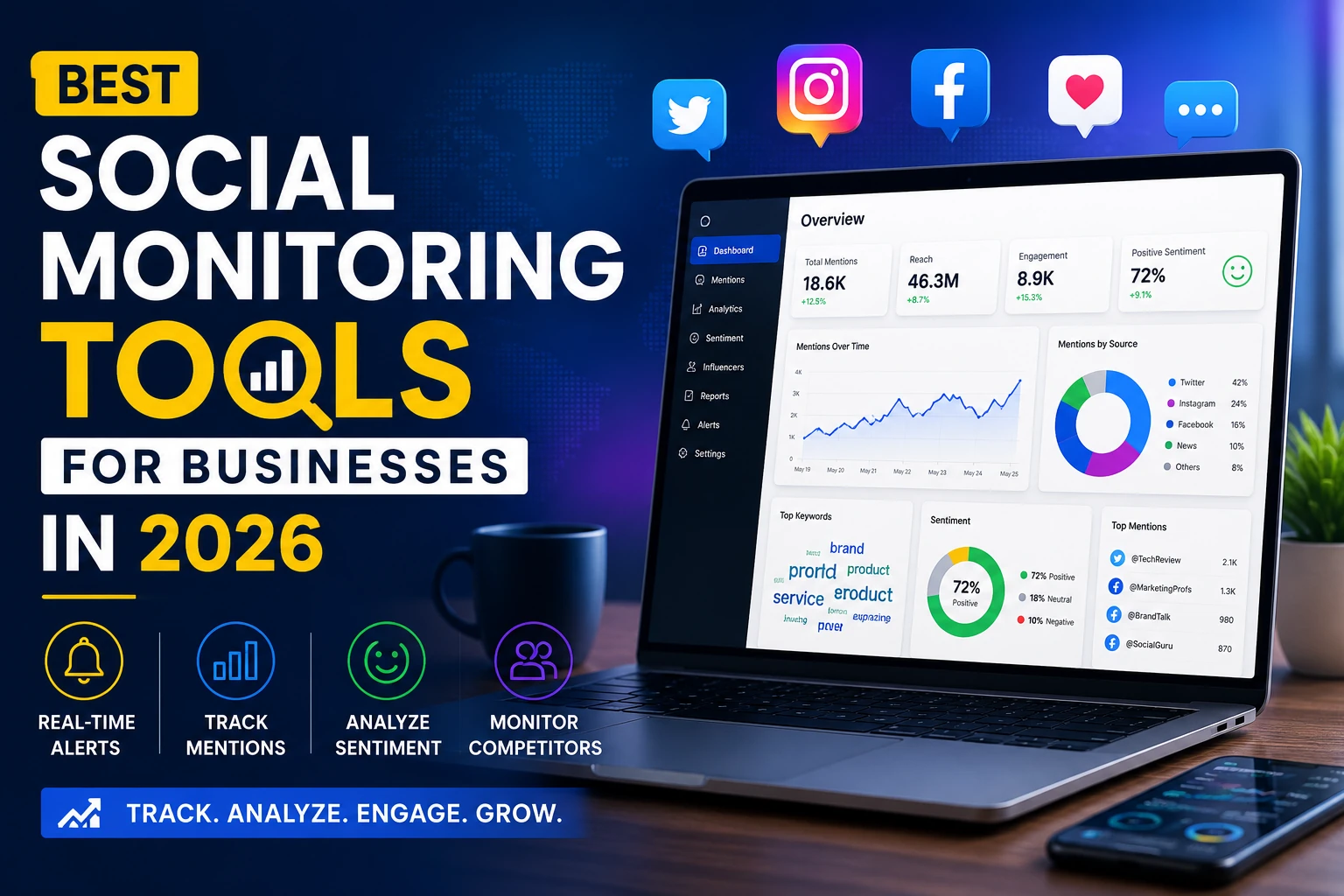
Best Social Monitoring Tools for Businesses in 2026
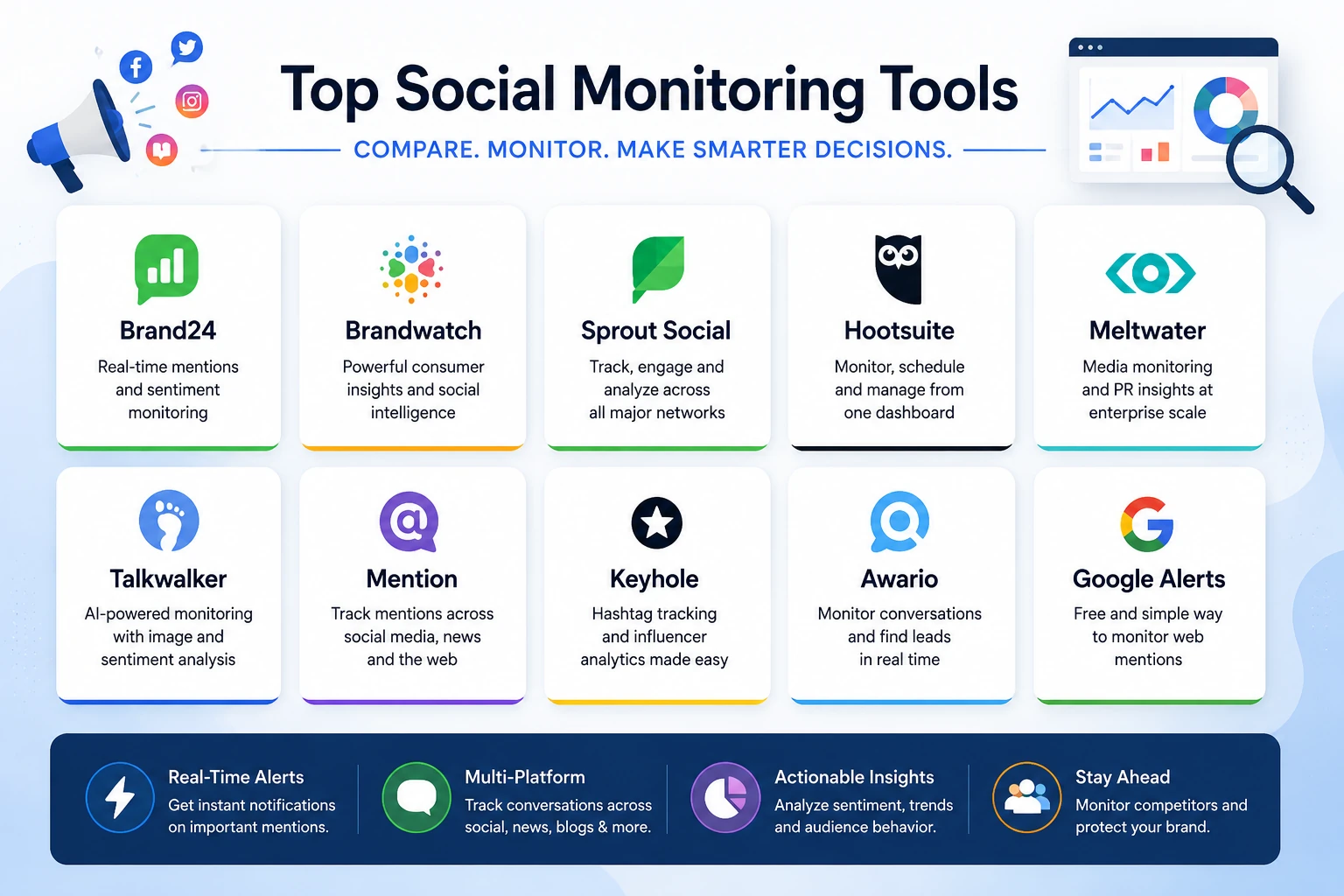
Leading social monitoring platforms serve different needs, from real-time brand mentions and campaign tracking to enterprise consumer intelligence.The following shortlist covers different levels of business complexity. Some platforms emphasize straightforward brand monitoring, while others provide enterprise-scale listening, media intelligence, social management, competitive research, or campaign analytics.
Tool
Best For
Primary Strength
Typical Business Fit
Brand24
Brand and mention monitoring
Accessible monitoring and sentiment insights
SMB to Enterprise
Brandwatch
Consumer intelligence
Large-scale listening and research
Enterprise
Sprout Social
Social management plus listening
Unified social workflows and intelligence
Mid-market / Enterprise
Hootsuite
Social management teams
Publishing, engagement and monitoring ecosystem
SMB to Enterprise
Meltwater
PR and media intelligence
Media monitoring and reputation intelligence
Mid-market / Enterprise
Talkwalker
Enterprise brand intelligence
Advanced listening and media analysis
Enterprise
Mention
Brand mention tracking
Monitoring online brand conversations
SMB / Marketing teams
Keyhole
Campaign and hashtag tracking
Social campaign analytics
Agencies / Marketing teams
Awario
Affordable web and social monitoring
Keyword and mention monitoring
Small / Growing businesses
Google Alerts
Basic web monitoring
Simple alerts for indexed web content
Individuals / Small businesses
Note: Platform capabilities, data-source access, plans, integrations and pricing can change. Always verify current functionality directly with the provider before purchasing.
1. Brand24 — Best for Accessible Brand Monitoring
Brand24 is a strong option for businesses that want to monitor online conversations without immediately adopting a highly complex enterprise research platform.The platform currently provides capabilities around online mentions, reach, sentiment, share of voice, alerts, influencer or source analysis, reporting, competitor comparison, AI-assisted insights, and broader brand intelligence.
Best for: Brands, agencies and marketing teams needing accessible monitoring.
Useful for: Mentions, reputation, sentiment, competitors and campaign monitoring.
Strength: Combines monitoring with increasingly sophisticated analysis.
Consider carefully: Confirm the required plan and data coverage for your specific channels.
2. Brandwatch — Best for Enterprise Consumer Intelligence
Brandwatch is designed for organizations that need deeper analysis of large volumes of digital conversation rather than only receiving alerts when a brand name appears.Its Consumer Intelligence environment is aimed at marketers, researchers, analysts, and enterprise teams that need to discover conversations, analyze audiences, investigate market trends, compare brands and extract wider consumer insights.
Best for: Large brands, research teams and enterprises.
Strength: Large-scale consumer and conversation intelligence.
3. Sprout Social — Best for Social Management and Listening Together
Sprout Social combines social media management with monitoring, engagement, analytics and deeper listening capabilities.This combination can be useful for teams that do not want monitoring intelligence isolated from everyday social publishing and customer-engagement workflows.
Best for: Established social teams and multi-user marketing departments.
Strength: Connects engagement, monitoring and social intelligence.
Useful for: Brand health, customer conversations, competitor analysis and trends.
Consider carefully: Advanced listening capabilities may depend on the selected package or add-ons.
Sprout Social provides current information about its deeper listening functionality on its official Social Listening page.
4. Hootsuite — Best for Teams Managing Multiple Social Channels
Hootsuite is widely associated with managing multiple social accounts from a centralized environment. Its broader platform includes publishing, engagement, analytics and monitoring-related capabilities.It can make sense for organizations where monitoring is one component of a larger day-to-day social management workflow rather than a separate research operation.
Best for: Teams operating multiple social channels.
Strength: Broader social media management environment.
Useful for: Publishing, engagement, monitoring and reporting workflows.
Consider carefully: Compare monitoring depth with specialist listening platforms if research is your main requirement.
5. Meltwater — Best for PR and Media Intelligence
Meltwater is particularly relevant for organizations that need to monitor brand reputation across a wider communications landscape rather than concentrating only on social media.Its broader positioning around media, social and consumer intelligence makes it useful to public relations, communications and enterprise reputation teams.
Best for: PR, communications and reputation teams.
Strength: Broader media-monitoring perspective.
Useful for: Brand reputation, media coverage and communications intelligence.
Consider carefully: Small organizations should evaluate whether they need enterprise-level media intelligence.
6. Talkwalker — Best for Advanced Enterprise Social Listening
Talkwalker targets organizations that need sophisticated listening and brand intelligence across large amounts of online content.Enterprise teams may consider it for reputation management, consumer intelligence, competitive intelligence, campaign measurement and broad digital monitoring.
Best for: Global enterprises and sophisticated research teams.
Strength: Advanced listening and analytics.
Useful for: Reputation, markets, campaigns and competitive intelligence.
Consider carefully: Requirements, onboarding and pricing should be evaluated against actual enterprise needs.
7. Mention — Best for Straightforward Mention Tracking
Mention has historically focused on helping organizations discover references to brands and keywords across social and web sources.It can be relevant to marketing and communications teams that want a straightforward way to track online discussions and maintain visibility around their brand.
Best for: Marketing teams focused on brand mentions.
Strength: Straightforward monitoring workflow.
Useful for: Brand monitoring, online conversation discovery and alerts.
Consider carefully: Verify current plans, product positioning and integrations because social-monitoring products evolve frequently.
8. Keyhole — Best for Hashtag and Campaign Monitoring
Keyhole is particularly relevant when the objective is monitoring campaigns, hashtags, social performance, influencers or specific marketing initiatives.Rather than treating social monitoring purely as reputation management, campaign-oriented analytics can help marketers understand how specific initiatives are being discussed and amplified.
Best for: Agencies, campaign managers and event marketers.
Strength: Campaign and hashtag analysis.
Useful for: Influencer activity, campaign tracking and social analytics.
Consider carefully: Compare broader web-monitoring requirements against specialist reputation platforms.
9. Awario — Best for Budget-Conscious Monitoring
Awario is worth considering for smaller businesses and teams that want keyword and brand-monitoring capabilities without immediately moving to a large enterprise intelligence platform.
Best for: Small businesses and growing marketing teams.
Strength: Accessible monitoring-focused approach.
Useful for: Brand mentions, competitors and conversation discovery.
Consider carefully: Check current source coverage against the channels most important to your business.
10. Google Alerts — Best for Basic Web Alerts
Google Alerts is not a complete social listening platform, but it remains useful as a basic supplementary tool for monitoring certain new web pages that Google discovers around selected terms.Businesses can create alerts around their company name, product names, executives or competitors and receive notifications when relevant indexed web content appears.
Best for: Basic supplementary web monitoring.
Strength: Simple and accessible.
Useful for: Selected web mentions.
Limitation: It is not a substitute for dedicated real-time social monitoring, sentiment analysis or enterprise listening.
Key Features to Look for in Social Monitoring Tools
Do not select a monitoring platform simply because it advertises AI or claims to monitor “the entire internet.” Evaluate exactly what the tool can collect, how quickly it finds relevant conversations, and whether your team can act on the information.
Real-Time or Near Real-Time Alerts
Fast alerts are particularly valuable for reputation management, product problems, customer complaints, viral conversations and PR issues.
Source Coverage
Ask which social networks, websites, forums, review sites, blogs, news sources, video platforms and other channels are actually included.Data access varies between providers because social platforms impose different API, licensing and privacy restrictions.
Sentiment Analysis
Sentiment analysis attempts to categorize conversations as positive, negative or neutral. It can be useful for identifying broad patterns, but teams should not assume automated sentiment is perfect.Sarcasm, regional language, industry terminology and ambiguous statements can still be difficult for automated systems to interpret accurately.
Competitor Monitoring
A useful platform should allow businesses to compare conversations around competitors, products or categories rather than monitoring only their own name.
Share of Voice
Share-of-voice analysis can help estimate how visible a brand is within a tracked conversation compared with selected competitors.
Filtering and Noise Reduction
Common words or ambiguous brand names can create enormous amounts of irrelevant data. Advanced filters, exclusions, Boolean logic and contextual search tools can make monitoring considerably more useful.
Historical Data
Historical information can help businesses compare campaign performance, identify long-term reputation changes and investigate how conversations developed over time.
Reporting and Exporting
Agencies and larger organizations should consider dashboards, scheduled reports, exports, API access and stakeholder-friendly reporting options.
How Social Monitoring Tools Help Businesses Grow
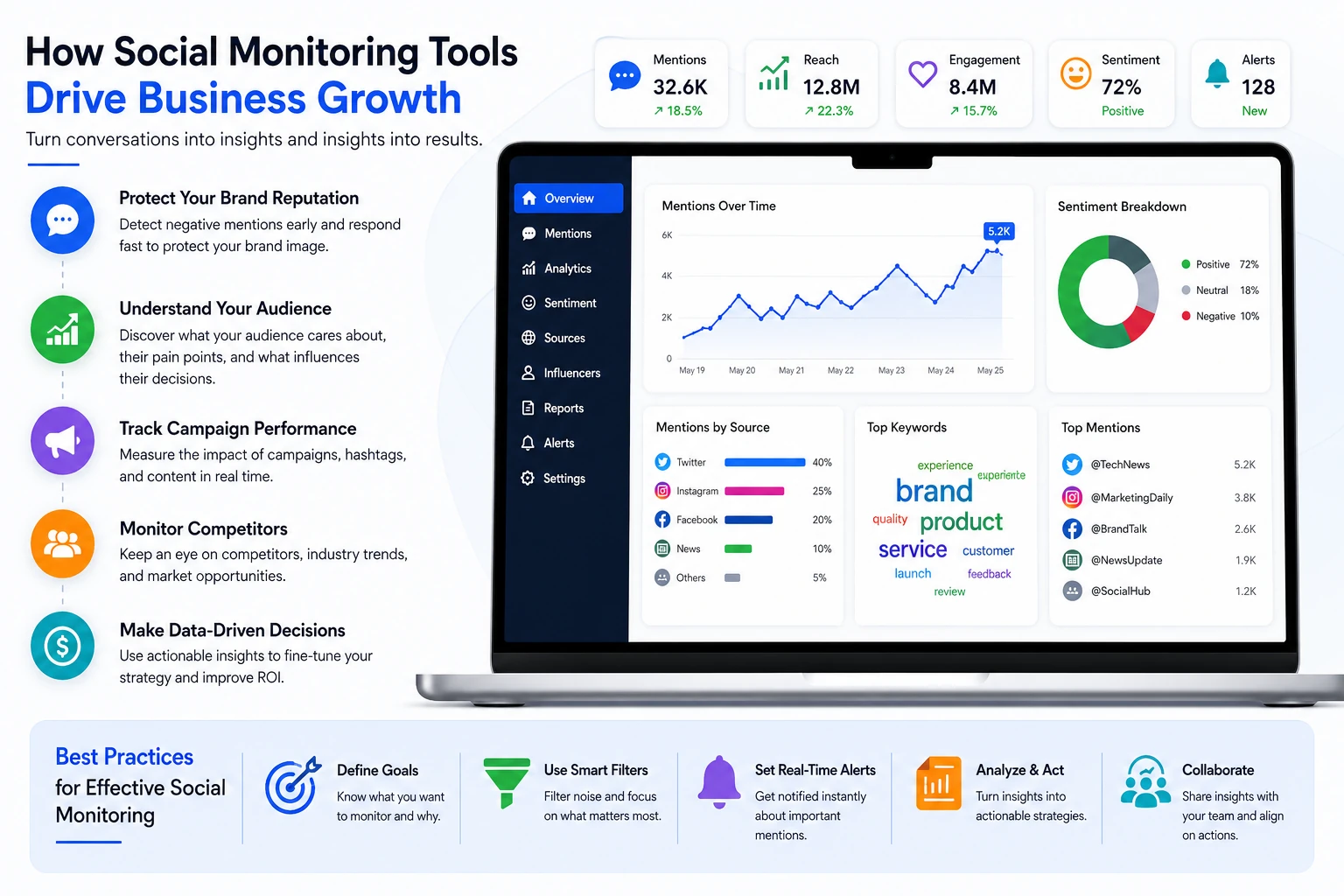
Social monitoring can turn online conversations into useful insights for reputation, customer understanding, campaigns, competitors and business decisions.
Protect Brand Reputation
A customer complaint can spread quickly. Monitoring gives businesses a better opportunity to identify important discussions early and decide whether a response is appropriate.
Understand Customer Needs
Online conversations can reveal repeated questions, frustrations, desired features, purchase barriers and customer language that may never appear in a formal survey.
Track Marketing Campaigns
Monitoring campaigns, slogans, hashtags and product names can provide additional context beyond traditional website and advertising analytics.
Monitor Competitors
Competitor conversations can reveal market gaps, customer dissatisfaction, product strengths, campaign activity and emerging opportunities.
Discover Influencers and Advocates
Monitoring can help identify people and publishers who repeatedly discuss a brand or industry and whose audiences may influence wider conversations.
Improve Content Strategy
Frequently discussed topics, audience questions and recurring language can provide useful inputs for editorial planning.Businesses that want to measure how content performs after publication can also read the XVIFS guide to Content Analytics.
Best Social Monitoring Tools by Business Need
Business Need
Platforms Worth Shortlisting
General brand monitoring
Brand24, Mention, Awario
Enterprise consumer intelligence
Brandwatch, Talkwalker
Social management + monitoring
Sprout Social, Hootsuite
PR and media intelligence
Meltwater
Campaign and hashtag analysis
Keyhole
Budget-conscious monitoring
Awario, Google Alerts as a supplementary tool
Competitive intelligence
Brand24, Brandwatch, Talkwalker
These are starting points rather than universal recommendations. A platform should be selected only after confirming the sources, features, geographic coverage, historical data and workflows your organization actually requires.
How Much Do Social Monitoring Tools Cost?
There is no reliable universal price for Social Monitoring Tools. Vendors use different packaging models, and costs can change based on monitored topics, query volume, users, historical data, number of mentions, source coverage, AI capabilities, exports, API access and support.Common pricing approaches include:
Monthly subscriptions
Tiered plans
Usage or mention limits
Per-user pricing
Additional listening modules
Custom enterprise contracts
Separate API or data access
Do not evaluate price without considering data coverage. A cheaper platform that misses the conversations important to your organization may provide less value than a more expensive system with better coverage and filtering.
Social Monitoring Tools for Small Businesses
A smaller company normally does not need the same monitoring infrastructure as a multinational consumer brand.Small businesses should prioritize these capabilities as part of a wider growth strategy. For additional practical ideas, see our Effective Marketing Strategies for Small Businesses guide.
Easy setup
Brand and competitor alerts
Relevant source coverage
Simple sentiment analysis
Useful reporting
Affordable pricing
Low administrative overhead
Brand24, Awario, Mention or a lightweight monitoring stack may deserve evaluation depending on requirements. Google Alerts can supplement a paid platform but should not be considered a complete social-monitoring replacement.
Social Monitoring Tools for Enterprises
Enterprise monitoring usually involves more than receiving notifications when a brand is mentioned.Larger organizations may require:
Multiple brands and markets
Large-scale data access
Historical analysis
Multilingual monitoring
Advanced sentiment and topic analysis
Audience intelligence
Complex Boolean queries
API access
Team permissions
Executive dashboards
Competitive benchmarking
PR and crisis workflows
Brandwatch, Talkwalker, Meltwater and enterprise configurations of other platforms are more relevant when requirements reach this level.
Social Monitoring Tools for Agencies
Agencies have another important requirement: they must separate and report on multiple clients efficiently.Useful agency features can include:
Multiple projects
Client dashboards
Scheduled reports
Exportable data
Competitive comparisons
Campaign monitoring
Team permissions
White-label or presentation-ready reporting where available
How to Choose the Best Social Monitoring Tool
Step 1: Define What You Need to Monitor
Write down the exact brands, products, competitors, people, topics and campaigns that matter to your business.
Step 2: Identify the Required Sources
Determine whether your audience primarily discusses your industry on social networks, Reddit, forums, news sites, blogs, videos, reviews or other channels.
Step 3: Test Real Queries
Do not rely only on a vendor demonstration. Test your own brand, competitors and industry keywords if a trial or proof of concept is available.
Step 4: Measure Noise
A tool that finds thousands of irrelevant results creates more work rather than less. Test how easily irrelevant mentions can be filtered.
Step 5: Review Alert Quality
Determine whether urgent conversations can be identified quickly without overwhelming the team with unnecessary notifications.
Step 6: Evaluate Reporting
Ask whether the outputs can actually be understood by managers, clients and decision-makers—not only analysts.
Step 7: Calculate Total Cost
Include additional users, projects, data limits, historical access, API requirements, reporting and optional listening modules.
XVIFS Social Monitoring Tool Selection Checklist
Does it monitor the channels important to our audience?
Can it detect untagged brand mentions where supported?
How quickly are new mentions discovered?
Can irrelevant results be filtered effectively?
Does it provide sentiment analysis?
Can we monitor competitors?
Can we track campaign keywords and hashtags?
Does it offer historical data?
Can we create real-time alerts?
Does it support multiple team members?
Are reports understandable and exportable?
Can it integrate with our existing marketing stack?
Does it provide API access if required?
What are the usage limits?
What is the realistic annual cost?
Best Practices for Effective Social Monitoring
Monitor More Than Your Exact Brand Name
Include common misspellings, product names, campaign terms, executive names and relevant branded phrases where appropriate.
Use Negative Keywords and Filters
If your company name is ambiguous, exclusions can dramatically improve monitoring quality.
Create Priority Alerts
Not every mention deserves an immediate notification. Separate high-risk terms, high-influence sources or unusual mention spikes from routine conversations.
Do Not Trust Sentiment Blindly
Automated sentiment is useful for patterns, but sensitive decisions should still include human review.
Connect Monitoring to Action
Monitoring has little value if insights remain inside a dashboard. Decide which team should act on customer issues, product feedback, PR concerns, sales opportunities and competitor insights.
Social Monitoring and Online Advertising
Monitoring data can also improve advertising decisions. Audience conversations can reveal pain points, language, objections and emerging interests that help marketers refine messages and campaign ideas. Businesses using AI across these workflows can also explore our AI Business Solutions guide.For businesses comparing paid distribution channels, our guide to Internet Advertising Platforms explains the major options available to businesses in 2026.
Social Monitoring, AI and the Future of Brand Visibility
Social monitoring is expanding beyond traditional social networks. Businesses increasingly need to understand how their brands appear across search engines, online communities, media sources and AI-generated answers.Some monitoring platforms are already adding AI-assisted analysis, conversational research, anomaly detection and broader AI visibility capabilities.This trend is particularly important because consumers can now discover brands through AI search experiences as well as traditional search and social channels. For a practical workflow, see our How to Track Brand Mentions in AI Search guide.XVIFS will cover this emerging area separately in our guide to tracking brand mentions in AI search so that traditional social monitoring and AI visibility can be treated as connected but distinct marketing disciplines.
Frequently Asked Questions About Social Monitoring Tools
What are social monitoring tools?
Social monitoring tools are platforms that help businesses find and analyze online conversations around brands, products, competitors, campaigns, people or keywords across supported digital sources.
What is the best social monitoring tool?
There is no single best platform for every business. Brand24 can be attractive for accessible brand monitoring, Brandwatch and Talkwalker for enterprise intelligence, Sprout Social and Hootsuite for broader social management workflows, Meltwater for media intelligence, and Keyhole for campaign-focused analysis.
What is the difference between social monitoring and social listening?
Monitoring usually focuses on identifying specific mentions and conversations, while social listening analyzes broader patterns, trends, sentiment and audience behavior to support strategic decisions.
Can social monitoring tools track competitors?
Many platforms allow users to monitor competitor names, products, campaigns or other relevant keywords. The depth of competitive analysis varies by platform and plan.
Do social monitoring tools provide sentiment analysis?
Many modern platforms include automated sentiment analysis. However, sentiment detection is not perfect, so important or ambiguous results should still be reviewed by people.
Are there free social monitoring tools?
Some platforms offer trials or limited free options, and Google Alerts can provide basic web alerts. However, comprehensive monitoring, advanced analytics, sentiment analysis, historical data and enterprise coverage generally require paid software.
Can social monitoring tools prevent a reputation crisis?
No tool can guarantee that a reputation problem will be prevented. Monitoring can help businesses detect relevant conversations earlier, but effective crisis management still requires judgment, communication processes and appropriate action.
How should a small business choose social monitoring software?
Start with the sources you need, the number of brands or competitors you want to monitor, alert requirements, reporting needs and budget. Test real queries before committing to a long-term plan.
Final Verdict: Which Social Monitoring Tool Should You Choose?
The best Social Monitoring Tools are the ones that reliably capture the conversations important to your organization and make those conversations easier to understand and act upon.Small and growing businesses should generally prioritize ease of use, relevant source coverage, alerts, sentiment analysis and affordable reporting. Agencies should look closely at project management, client reporting and campaign tracking. Enterprises need deeper data coverage, advanced filtering, historical analysis, integrations, multilingual support, competitive intelligence and governance.Do not make a final decision from a feature comparison alone. Shortlist two or three platforms, test them using your actual brand and competitor keywords, compare the quality of the results, examine how much irrelevant noise they produce, and calculate the full annual cost.When implemented properly, social monitoring turns online conversations from background noise into a practical source of customer intelligence, reputation awareness, competitive insight and better marketing decisions.XVIFS Editorial Note: Social monitoring platforms change frequently because of product updates, social-network API policies, data licensing and new AI capabilities. Product references in this guide are intended to help businesses build a shortlist. Verify critical capabilities, source coverage, availability and current pricing directly with each provider before purchasing.
XVIFS helps businesses, marketers, creators, and entrepreneurs discover practical AI tools, SaaS platforms, automation solutions, and digital marketing strategies. Explore our tutorials, software reviews, comparisons, and step-by-step guides designed to help you work smarter, automate faster, and grow your business online.