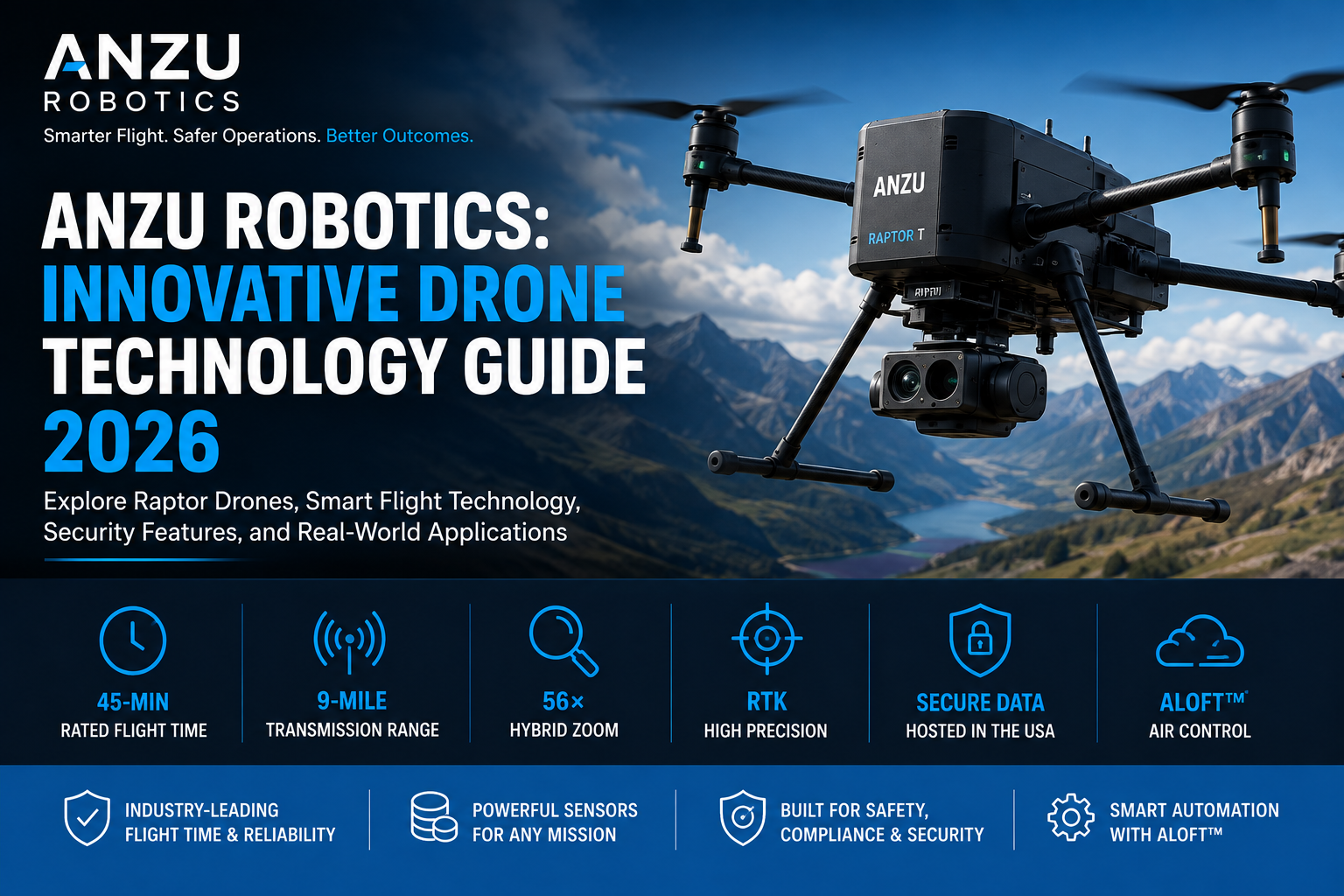
Anzu Robotics has become a notable name in commercial drone technology by combining professional aerial hardware, secure software, and practical tools for mapping, inspection, public safety, thermal imaging, and other business operations. The company is American-owned and headquartered in Austin, Texas, while nearly all components and final assembly of its Raptor-series drones are completed in Malaysia.
Its two flagship platforms, the Raptor and Raptor T, were introduced in 2024 and are designed for professional users who want long flight times, strong imaging capabilities, RTK positioning options, Remote ID support, and a software environment powered by Aloft Air Control.
In this 2026 guide, we explain how Anzu Robotics positions its Raptor-series drones, what separates the Raptor from the Raptor T, how data security works, where the drones are commonly used, and what businesses should understand about compliance before buying.
For businesses exploring automation more broadly, you can also read our AI tools for small businesses guide and our Make.com tutorial for beginners to see how software automation can complement physical automation.
What Is Anzu Robotics?
Anzu Robotics describes itself as an American-owned and operated commercial drone manufacturer headquartered in Austin, Texas. According to the company’s official FAQ, its Raptor-series drone hardware is manufactured and assembled primarily in Malaysia, then sent to the United States for firmware installation and quality-control procedures.
The company’s strategy combines licensed aerial technology with its own business operations, software partnerships, security approach, dealer network, support services, and product development. Its software relationship with Aloft is particularly important because Aloft Air Control supports flight operations, data storage, approvals, team workflows, and optional enterprise capabilities.
Anzu Raptor vs Raptor T: Key Differences
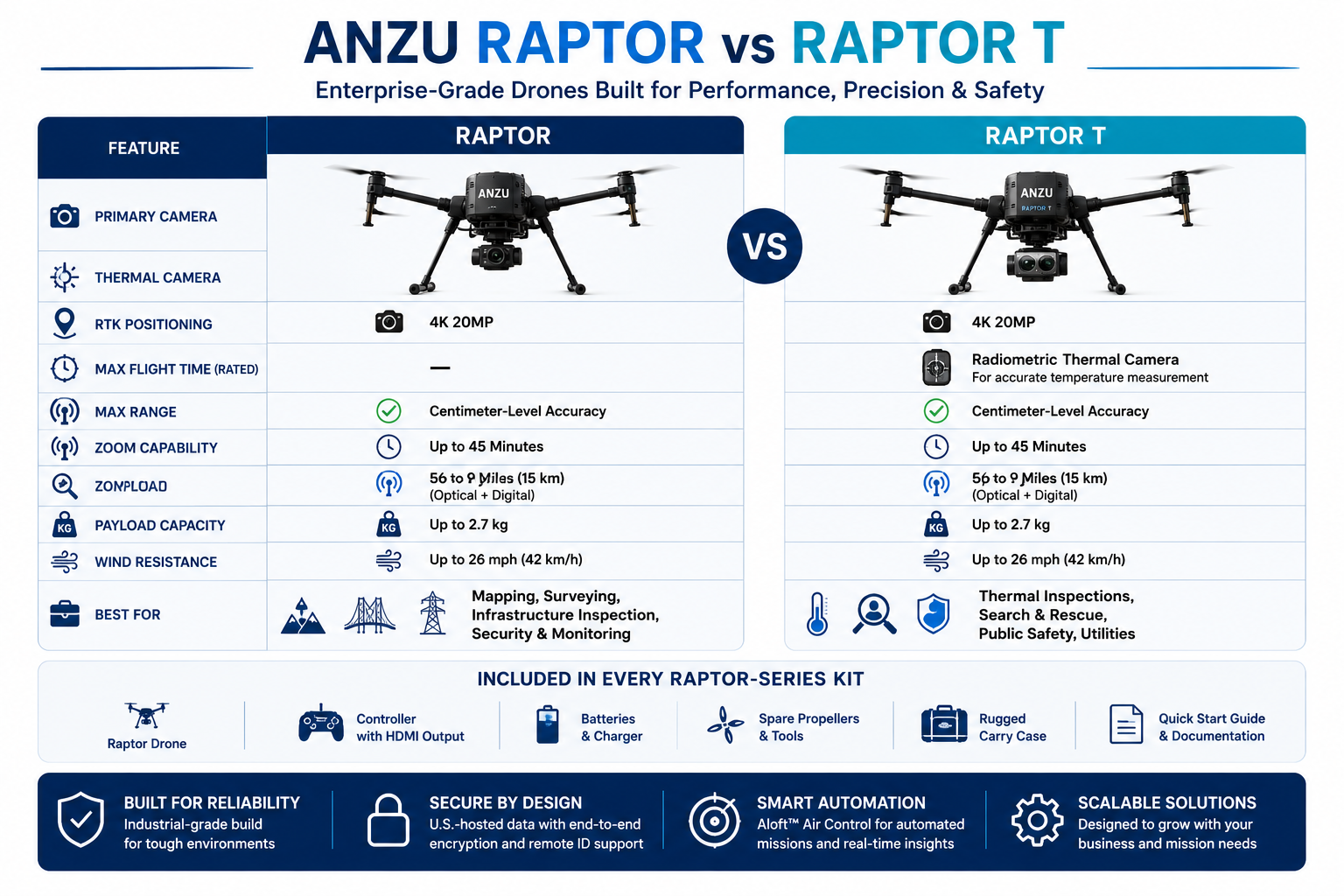
The Raptor and Raptor T share much of the same core flight platform. Both are rated for up to 45 minutes of flight time per fully charged battery, although real-world flight time varies with weather, altitude, payload, temperature, battery condition, and flight style.
The major difference is the payload. The standard Raptor is aimed at high-quality visual data capture, mapping, surveying, inspection, and general commercial work. The Raptor T adds a 640×512 LWIR thermal sensor and radiometric functionality, allowing temperature measurement at the pixel level in compatible radiometric file types.
| Feature | Anzu Raptor | Anzu Raptor T |
|---|---|---|
| Primary Use | Mapping, surveying, inspection, visual data capture | Thermal inspection, public safety, search and rescue, utilities |
| Rated Flight Time | Up to 45 minutes | Up to 45 minutes |
| Wind Resistance | Rated up to 26 mph | Rated up to 26 mph |
| RTK Accessory | Available | Available |
| Thermal Sensor | No dedicated thermal payload | 640×512 LWIR radiometric sensor |
| Remote ID | Supported | Supported |
| Controller HDMI Output | Yes | Yes |
Raptor-Series Flight Performance and Portability
The Raptor-series drones are relatively compact commercial platforms. Anzu lists the Raptor at approximately 915 g and the Raptor T at approximately 920 g. Both are rated for wind resistance up to 26 mph, which can be useful for professional work where conditions are not always perfectly calm.
The gimbal’s controllable tilt range extends from -90° to 35°, allowing operators to capture downward-facing imagery as well as elevated inspection angles. The controller also includes HDMI output, which can be useful when a team needs to display the live feed on a larger screen.
RTK Positioning and Mapping Workflows
Anzu Robotics offers an RTK module as an accessory for the Raptor and Raptor T. RTK can improve positioning accuracy for professional data-acquisition workflows such as mapping, surveying, asset inspection, construction documentation, and repeatable missions.
Anzu also states that the Raptor-series payloads are suitable for photogrammetry. Businesses using drones for mapping should still evaluate their complete workflow—including mission planning, ground control requirements, processing software, accuracy targets, and regulatory obligations—rather than judging performance from the aircraft specification alone.
How Anzu Robotics Drones Are Used in Business
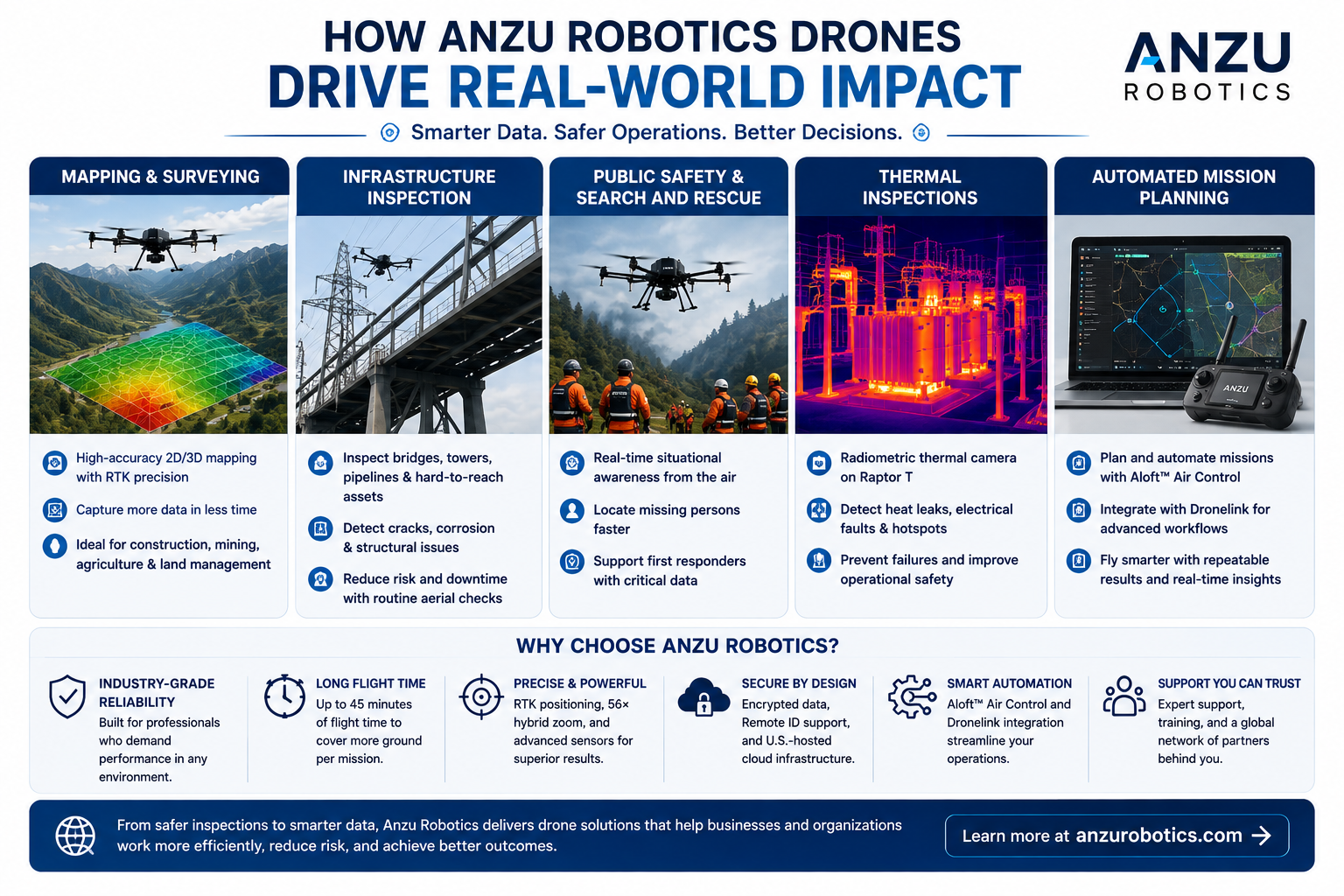
Mapping and Surveying
Mapping teams can use aerial imagery for construction progress, land surveys, site documentation, mining, agriculture, and other geospatial workflows. Adding RTK can improve positioning for projects that require more precise and repeatable data collection.
Infrastructure Inspection
Commercial drones can reduce the need for people to access difficult or hazardous locations during visual inspections. Bridges, towers, rooftops, utility assets, industrial facilities, and other infrastructure can often be reviewed from the air before a closer physical inspection is required.
Public Safety and Search and Rescue
The Raptor T’s thermal capability can be useful in public-safety and search-and-rescue scenarios where teams need aerial situational awareness or thermal information. Operators remain responsible for aviation regulations, flight permissions, operating procedures, and mission-specific safety requirements.
Thermal Inspections
Because the Raptor T is radiometric, it can capture thermal information that supports inspection workflows involving temperature differences. Potential applications include electrical systems, utilities, building envelopes, roofs, solar installations, and other assets where heat patterns can help identify areas requiring further investigation.
Automated Mission Planning
Third-party automation can extend the Raptor ecosystem. Dronelink officially supports the Anzu Raptor and Raptor T for virtual-stick mission types such as mapping, waypoints, orbits, facades, inspections, panoramas, and other automated workflows, subject to its documented setup requirements and limitations.
Aloft Air Control and the Anzu Software Ecosystem
The software side of the platform is built around a strategic partnership with Aloft. Anzu’s official FAQ explains that Aloft develops the Air Control app used for drone operation, data storage, and additional enterprise features.
Optional enterprise Air Control functionality can include team coordination, workflow tools, reporting, live streaming, waivers and COA-related information, and other fleet-management features. Not every business needs those capabilities, so organizations should compare the standard and enterprise options before purchasing subscriptions.
Data Security and U.S.-Based Hosting
Data security is one of the main areas Anzu Robotics emphasizes in its product positioning. According to Anzu, media captured by the aircraft is stored on the drone’s onboard SD card, while flight-log and software services are supported through Aloft infrastructure.
Anzu states that the servers used through Aloft are based in the United States and that customer information is not provided to third parties unless the drone owner explicitly transfers it. The company also states that Aloft holds ISO 27001 and SOC 2 Type II certifications.
Organizations with strict security requirements should still conduct their own vendor assessment, review contractual terms, confirm current software architecture, and verify whether the platform meets their internal cybersecurity and data-governance policies.
Remote ID, NDAA and Compliance Considerations
Compliance requires careful wording. According to the official Anzu Robotics FAQ, both the Raptor and Raptor T are Remote ID compliant.
However, businesses should not automatically describe the Raptor series as NDAA compliant. Anzu states that the Raptor T thermal sensor is sourced from China and acknowledges that this component may fall outside NDAA parameters. The company also explains that the Raptor-series drones are currently not Blue UAS certified.
This distinction can matter significantly for government-funded organizations, public-sector procurement, regulated industries, and contractors working under specific sourcing rules. Buyers should verify current eligibility requirements with the relevant procurement or compliance team before purchasing.
What Is Included with a Raptor-Series Drone?
Anzu says a new Raptor-series package includes the aircraft with the applicable payload, a controller with built-in screen, a flight battery, charging station, propellers, manuals, and a hard case with custom foam inserts.
Available accessories include the RTK module and a loudspeaker. The correct package for a business depends on whether the mission requires precision positioning, public-address functionality, thermal capability, additional batteries, or specialized software.
Anzu Care, Warranty and Support
New Anzu drones include one year of Anzu Care protection according to the company’s current FAQ. The program is designed to support accidental-damage situations, while the standard warranty period for new Raptor-series drones is also listed as one year from the purchase date.
Owners should register the aircraft and keep proof of purchase if they want to make a warranty claim. Service is handled through certified resources in the drone ecosystem, with Anzu retaining responsibility for customer satisfaction related to service work.
Who Should Consider Anzu Robotics?
- Surveying and mapping teams that need a compact commercial platform with RTK capability.
- Infrastructure operators conducting recurring visual or thermal inspections.
- Public-safety organizations evaluating thermal aerial tools for situational awareness.
- Utilities and industrial teams that need radiometric thermal inspection capability.
- Commercial drone service providers that want a professional platform with U.S.-hosted software infrastructure.
- Organizations using automated missions that want third-party mission-planning support such as Dronelink.
What Businesses Should Check Before Buying
- Mission requirements: decide whether you need standard visual imaging, thermal imaging, RTK, or automated mission planning.
- Regulatory requirements: confirm local aviation rules, pilot certification, Remote ID obligations, and procurement restrictions.
- NDAA or sourcing rules: verify whether your organization has restrictions that affect Raptor-series eligibility.
- Software requirements: determine whether standard Air Control is sufficient or enterprise features are required.
- Workflow integration: evaluate how drone data will move into GIS, inspection, reporting, asset-management, or automation systems.
- Support and service: confirm local dealer availability, repair turnaround, warranty coverage, and replacement options.
Anzu Robotics and the Bigger Automation Trend
Commercial drones are increasingly part of a larger automation stack. The aircraft captures information, software processes and distributes that information, and business automation can move the resulting data into reports, CRMs, spreadsheets, notifications, or other systems. As drones and robotics become more intelligent, Edge AI for real-time analytics can also help process sensor, camera, and operational data closer to where it is generated, supporting faster automated decisions without sending every raw data stream to the cloud first.
If your organization is building automated workflows around business data, our Make.com beginner guide explains the foundations of no-code automation. Companies focused on broader AI adoption can also explore our AI tools for small businesses, AI sales tools guide, and AI customer support tools comparison.
Frequently Asked Questions About Anzu Robotics
Is Anzu Robotics an American company?
Yes. Anzu states that it is American-owned and operated and is headquartered in Austin, Texas. Its Raptor-series hardware is primarily manufactured and assembled in Malaysia.
How long can the Anzu Raptor fly?
The Raptor and Raptor T are rated for up to 45 minutes per fully charged battery. Actual flight time can be lower depending on environmental conditions, altitude, temperature, wind, payload, and operating style.
What is the difference between Raptor and Raptor T?
The biggest difference is thermal imaging. The Raptor T includes a 640×512 LWIR thermal sensor and supports radiometric temperature measurement, making it more suitable for thermal inspection, public safety, utilities, and search-and-rescue workflows.
Are Anzu Raptor drones Remote ID compliant?
Yes. Anzu’s official FAQ states that both the Raptor and Raptor T include Remote ID and are compliant with that requirement.
Are Anzu Raptor drones NDAA compliant?
Businesses should not assume that they are. Anzu says the Raptor T thermal sensor is sourced from China and may fall outside NDAA parameters. Organizations subject to NDAA or other procurement rules should verify eligibility before purchasing.
Does Anzu Robotics store data in the United States?
Anzu states that the servers used through its Aloft software partnership are based in the United States. Captured images and video are stored on the aircraft’s onboard SD card until the operator transfers them.
Can Dronelink automate Anzu Raptor missions?
Yes. Dronelink currently documents support for the Raptor and Raptor T and supports multiple virtual-stick mission types. Users should review Dronelink’s current support notes because some payload and thermal functions have limitations.
Final Verdict: Is Anzu Robotics Worth Considering in 2026?
Anzu Robotics offers an interesting commercial-drone option for organizations that value professional imaging, RTK capability, thermal inspection options, Remote ID support, U.S.-based software infrastructure, and compatibility with a growing mission-planning ecosystem.
The Raptor is the more straightforward choice for mapping, surveying, visual inspections, and general commercial operations, while the Raptor T adds radiometric thermal capability for organizations that need temperature-based inspection or public-safety workflows.
The most important consideration is procurement fit. The platform’s security approach and U.S.-hosted software may appeal to many commercial users, but organizations subject to NDAA, Blue UAS, or other sourcing requirements must verify compliance rather than relying on broad marketing assumptions.
For the latest specifications, purchasing information, software changes, and compliance statements, always confirm details directly with Anzu Robotics before making a purchasing decision.
Editor’s note: Drone specifications, software features, integrations, regulations, and compliance requirements can change. This guide is designed for informational purposes and should not replace official product documentation, aviation regulations, procurement guidance, or professional compliance advice.