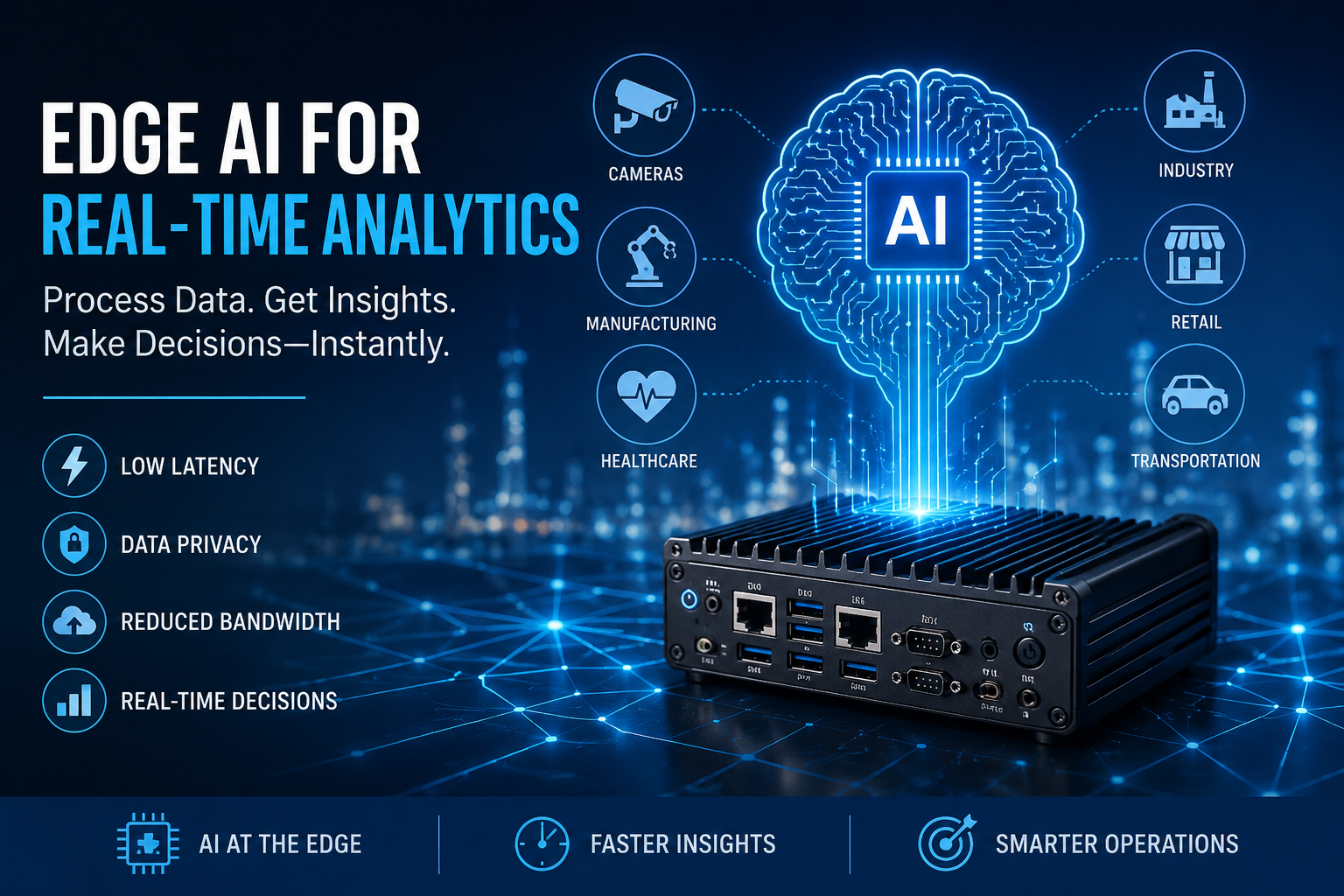
Edge AI for real-time analytics is changing how businesses turn live data into immediate decisions. Instead of sending every camera frame, sensor reading or machine signal to a distant cloud data center, Edge AI processes important data close to where it is created. That can reduce delay, lower network usage and allow systems to respond even when connectivity is limited.
The idea is simple but powerful: place AI inference close to the physical world. A camera can identify a defect on a production line, an industrial sensor can flag abnormal equipment behavior, a retail system can analyze activity inside a store, or a vehicle can react to changing road conditions without waiting for a round trip to the cloud.
This does not mean the cloud disappears. In many real deployments, the cloud and edge work together. The cloud remains useful for large-scale model training, long-term storage, fleet management and historical analytics, while the edge handles time-sensitive inference and local decisions.
In this guide, XVIFS explains how Edge AI for real-time analytics works, why organizations use it, the architecture behind it, important industry use cases, how it compares with cloud AI, what hardware and software are required, the main risks, and how to plan a practical implementation in 2026.
Quick answer: Edge AI is most valuable when data must be analyzed quickly, continuously or privately near its source. It is especially useful for manufacturing, healthcare, retail, transportation, smart infrastructure, energy and other environments where waiting for cloud processing can create delay, cost or operational risk.
Editorial note: XVIFS based this guide on current public documentation from technology providers and industry implementation resources. Exact performance, latency, cost and ROI depend heavily on hardware, models, network conditions and deployment design, so avoid treating generic benchmark numbers as guarantees.
What Is Edge AI for Real-Time Analytics?
Edge AI for real-time analytics combines artificial intelligence with edge computing so that data can be analyzed near the location where it is generated.
Traditional cloud AI often follows this pattern:
Device → Network → Cloud → AI processing → Result → Device
An edge AI system can shorten that loop:
Device → Local edge processor → AI inference → Immediate result
Selected information can still be sent to the cloud afterward for storage, reporting, model improvement or centralized management.
According to Dell Technologies, Edge AI processes data where it is created to reduce latency and speed up decisions. Dell also describes a hybrid architecture in which models can be trained or retrained in the cloud and then deployed locally for inference.
IBM’s Edge AI overview similarly highlights lower latency, reduced bandwidth usage, real-time processing and stronger data privacy as major benefits of running AI close to the data source.
How Edge AI for Real-Time Analytics Works
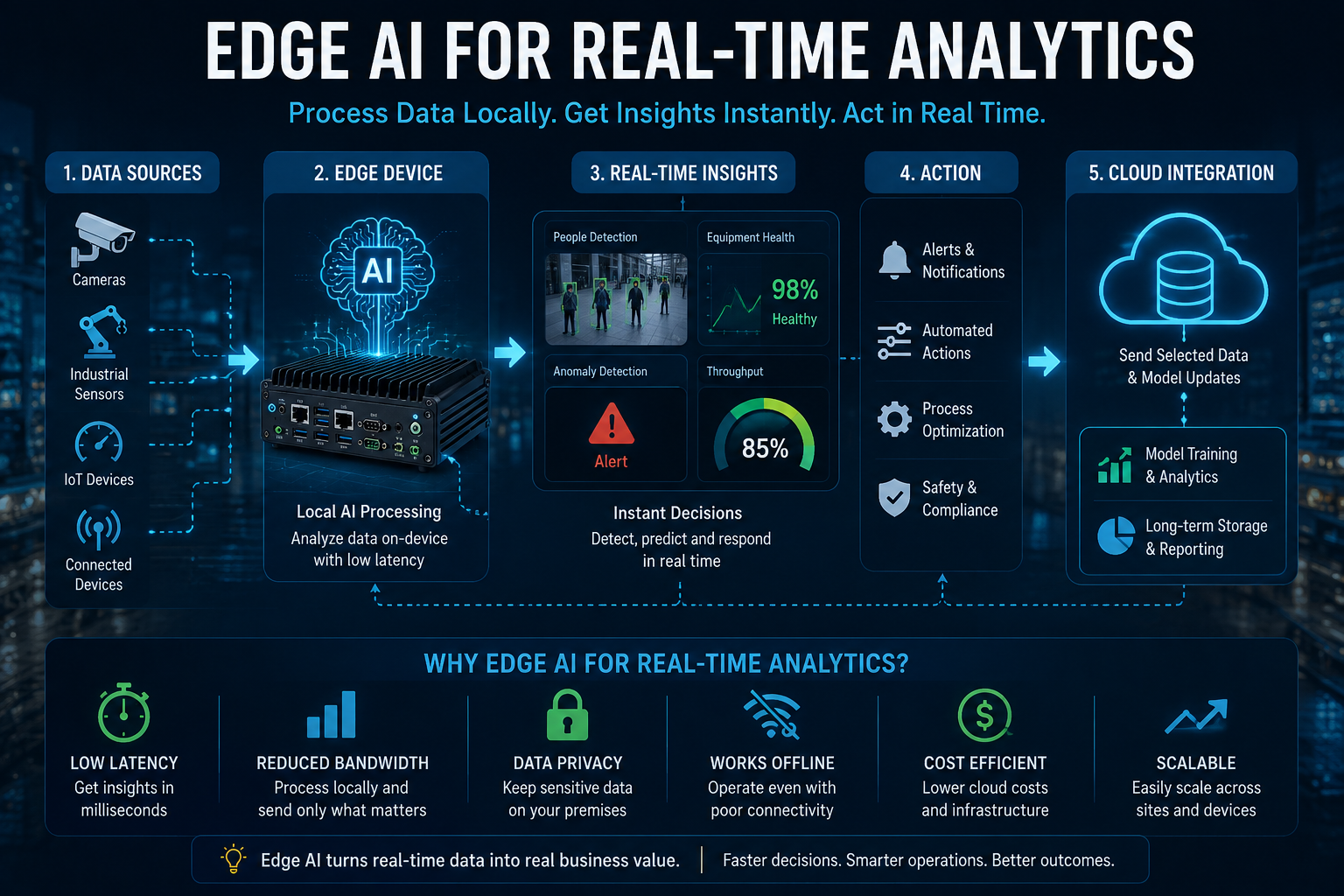
A practical Edge AI for real-time analytics pipeline usually contains five stages.
1. Data Is Generated at the Edge
The process begins with physical or digital data sources. In many deployments, those connected sensors, cameras, gateways and machines form part of a wider IoT environment. For a deeper explanation of how these devices communicate and exchange data, see our guide to what an IoT network is.
These can include:
- industrial sensors;
- security and inspection cameras;
- IoT devices;
- medical devices;
- vehicles and transportation systems;
- retail cameras and scanners;
- energy equipment;
- robotics;
- environmental sensors;
- connected machinery.
Many of these sources produce continuous data streams. Sending every raw signal to the cloud can consume bandwidth and introduce unnecessary delay.
2. An Edge Device Processes the Data
A local computer, gateway, embedded processor or industrial edge server receives the data. Depending on the workload, this system may use CPUs, GPUs, NPUs or other accelerators designed for AI inference.
The device can preprocess incoming data before inference. For example, a vision system may resize images, remove irrelevant frames or isolate regions of interest before sending them into a machine-learning model.
3. The AI Model Runs Inference Locally
Inference is the stage where a trained AI model analyzes new data and produces a prediction, classification or decision.
Examples include:
- identifying a defective product;
- detecting unusual vibration in a motor;
- recognizing a safety hazard;
- classifying objects in a camera feed;
- predicting equipment failure;
- detecting abnormal patient signals;
- identifying traffic conditions;
- estimating inventory or customer movement.
Because inference happens locally, the system does not need to wait for a remote cloud server before producing the initial result.
4. The System Takes or Recommends an Action
Real-time analytics becomes valuable when insights lead to action.
The system may:
- send an alert;
- stop a machine;
- flag an item for inspection;
- adjust a process parameter;
- notify an operator;
- change traffic signaling;
- trigger a maintenance workflow;
- record an event for later analysis.
Microsoft’s current Edge AI implementation scenarios include real-time digital inspection, predictive maintenance and operational monitoring with local data-stream processing, edge inference, dashboards and automated alerts. Microsoft’s Edge AI scenario documentation provides useful examples of how these capabilities fit into industrial deployments.
5. Selected Data Goes to the Cloud
Edge AI is often part of a hybrid system rather than a completely isolated one.
The cloud can still handle:
- model training and retraining;
- long-term storage;
- fleet-wide reporting;
- historical analytics;
- centralized policy management;
- software and model distribution;
- large-scale data science;
- cross-site comparisons.
This division of work lets organizations keep time-sensitive inference close to operations while using cloud infrastructure for tasks that benefit from centralized scale.
Why Edge AI for Real-Time Analytics Matters
Lower Latency
One of the biggest advantages of Edge AI for real-time analytics is the ability to reduce the delay between data creation and response.
A system controlling equipment, monitoring a patient or detecting a road hazard may not have the luxury of waiting for data to travel to a remote region and back. Local processing shortens the path between observation and action.
Dell’s June 2026 discussion of Edge AI describes cloud-only processing as a potential bottleneck for time-sensitive AI and argues for a hybrid model where real-time inference happens locally while heavier training remains centralized.
Reduced Bandwidth Usage
High-resolution video and continuous sensor streams can create enormous amounts of data. Edge processing allows a system to analyze the stream locally and transmit only what matters.
Instead of uploading hours of raw footage, for example, a system might send only detected events, summarized metrics, selected images or anomaly records.
Improved Data Privacy
Keeping data closer to where it is generated can reduce how much sensitive information needs to cross public or wide-area networks.
This can be especially relevant for healthcare, industrial facilities, stores, workplaces and other environments handling sensitive operational or personal information.
Local processing does not automatically make a deployment secure, however. Edge devices still require access control, encryption, secure updates, physical protection and careful lifecycle management.
Operation With Limited Connectivity
Factories, mines, remote energy sites, vehicles and rural facilities cannot always rely on perfect internet connectivity.
Edge AI can continue performing local inference even when the cloud connection is slow or temporarily unavailable, provided the local application has been designed for offline operation.
Faster Operational Feedback
Real-time analytics can turn AI from a reporting tool into an operational system.
Instead of discovering a production problem in tomorrow’s dashboard, an organization can potentially detect the issue while it is happening and respond immediately.
Edge AI for Real-Time Analytics Use Cases
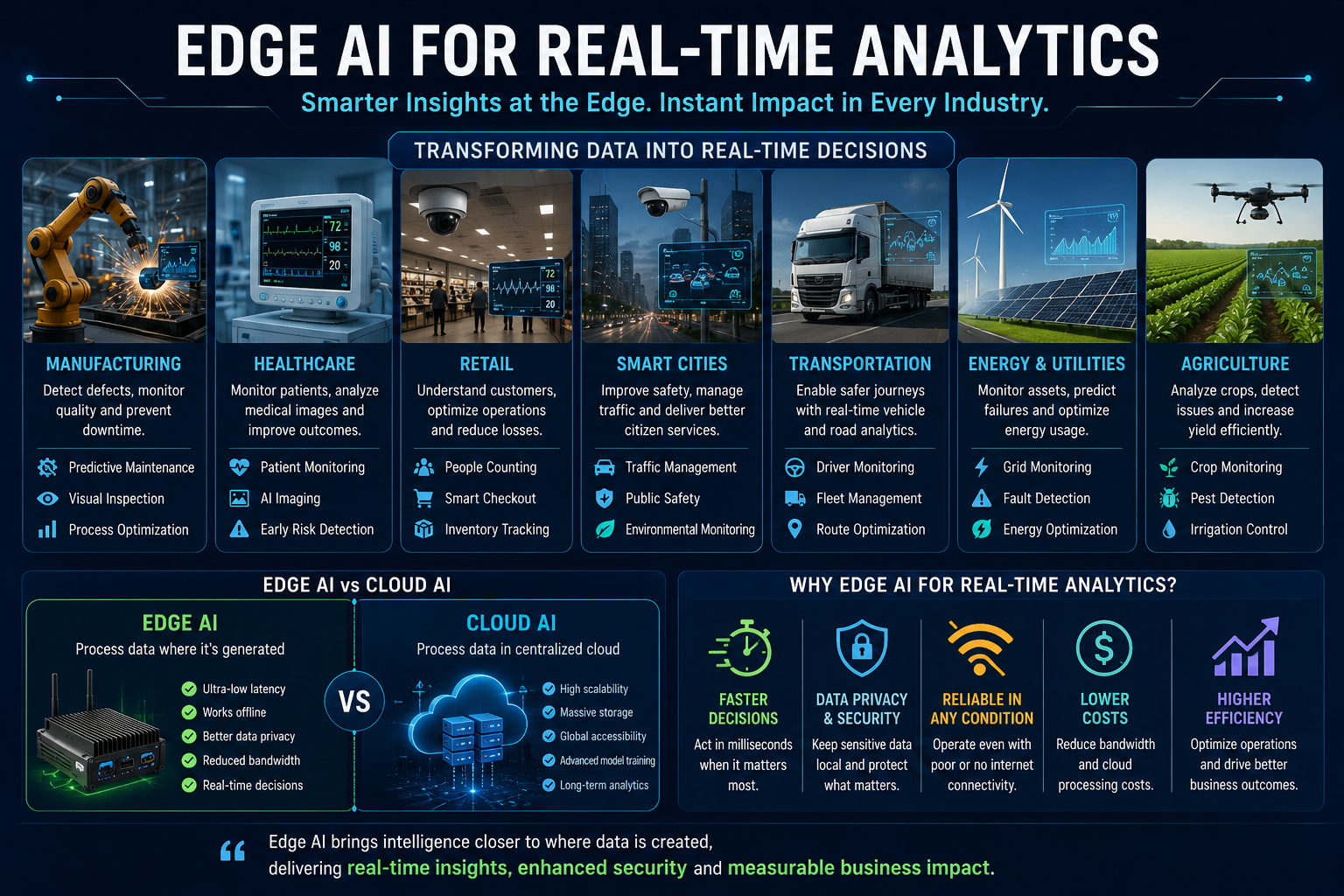
Manufacturing and Quality Inspection
Manufacturing is one of the clearest applications of Edge AI for real-time analytics.
Computer-vision systems can inspect products as they move through a production line, while sensor-based models can monitor machinery for unusual conditions. The key advantage is that the result can be used immediately rather than after production has moved on.
Microsoft’s digital inspection scenario describes automated quality workflows using computer vision, sensor fusion and edge inference with immediate feedback loops. Its predictive-maintenance scenario combines real-time sensor processing, machine-learning models, dashboards and automated maintenance alerts.
Typical applications include:
- visual defect detection;
- predictive maintenance;
- equipment-health monitoring;
- worker safety;
- process optimization;
- robotics;
- quality control.
Healthcare and Medical Devices
Healthcare edge AI can process medical data close to the patient or clinical device.
Potential applications include medical imaging, patient monitoring, surgical systems and intelligent diagnostic devices where fast analysis is valuable.
NVIDIA’s IGX platform is specifically positioned for industrial, robotics and medical edge environments. NVIDIA also documents use of its Holoscan and IGX platforms in real-time AI-assisted medical devices.
Healthcare deployments require particularly careful validation, security and regulatory compliance. Edge AI should support—not bypass—clinical and safety requirements.
Retail
Retail environments generate live data from cameras, checkout systems, shelves and customer interactions.
Edge AI can support:
- people counting;
- queue monitoring;
- inventory visibility;
- loss prevention;
- smart checkout;
- in-store personalization;
- operational monitoring.
Local processing is useful because high-volume video does not always need to leave the store to deliver immediate operational insight.
Smart Cities and Public Infrastructure
Cities generate continuous streams from traffic cameras, environmental sensors, public infrastructure and transportation systems.
Edge AI can analyze data close to intersections, transit systems or infrastructure assets to support faster local decisions while sending summarized information to central systems.
Applications include traffic monitoring, incident detection, environmental monitoring and infrastructure inspection.
Transportation and Logistics
Vehicles and logistics environments often require decisions while moving through changing conditions.
Examples include:
- driver monitoring;
- fleet analytics;
- route and traffic analysis;
- warehouse robotics;
- vehicle safety systems;
- asset tracking;
- local anomaly detection.
These environments illustrate why local inference matters: a time-sensitive safety decision should not depend entirely on a stable cloud connection.
Energy and Utilities
Energy infrastructure is distributed across power generation, substations, renewable systems, pipelines and remote equipment.
Edge analytics can support:
- fault detection;
- asset-health monitoring;
- predictive maintenance;
- grid monitoring;
- energy optimization;
- remote-site analytics.
Processing data near equipment can be useful where connectivity is constrained or operational response needs to happen quickly.
Agriculture
Edge AI can also bring intelligence to farms and agricultural equipment.
Connected cameras, drones and sensors can support crop monitoring, irrigation decisions, pest detection, equipment monitoring and local environmental analysis without requiring every raw data stream to be continuously uploaded.
Edge AI vs Cloud AI
The question is not whether Edge AI is universally better than cloud AI. Each architecture is suited to different workloads.
| Factor | Edge AI | Cloud AI |
|---|---|---|
| Processing Location | Near the device or data source | Centralized data center or cloud region |
| Latency | Usually lower for local inference | Depends on network and cloud round trip |
| Bandwidth | Can reduce raw-data transmission | Often requires more data transfer |
| Connectivity | Can support offline or limited-connectivity operation | Generally depends more heavily on network availability |
| Compute Scale | Limited by local hardware | Can access large centralized compute resources |
| Model Training | Possible for some workloads, but usually constrained | Well suited to large-scale model training |
| Long-Term Storage | Usually limited | Well suited to centralized historical storage |
| Data Locality | More data can remain near its source | Data generally moves to remote infrastructure |
IBM’s current comparison of Edge AI vs Cloud AI makes the same basic distinction: edge systems prioritize local processing, lower latency and bandwidth efficiency, while cloud systems provide greater centralized computational capacity.
For many organizations, the best architecture is therefore hybrid.
A Practical Edge AI Architecture
A production deployment can be thought of as several layers.
Data Layer
Cameras, sensors, PLCs, medical devices, vehicles or IoT endpoints generate data.
Connectivity Layer
Protocols and networks transport information from devices to local compute. Industrial deployments may involve specialized protocols in addition to Ethernet, Wi-Fi or cellular connectivity.
Edge Compute Layer
Local gateways, embedded systems or edge servers run applications and machine-learning inference.
Application Layer
Business logic turns model output into dashboards, alerts, actions or integrations with operational systems.
Cloud and Management Layer
Central systems can handle model training, software distribution, observability, long-term storage, fleet management and analytics across multiple locations.
This layered architecture helps explain why Edge AI is more than simply installing a model on a small computer. The real system also needs device management, networking, security, monitoring and an operational workflow around the AI output.
Hardware Requirements for Edge AI
The right hardware depends on the workload.
A simple anomaly-detection model running on sensor data may require far less compute than a system processing multiple high-resolution video streams.
Common hardware considerations include:
- CPU performance;
- GPU or AI accelerator capability;
- memory;
- local storage;
- camera and sensor interfaces;
- power consumption;
- thermal design;
- environmental ruggedness;
- network connectivity;
- physical size;
- security features.
Dell notes that edge hardware often needs specialized designs because remote, industrial or store environments have different size, power and durability requirements from traditional data centers.
NVIDIA’s industrial-grade IGX platform similarly emphasizes high-bandwidth sensor processing, AI compute, security and reliability for industrial, robotics and medical applications.
Software Requirements for Edge AI
Hardware alone does not create a useful Edge AI for real-time analytics system.
Software capabilities may include:
- device drivers;
- data ingestion;
- stream processing;
- AI inference runtimes;
- containers;
- model management;
- dashboards;
- alerting;
- APIs;
- observability;
- remote updates;
- security monitoring.
Production teams also need a reliable method for deploying new models and rolling back changes when necessary.
Edge AI Security and Privacy Challenges
Local processing can reduce unnecessary data movement, but edge systems introduce their own security challenges.
Unlike a centralized data center, edge devices can be spread across factories, stores, vehicles and remote locations. Some may be physically accessible to people outside the IT team.
Important controls include:
- device identity and authentication;
- encrypted data at rest and in transit;
- secure boot;
- signed software and model updates;
- least-privilege access;
- physical protection;
- remote patching;
- network segmentation;
- monitoring and logging;
- data-retention policies.
Organizations should also determine what data truly needs to leave the edge and what should remain local.
Model Drift and Edge AI Maintenance
AI models are not permanent.
Changes in equipment, lighting, camera position, customer behavior, product design or environmental conditions can gradually reduce model accuracy. This is commonly called model drift or data drift.
A robust deployment should therefore monitor:
- model confidence;
- error rates;
- false positives and false negatives;
- changes in input data;
- device health;
- inference performance;
- software versions.
Selected edge data can be sent to centralized systems to support retraining and validation before updated models are redeployed.
How to Implement Edge AI for Real-Time Analytics
Step 1: Start With a Business Decision
Do not begin by buying an edge GPU.
Begin with the decision that needs to happen faster.
Examples:
- Should this product be rejected?
- Does this machine require attention?
- Is this situation unsafe?
- Is inventory running low?
- Is an asset behaving abnormally?
Step 2: Identify the Data Source
Determine which cameras, sensors or systems contain the information needed to make the decision.
Step 3: Define the Response-Time Requirement
Not every workload requires real-time inference.
If a report can wait an hour, cloud processing may be perfectly adequate. Edge AI becomes more compelling when the value of the system depends on immediate or near-immediate response.
Step 4: Build a Small Proof of Concept
Start with one machine, one camera, one production line or one clearly defined site.
Microsoft’s current Edge AI planning framework repeatedly uses phased implementations—from proof of concept to proof of value, production and scale—which is a sensible approach for reducing deployment risk.
Step 5: Measure Business Outcomes
Do not measure only model accuracy.
Track business metrics such as:
- downtime;
- defect rate;
- inspection time;
- response time;
- network usage;
- manual labor saved;
- maintenance cost;
- operational throughput.
Step 6: Design the Cloud-Edge Relationship
Decide what stays local, what goes to the cloud, how models are updated and how historical information is stored.
Step 7: Build for Fleet Management
A prototype with one edge device is very different from managing hundreds or thousands of devices.
Production architecture needs remote updates, monitoring, configuration management and recovery procedures.
Common Edge AI Implementation Mistakes
Using Edge AI When Cloud Analytics Is Enough
Edge architecture adds hardware and operational complexity. If latency, bandwidth, privacy or connectivity are not meaningful problems, centralized processing may be simpler.
Ignoring Data Quality
Real-time inference cannot compensate for unreliable sensors, poor camera positioning or inconsistent data.
Buying Hardware Before Validating the Use Case
Hardware selection should follow workload requirements, not precede them.
Ignoring Model Lifecycle Management
A model that works during a pilot still needs monitoring, retraining and controlled deployment in production.
Forgetting Physical Security
Edge systems may operate outside traditional server rooms. Physical access and environmental conditions matter.
Sending Everything to the Cloud Anyway
If an organization processes locally but still uploads every raw data stream, it may lose much of the bandwidth and data-locality advantage.
Edge AI Costs and ROI
There is no universal cost for Edge AI for real-time analytics.
Total cost can include:
- edge hardware;
- sensors and cameras;
- AI accelerators;
- networking;
- model development;
- integration;
- cloud services;
- software licensing;
- maintenance;
- security;
- device management;
- staff training.
ROI should be measured against a specific business outcome, such as avoiding downtime, reducing scrap, accelerating inspection, lowering network costs or improving safety.
Be cautious with generic claims promising a fixed percentage of bandwidth savings, downtime reduction or ROI. Results depend on the workload and deployment environment.
Who Should Consider Edge AI?
Edge AI for real-time analytics is worth investigating when one or more of these conditions apply:
- decisions need to happen quickly;
- large amounts of streaming data are generated locally;
- connectivity is limited or unreliable;
- data should remain on premises where possible;
- operations need to continue without the cloud;
- many cameras or sensors generate continuous data;
- local automation can create measurable business value.
Businesses that are still exploring broader AI adoption may also find our guides to the best AI tools in 2026 and AI tools for small businesses useful for understanding where specialized Edge AI fits within a wider technology stack.
The Future of Edge AI in 2026 and Beyond
Edge AI is becoming more capable as specialized hardware improves and models become easier to optimize for local inference.
Smaller language and vision models can also make it practical to run increasingly sophisticated AI locally without requiring the computational scale of a cloud data center.
At the same time, the most realistic enterprise architecture is likely to remain hybrid. Cloud infrastructure is highly effective for training, large-scale data processing and centralized management, while edge systems excel where real-time interaction with the physical world matters.
The strategic question is therefore shifting from “edge or cloud?” toward “which parts of this workload belong at the edge, and which belong in the cloud?”
Frequently Asked Questions About Edge AI for Real-Time Analytics
What is Edge AI for real-time analytics?
Edge AI for real-time analytics uses AI models on local edge devices to analyze data close to where it is generated. This allows systems to produce insights and actions without sending every piece of raw data to a remote cloud platform first.
What is the difference between Edge AI and edge computing?
Edge computing is the broader practice of processing data near its source. Edge AI is a specific use of edge computing in which artificial-intelligence models perform inference or other AI tasks locally.
Is Edge AI faster than cloud AI?
Edge AI can reduce response latency for local inference because data does not need to make a full network round trip to a cloud data center. Actual performance still depends on the device, model, workload and system design.
Does Edge AI work without the internet?
It can, provided the application and model are stored locally and the workflow is designed for offline operation. Cloud-dependent features such as centralized reporting, retraining or remote updates may still require connectivity.
Does Edge AI replace the cloud?
Usually not. Many deployments use the edge for time-sensitive inference and the cloud for training, long-term storage, management and large-scale analytics.
What hardware is used for Edge AI?
Edge AI can run on embedded processors, gateways, industrial PCs and edge servers using CPUs, GPUs, NPUs or dedicated AI accelerators. Hardware selection depends on workload complexity, power, environmental conditions and performance requirements.
What industries use Edge AI?
Common industries include manufacturing, healthcare, retail, transportation, logistics, smart infrastructure, energy, utilities and agriculture.
Is Edge AI secure?
Local processing can reduce unnecessary data transmission, but security depends on implementation. Edge devices still require authentication, encryption, secure software updates, network controls and physical protection.
Why is Edge AI useful for manufacturing?
Factories generate continuous data from machines, sensors and cameras. Edge AI can analyze that information locally for quality inspection, predictive maintenance, safety monitoring and process optimization.
What is the biggest challenge with Edge AI?
One of the biggest challenges is operational complexity. Organizations must manage distributed hardware, models, software updates, security, monitoring and data quality across potentially many locations.
Final Verdict: Is Edge AI for Real-Time Analytics Worth It?
Edge AI for real-time analytics is not a replacement for every cloud workload. It is a practical architecture for situations where the value of AI depends on processing live data close to the physical environment.
The strongest use cases share a common pattern: data arrives continuously, decisions need to happen quickly, bandwidth or connectivity matters, and local action creates measurable operational value.
Manufacturing systems can inspect products as they move through production. Healthcare devices can analyze information near the patient. Retail systems can respond to in-store activity. Transportation and energy systems can make decisions without depending entirely on a distant cloud connection.
For most organizations, the best design will combine both worlds: use the edge for immediate inference and action, and use the cloud for model training, long-term analytics, management and scale.
The right starting point is not hardware. Start with one high-value real-time decision, prove that local AI improves the outcome, measure the business impact and then scale deliberately.
Last reviewed: August 2026
Disclosure: Technology capabilities, hardware specifications and platform features change over time. Confirm current requirements and product details with official providers before deploying Edge AI in production, safety-critical or regulated environments.