This XVIFS guide compares 12 major Internet Advertising Platforms, explains what each is best suited for, and shows how businesses can choose an advertising mix without spreading their budget across too many channels.
What Are Internet Advertising Platforms?
Internet Advertising Platforms are digital systems that allow advertisers to create, target, deliver, manage, and measure paid advertisements online. Depending on the platform, ads may appear in search results, social feeds, videos, websites, apps, ecommerce product pages, messaging environments, or other digital placements.
Most platforms provide some combination of campaign objectives, audience targeting, bidding, budgeting, creative management, conversion measurement, and reporting. However, their audiences and advertising environments differ substantially.
The best platform therefore depends on the job the advertiser needs it to perform. Businesses should avoid choosing channels only because they are popular. A platform with a smaller but highly relevant audience can sometimes produce better commercial results than one with enormous reach.
Internet Advertising Platforms Comparison for 2026
The table below provides a high-level comparison. Exact targeting options, formats, policies, and pricing change frequently, so businesses should confirm current capabilities through each platform’s official documentation before launching campaigns.
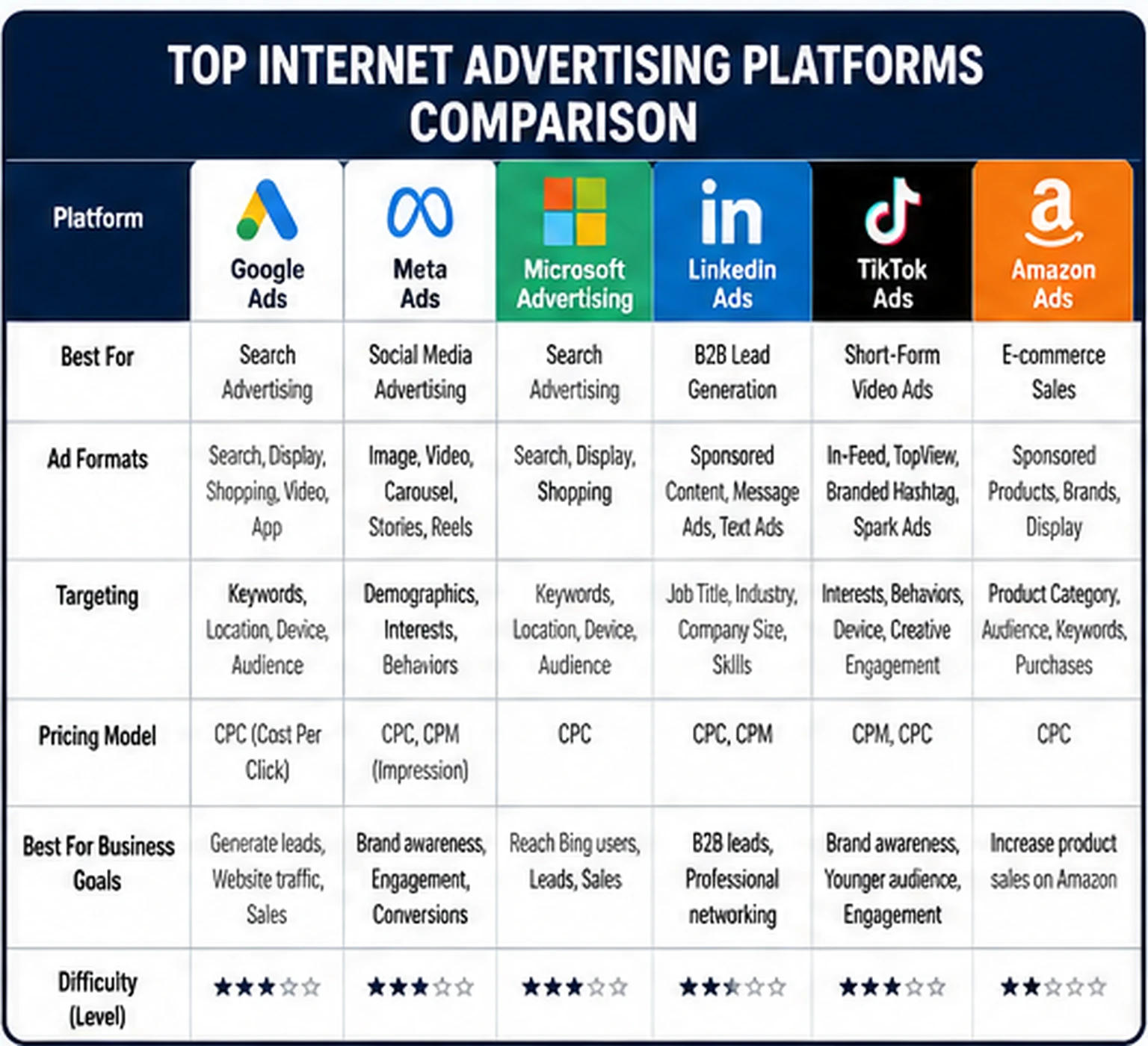
| Platform | Especially Useful For | Common Ad Environment |
|---|---|---|
| Google Ads | Capturing existing search demand | Search, shopping, video, display and other Google inventory |
| Meta Ads | Consumer discovery, visual campaigns and remarketing | Facebook, Instagram and Meta placements |
| Microsoft Advertising | Additional search advertising reach | Microsoft search and partner inventory |
| LinkedIn Ads | B2B and professional audiences | LinkedIn feed and professional environment |
| TikTok Ads | Short-form video and discovery | TikTok content feed |
| Amazon Ads | Product discovery and ecommerce shoppers | Amazon shopping and advertising inventory |
| YouTube Ads | Video storytelling, awareness and consideration | YouTube video environment |
| Pinterest Ads | Visual discovery and planning-oriented audiences | Pinterest feed and search |
| Reddit Ads | Interest communities and contextual conversations | Reddit communities and feeds |
| Snapchat Ads | Mobile-first visual campaigns | Snapchat experiences |
| X Ads | Real-time conversation and interest targeting | X timeline and related placements |
| Programmatic/Display | Broad web/app reach and audience buying | Publisher websites, apps and digital inventory |
1. Google Ads
Google Ads is one of the most important Internet Advertising Platforms because it can reach users while they are actively searching for information, products, services, or local businesses.
Search advertising is especially valuable when a business knows the phrases potential customers use before buying. Advertisers can build campaigns around relevant keywords and send users to landing pages designed around the same intent.
Google’s advertising ecosystem also extends beyond traditional text search advertising, including shopping, video, app, display, and automated campaign options. The right campaign type depends on the business objective and available assets.
Best suited for
- lead generation;
- local services;
- ecommerce search demand;
- high-intent product or service queries;
- businesses that can track valuable conversions.
2. Meta Ads
Meta Ads allows businesses to advertise across Meta’s consumer platforms and placements. It is particularly useful when visual creative, audience discovery, remarketing, and repeated exposure are important.
Unlike search advertising, users are often not actively typing a request for the advertised product. The creative must therefore earn attention and communicate value quickly.
Meta can work well for ecommerce, local businesses, consumer services, events, apps, and brands with strong visual or video assets.
3. Microsoft Advertising
Microsoft Advertising gives advertisers another way to reach search users and related Microsoft advertising inventory.
Businesses already running successful paid-search campaigns may evaluate Microsoft Advertising as an additional source of qualified traffic rather than relying on a single search ecosystem.
The decision should be based on actual audience availability, conversion quality, and economics rather than assuming performance will be identical across search platforms.
4. LinkedIn Ads
LinkedIn Ads is particularly relevant to B2B advertisers because LinkedIn’s environment centers on professional identities, companies, industries, careers, and business relationships.
This makes it useful for campaigns aimed at specific professional audiences, although advertisers should carefully compare lead value with acquisition cost.
Common LinkedIn advertising goals
- B2B lead generation;
- enterprise software promotion;
- professional events and webinars;
- account-based marketing support;
- business thought leadership;
- recruitment-related promotion where appropriate.
5. TikTok Ads
TikTok for Business gives advertisers access to a short-form, mobile-first video environment. Success often depends heavily on creative quality and whether the advertisement feels natural within the content experience.
TikTok can be attractive for brands that can demonstrate products visually, work with creators, produce frequent creative variations, or communicate an idea quickly through video.
Businesses should not choose TikTok simply because it is popular. First confirm that the target audience and buying journey fit the platform.
6. Amazon Ads
Amazon Ads can be particularly important for brands and sellers because advertising can reach people within or around a shopping ecosystem.
For ecommerce businesses, this creates a different intent environment from general social advertising. A user viewing or searching for products may already be closer to a purchase decision.
Businesses should evaluate advertising together with product availability, pricing, reviews, product-page quality, margins, and fulfillment because ads cannot compensate indefinitely for a weak product offer.
7. YouTube Advertising
YouTube advertising is available through Google’s advertising ecosystem and provides access to a major video environment. It can support brand awareness, product demonstrations, education, remarketing, and campaigns that benefit from more storytelling space than a small static advertisement provides.
Video quality matters, but expensive production is not always necessary. A clear opening, relevant message, credible demonstration, and strong call to action can matter more than cinematic effects.
Businesses considering YouTube should plan multiple creative versions and measure whether viewers take meaningful actions after exposure.
8. Pinterest Ads
Pinterest Ads operates in a highly visual discovery environment where users often explore ideas, products, projects, styles, and future plans.
This can make Pinterest relevant to categories such as home improvement, interiors, fashion, food, beauty, weddings, travel, crafts, and other visually driven purchase journeys.
Advertisers should assess whether their products naturally fit planning and inspiration behavior rather than treating Pinterest as a generic social network.
9. Reddit Ads
Reddit for Business allows advertisers to reach users across interest-based communities and conversations.
Reddit audiences can be highly knowledgeable about specific subjects. Generic advertising language may therefore perform poorly compared with messages that demonstrate genuine understanding of the community’s interests and problems.
It can be useful for technology, gaming, software, specialist hobbies, consumer products, and other categories with active communities.
10. Snapchat Ads
Snapchat for Business offers mobile-first advertising formats within Snapchat’s visual communication environment.
Brands considering Snapchat should evaluate audience fit, creative requirements, geographic reach, and whether vertical mobile content aligns with the campaign.
11. X Ads
X for Business provides advertising opportunities around real-time conversation, interests, content, and events.
Whether it belongs in a company’s media plan depends on where its audience spends time, brand-safety requirements, campaign objectives, and measured performance. As with every channel, advertisers should evaluate current platform policies and capabilities directly before committing budget.
12. Programmatic and Display Advertising Platforms
Programmatic advertising uses technology to buy and deliver digital advertising inventory across websites, apps, video environments, and other publisher inventory. The ecosystem can include demand-side platforms, supply-side platforms, ad exchanges, data systems, and publishers.
Programmatic advertising can provide significant reach and targeting flexibility, but it also introduces additional considerations around measurement, viewability, placement quality, fraud prevention, privacy, frequency, and brand safety.
Smaller businesses should ensure they understand the buying model and reporting before moving budget away from simpler channels where conversion paths may be easier to measure.
How to Choose the Right Internet Advertising Platform
The best Internet Advertising Platforms for one company may be completely wrong for another. Platform selection should begin with the business objective rather than the platform name.
Paid advertising should also fit into a wider acquisition plan rather than operate in isolation. Small companies can use our guide to effective marketing strategies for small businesses to combine advertising with content, SEO, social media, email, local marketing, and customer retention.
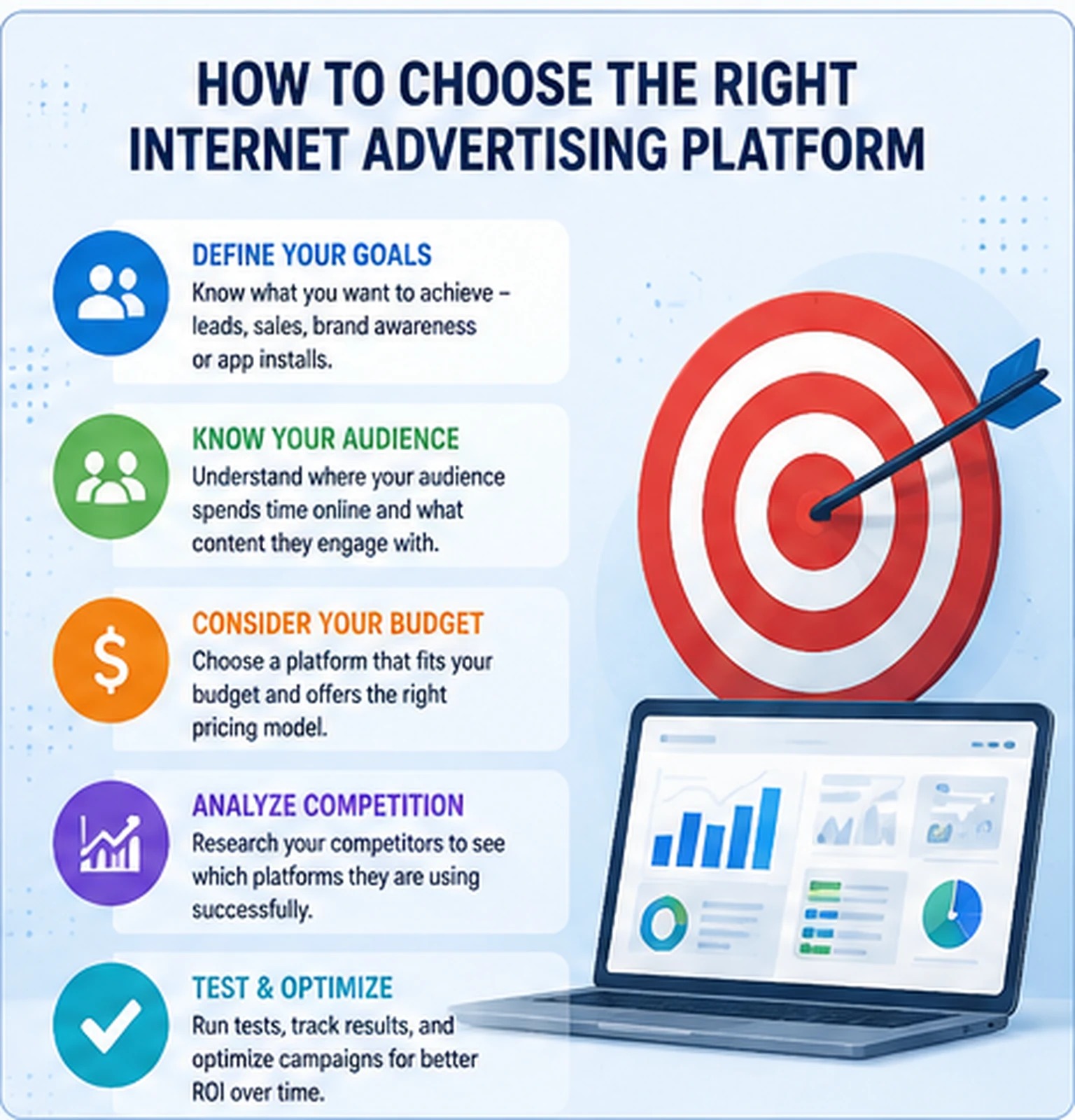
1. Define the Business Goal
Decide what success actually means. Goals may include qualified leads, ecommerce purchases, app installs, store visits, demo requests, subscriptions, video views, or brand awareness.
2. Understand the Audience
Identify who the customer is, what problem they are trying to solve, where they spend time online, and what information they need before making a decision.
3. Match the Platform to Intent
Search platforms can capture active demand. Social and video platforms can create or influence demand. Professional platforms can reach B2B audiences, while ecommerce platforms can reach shoppers near a purchase.
4. Consider the Budget
Do not divide a small budget across too many platforms. Concentrating enough spend to generate meaningful data on one or two suitable channels is often more useful than running tiny campaigns everywhere.
5. Evaluate Creative Requirements
A business with strong video production capability may have different opportunities from one that relies primarily on search-oriented landing pages. Choose channels the team can support with appropriate creative.
6. Test and Optimize
Start with controlled tests, define conversion measurement before spending heavily, and compare results using business outcomes rather than clicks alone.
Search Advertising vs Social Media Advertising
| Factor | Search Advertising | Social Advertising |
|---|---|---|
| User behavior | Often responding to an active query | Often discovering content while browsing |
| Primary strength | Capturing existing intent | Generating awareness and discovery |
| Creative | Keywords, copy, landing-page relevance | Images, video, hooks and storytelling |
| Targeting | Strongly influenced by queries and intent signals | Often audience, interest and behavioral signals |
| Typical challenge | Competitive high-intent auctions | Creative fatigue and interruption |
Many businesses eventually use both. Social or video advertising can introduce a brand, while search advertising captures users who later search for the product or category. The important point is to measure the combined customer journey rather than assuming every channel works independently.
How Much Do Internet Advertising Platforms Cost?
There is no universal advertising cost. Most major platforms use auction-based systems, meaning costs can vary according to audience, competition, geography, campaign objective, placement, creative quality, seasonality, and other factors.
Common pricing and reporting concepts include:
- CPC — Cost Per Click: advertising spend divided by clicks;
- CPM — Cost Per Thousand Impressions: the cost of one thousand ad impressions;
- CPA — Cost Per Acquisition/Action: spend divided by desired conversions;
- CPL — Cost Per Lead: advertising spend divided by leads;
- ROAS — Return on Ad Spend: tracked revenue attributed to advertising compared with advertising spend.
A low CPC does not automatically mean a campaign is successful. Ten expensive clicks that generate valuable customers may be better than hundreds of cheap clicks that produce no business outcome.
How to Measure Internet Advertising Performance
Measurement should be planned before campaigns launch. Otherwise, a business may spend money and later discover that it cannot reliably connect advertising activity with leads or sales.
Track meaningful conversions
Examples include purchases, qualified lead forms, booked appointments, phone calls, demo requests, registrations, or other actions with real business value.
Use consistent campaign tracking
Consistent campaign naming and URL parameters can make analytics easier to interpret. Google’s Google Analytics is one widely used analytics environment, but businesses should choose measurement tools that fit their stack and privacy requirements.
Measure beyond platform-reported clicks
Compare advertising data with CRM, ecommerce, sales, or other first-party business records where possible. Ecommerce teams should also connect campaign demand with operational data such as stock availability; our Small Business Inventory Management guide explains practical approaches to inventory tracking and replenishment. Platform attribution models may differ, so management should understand what each reported conversion actually represents.
Watch profitability, not vanity metrics
Impressions, video views, engagement, and clicks can help diagnose a campaign, but commercial campaigns ultimately need to connect with valuable outcomes.
How AI and Automation Are Changing Digital Advertising
Modern advertising systems increasingly use machine learning and automation for bidding, audience selection, creative combinations, campaign optimization, and reporting. This can reduce manual campaign work, but advertisers still need clear objectives, accurate conversion data, strong creative, and business oversight. When advertising data and AI workflows are hosted or integrated through cloud systems, teams should also consider a clear cloud security policy for access, data protection, vendors, and connected services.
For a broader look at business applications of artificial intelligence, read the XVIFS guide to AI Business Solutions. Businesses that want to connect advertising leads with CRM, email, spreadsheets, and internal processes can also explore Make.com workflows.
For more advanced cross-platform automation, our Artificial Intelligence Automation Agency guide explains how AI and workflow systems can connect business processes. Organizations building custom campaign dashboards, data pipelines, or marketing applications can also review our Cloud Application Development guide.
10 Common Internet Advertising Mistakes
- Advertising everywhere at once: small budgets become too fragmented to generate useful data.
- No clear conversion goal: campaigns optimize activity without knowing what business result matters.
- Sending all traffic to the homepage: landing pages should match the user’s intent and advertisement.
- Weak conversion tracking: optimization becomes unreliable when important actions are not measured correctly.
- Ignoring creative fatigue: repeated exposure to the same ad can reduce effectiveness.
- Judging campaigns only by CPC: inexpensive traffic is worthless if it does not create valuable outcomes.
- Copying competitors blindly: another company’s audience, economics, and offer may be different.
- Changing campaigns too quickly: constant changes can make it difficult to learn what actually worked.
- Ignoring mobile experience: many advertising journeys occur on mobile devices.
- Failing to check platform policies: advertising rules, targeting restrictions, and required disclosures can change.
Internet Advertising Platform Selection by Business Type
| Business Situation | Platforms Worth Evaluating First | Why |
|---|---|---|
| Local service business | Google Ads, Meta Ads | Capture local demand and build local awareness |
| B2B software/company | Google Ads, LinkedIn Ads, Microsoft Advertising | Search intent plus professional audiences |
| Ecommerce brand | Google Ads, Meta Ads, Amazon Ads, TikTok Ads | Shopping intent, discovery and visual product promotion |
| Visual lifestyle brand | Meta Ads, Pinterest Ads, TikTok Ads | Strong visual discovery environments |
| Educational/video-led brand | YouTube Ads, Google Ads, Meta Ads | Video education combined with demand capture |
| Niche community product | Reddit Ads plus relevant search/social channels | Potential access to concentrated interest communities |
These are starting points, not guarantees. A business should test based on its own audience, geography, offer, margins, conversion rate, and customer lifetime value.
How Many Advertising Platforms Should a Small Business Use?
A small business does not need to be active on every advertising platform. In many cases, one primary acquisition channel and one secondary testing channel are enough to begin.
For example, a local service company may concentrate on high-intent search advertising while testing Meta for local awareness and remarketing. A B2B company might prioritize search and LinkedIn. An ecommerce brand may combine search/shopping with social discovery.
Expansion should follow evidence. When one channel is producing repeatable results and the business has sufficient creative, tracking, and operational capacity, additional platforms can be tested deliberately.
Frequently Asked Questions About Internet Advertising Platforms
What are Internet Advertising Platforms?
Internet Advertising Platforms are online systems businesses use to create, target, deliver, manage, and measure paid advertisements across search engines, social networks, video services, ecommerce marketplaces, websites, apps, and other digital environments.
Which internet advertising platform is best?
There is no universal best platform. Google Ads can be strong for active search demand, Meta for consumer discovery and visual campaigns, LinkedIn for professional B2B audiences, and Amazon Ads for many ecommerce shopping journeys. The best choice depends on the specific business and campaign.
Which advertising platform is best for small businesses?
Small businesses should begin with the platform most closely aligned with their customer intent and available budget. Local and service businesses often evaluate search advertising first, while visual consumer brands may find social advertising more suitable.
Are Google Ads and Facebook Ads the same type of advertising?
No. Google search advertising often responds to explicit user queries, while Facebook and other Meta advertising frequently reaches users during content discovery. Both ecosystems also offer additional formats beyond this simplified distinction.
How much should a business spend on online advertising?
The appropriate budget depends on customer value, margins, conversion rates, market competition, geography, and testing objectives. Businesses should set a controlled budget they can measure rather than choosing an arbitrary amount based on another company’s spending.
Can I use more than one advertising platform?
Yes. Many businesses use several platforms, but each additional channel requires budget, creative, measurement, and management. Start with channels that have a clear strategic role and expand based on results.
What is the difference between CPC and CPM?
CPC represents cost per click, while CPM represents the cost per thousand impressions. Neither metric alone determines profitability; the campaign must ultimately be evaluated against its objective.
How do I know whether an advertising campaign is profitable?
Connect advertising spend with valuable outcomes such as qualified leads, sales, gross profit, or customer lifetime value. The appropriate profitability calculation depends on the business model.
Final Thoughts
The best Internet Advertising Platforms are the ones that connect a business with the right audience at the right stage of the buying journey while producing results that can be measured economically.
Google Ads, Meta Ads, Microsoft Advertising, LinkedIn Ads, TikTok Ads, Amazon Ads, YouTube, Pinterest, Reddit, Snapchat, X, and programmatic advertising all serve different purposes. Businesses do not need all of them.
Start with a clear objective, identify where your audience is most reachable, select one or two appropriate platforms, establish reliable conversion tracking, and run controlled tests. Once a channel demonstrates repeatable business value, optimize it before expanding the advertising mix.