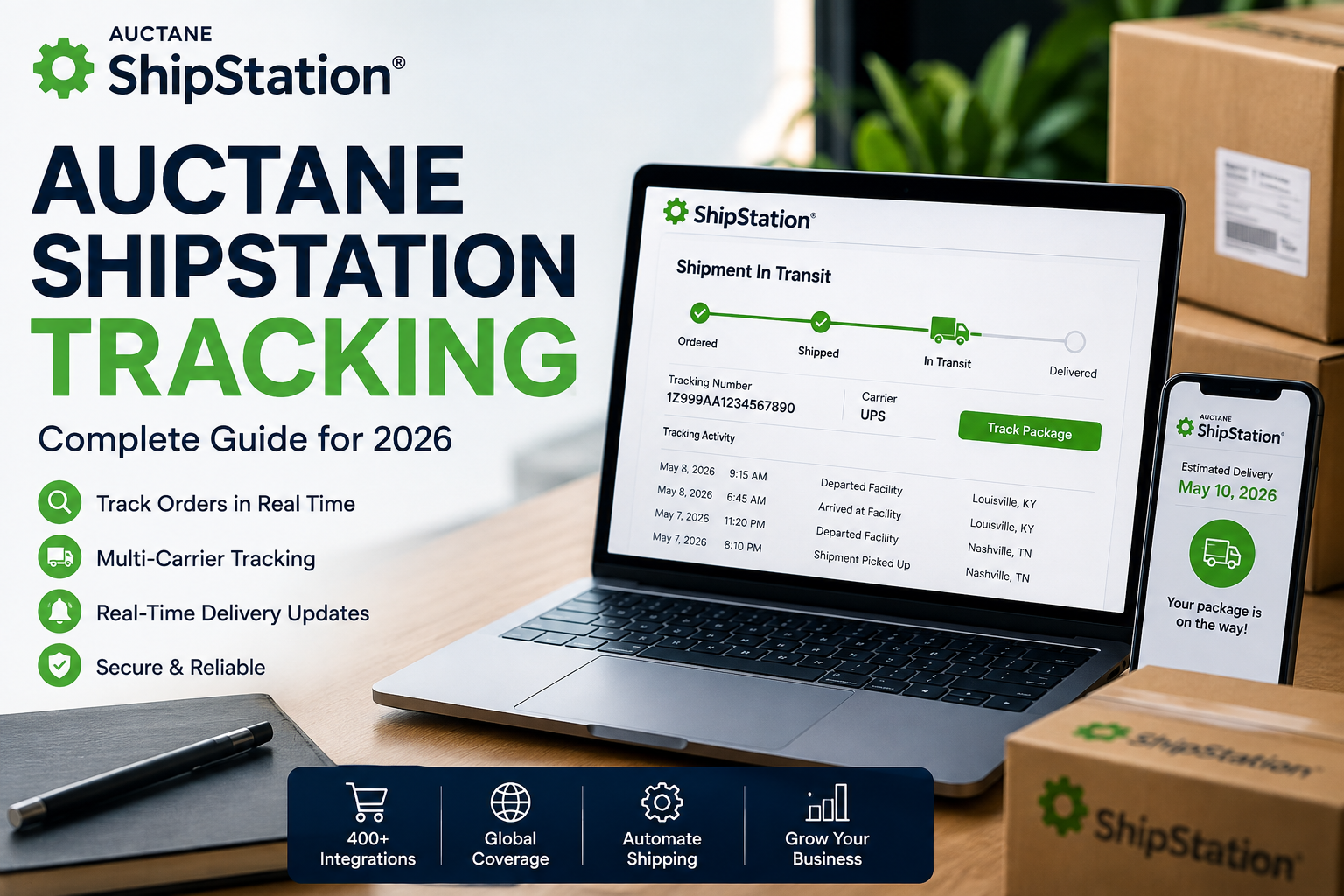
Auctane ShipStation Tracking helps ecommerce businesses monitor shipments, share delivery updates with customers and manage tracking across multiple carriers from one shipping platform. For merchants processing orders from several stores or marketplaces, centralizing shipping and tracking can reduce manual work and make post-purchase communication easier to manage.
ShipStation is a SaaS shipping platform within the Auctane ecosystem. In 2026, ShipStation advertises more than 400 integrations and access to more than 200 global carriers through its broader shipping and API ecosystem. Its tracking features include shipment status updates, branded tracking experiences, notifications, tracking APIs and webhooks for automated workflows.
This guide explains how Auctane ShipStation Tracking works, how customers receive tracking information, why a package may appear to come from Auctane or ShipStation, how branded tracking works, what to check when tracking is not updating, and seven practical tips for improving your shipping workflow.
What Is Auctane ShipStation Tracking?
Auctane ShipStation Tracking refers to shipment-tracking functionality associated with ShipStation, a shipping and order-fulfillment platform powered by Auctane. Merchants use ShipStation to import orders, compare shipping options, create labels, notify customers and monitor shipment progress across supported carriers.
ShipStation itself is not usually the company physically transporting the parcel. The carrier—such as UPS, USPS, FedEx, DHL Express or another supported service—moves the package. ShipStation helps the merchant create and manage the shipment while consolidating tracking information and customer communications.
That distinction is useful if you receive an email mentioning ShipStation or Auctane. The seller may use ShipStation behind the scenes even though you purchased the product from a completely different online store.
How Auctane ShipStation Tracking Works
The typical workflow begins when a customer places an order through an ecommerce store or marketplace. ShipStation can connect to supported sales channels, import order details and help the merchant choose a carrier service, create a shipping label and send shipment information back to the selling channel.
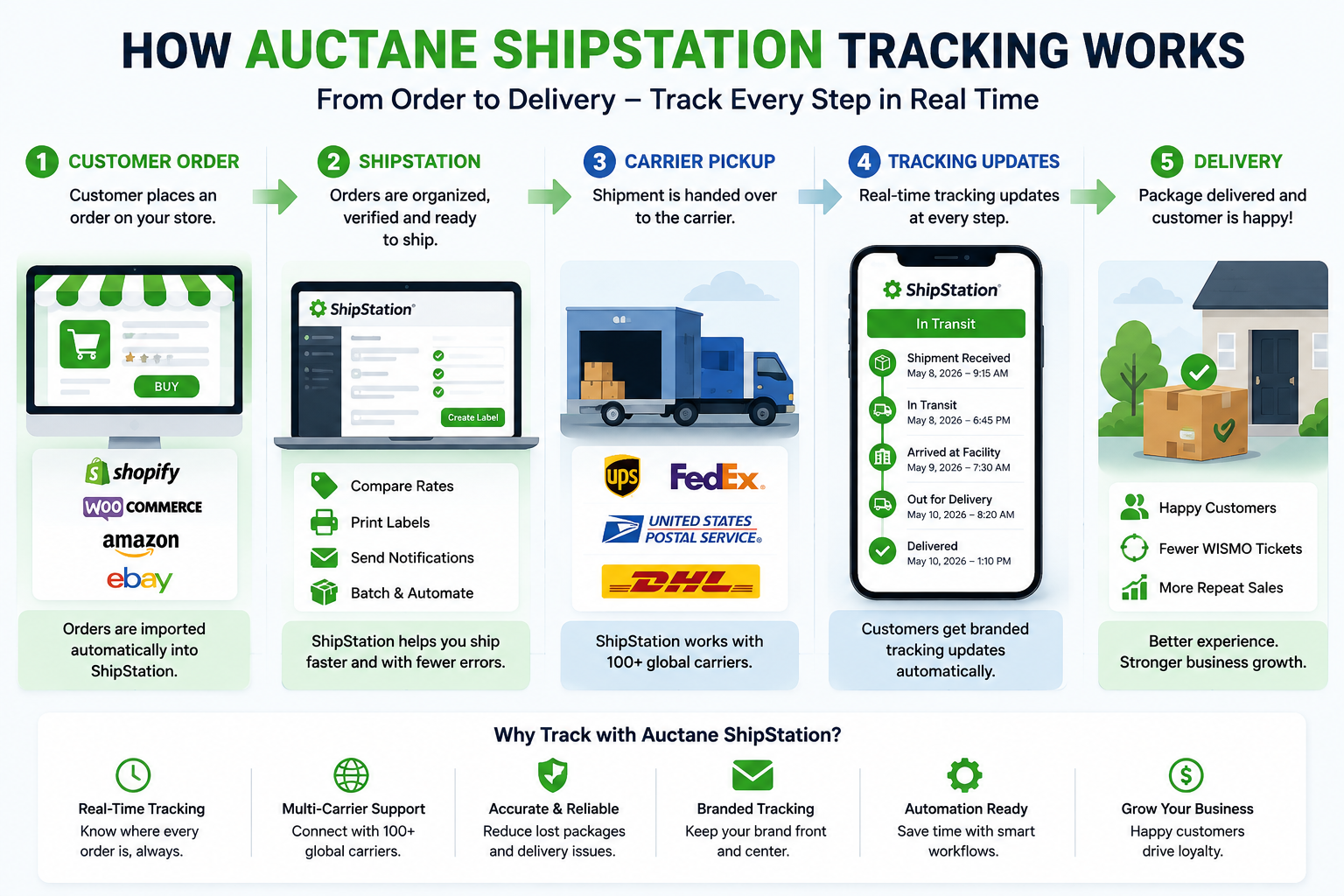
- Customer places an order: The purchase arrives through a connected store, marketplace or other order source.
- Order enters ShipStation: The merchant reviews the order and prepares it for fulfillment.
- A shipping service is selected: The merchant can compare available services and create the appropriate label.
- The carrier receives the parcel: Once the shipment enters the carrier network, tracking events begin to appear as scans are reported.
- Tracking information is shared: ShipStation can pass tracking information to supported selling channels and send customer notifications according to the merchant’s settings.
- The customer follows delivery: Depending on configuration, customers may view updates on a carrier page or a ShipStation branded tracking page.
Why Am I Getting a Package from Auctane ShipStation?
If a shipping email, label or tracking page mentions Auctane or ShipStation, it does not necessarily mean you purchased directly from Auctane. An ecommerce seller may simply use ShipStation as its shipping-management software.
To identify the actual seller, check your recent order-confirmation emails, payment history and the merchant name shown in the tracking notification. The tracking number can also help you identify the carrier responsible for the shipment.
If you truly do not recognize the purchase, do not click suspicious links or provide personal information. Verify the shipment through the retailer you believe may have sent it or use the carrier’s official tracking service.
How to Track a ShipStation Package
There is no single universal public ShipStation tracking box that every consumer must use. The exact tracking experience depends on how the merchant configured the shipment.
- Tracking email: The merchant may send an email containing a tracking link.
- Branded tracking page: The merchant may direct you to a customized tracking page powered by ShipStation.
- Carrier website: You may receive a carrier tracking number that can be entered directly on the carrier’s official website.
- Retailer account: Some online stores display shipment status inside your order history.
ShipStation’s official documentation notes that tracking visibility depends on how the shipment was created. For example, orders that are simply marked as shipped may not receive the same tracking-status updates inside ShipStation as labels created through supported connected carrier workflows.
Branded Tracking Pages in ShipStation
One of the most useful Auctane ShipStation Tracking features for ecommerce merchants is the branded tracking page. ShipStation allows businesses to customize the customer-facing tracking experience with store branding such as a logo, colors and other brand details.
This lets the merchant keep customers inside a more consistent post-purchase experience instead of sending every shopper directly to a generic carrier page. ShipStation also supports branded emails and delivery notifications that can complement the tracking page.
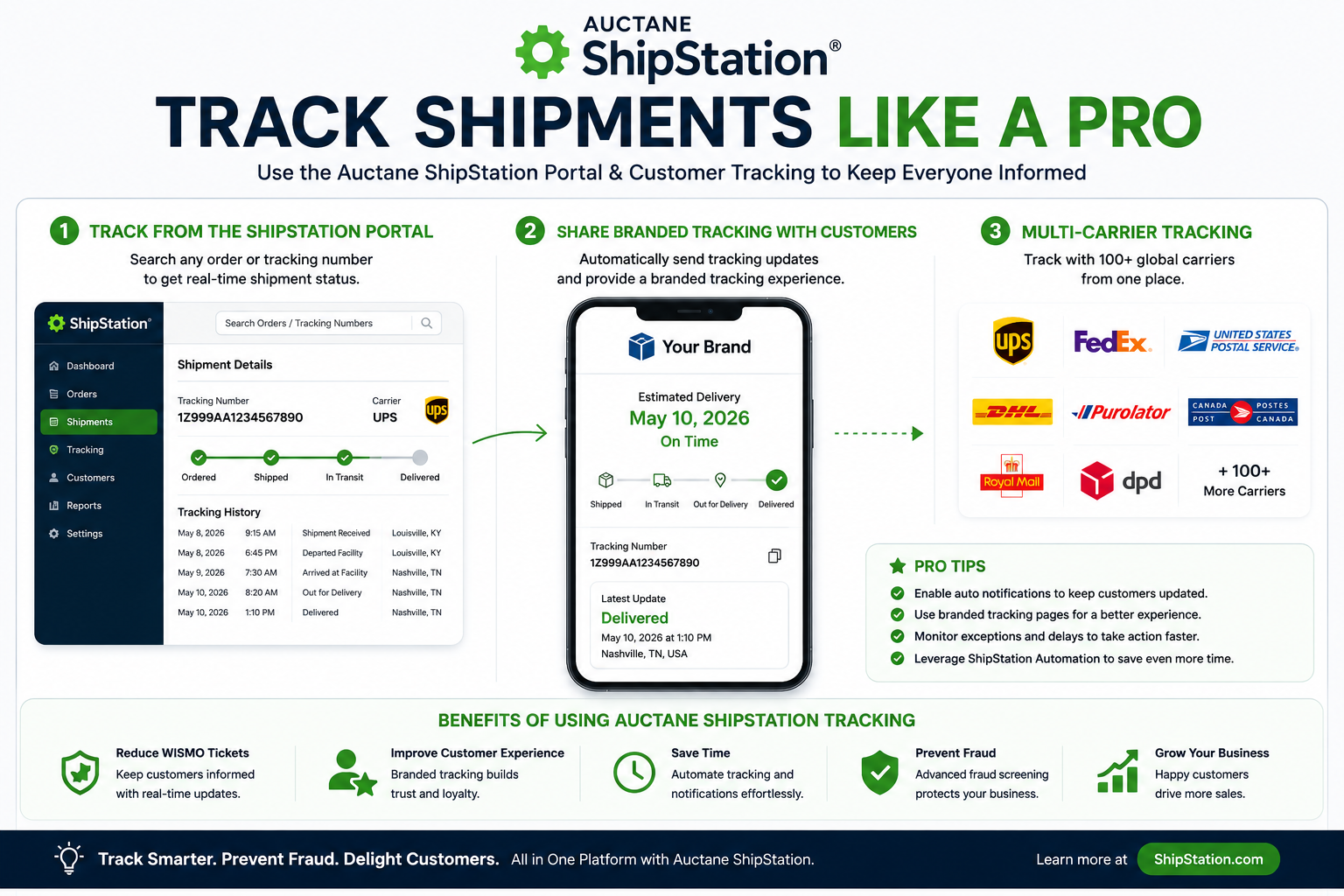
Accuracy note: the illustration above is a simplified educational representation. Carrier coverage, interface layout, available features and tracking behavior can vary by account, carrier, country and plan.
Auctane ShipStation Tracking Across Multiple Carriers
A major advantage of ShipStation is that merchants do not have to manage every carrier through a completely separate workflow. ShipStation currently advertises more than 200 global carriers in its shipping ecosystem, while its wider platform offers more than 400 integrations across carriers, marketplaces, ecommerce tools and other services.
For developers, ShipStation’s tracking API can normalize tracking events across supported carriers. Instead of interpreting a different status format for every carrier, businesses can work with standardized tracking states and detailed event history.
Tracking API and Webhooks for Ecommerce Automation
Developers and larger ecommerce teams can go beyond dashboard tracking. ShipStation provides APIs and webhooks that can be used to connect tracking events with other business systems.
A webhook can notify another application when a relevant event occurs instead of requiring that application to repeatedly poll ShipStation for updates. Current ShipStation documentation lists tracking events among the actions that can trigger webhook-driven workflows.
That opens the door to automations such as updating an internal database when a parcel is delivered, alerting a support team when a shipment enters an exception status or triggering post-delivery customer messaging.
If you are interested in workflow automation beyond shipping, XVIFS also covers Make.com automation and webhook-based workflows.
Auctane ShipStation Tracking Not Updating: What to Check
A tracking number may exist before useful carrier events appear. Delays can happen when a label has been created but the carrier has not yet physically received or scanned the package.
- Confirm that the package has actually shipped. A created label is not the same as a carrier acceptance scan.
- Check the carrier’s official tracking page. The carrier may have newer information than a merchant notification.
- Allow time for the first scan. Some parcels do not show movement immediately after label creation.
- Verify the tracking number. Make sure the number in the email or store account is complete and correct.
- Contact the seller. The merchant is normally the best point of contact for order-specific questions.
- Watch for exception statuses. Weather, customs, address problems and operational delays can interrupt normal movement.
International Auctane ShipStation Tracking
ShipStation supports international shipping workflows, but international tracking can be more complicated than domestic tracking. A parcel may move between carrier networks, pass through customs or experience periods with fewer visible scans.
For international shipments, review the carrier’s official tracking history and any customs-related status. Estimated delivery dates can change when customs clearance or cross-border handoffs take longer than expected.
Does ShipStation Automatically Send Tracking Numbers?
ShipStation can notify customers and connected marketplaces when shipments are created, but the exact behavior depends on the merchant’s settings and the way the order was fulfilled. ShipStation’s documentation shows notification options for customers and marketplaces when orders are marked as shipped, and branded tracking can also be linked from customer communications.
Merchants should therefore test notification rules before assuming every shipment will automatically generate the same customer message across every selling channel.
7 Powerful Tips for Better Auctane ShipStation Tracking in 2026
1. Use branded tracking for a better post-purchase experience
Configure the branded tracking page where appropriate so customers see a consistent experience after checkout instead of jumping between disconnected interfaces.
2. Keep customer notifications enabled and accurate
Tracking is useful only when customers can access it. Review notification settings for each selling channel and make sure shipment emails point to the correct tracking experience.
3. Build workflows around shipment exceptions
Delivery problems matter more than routine scans. Use available automation or webhooks to surface exceptions quickly so the support team can respond before the customer becomes frustrated.
4. Avoid treating label creation as proof of movement
A tracking number can be generated before the parcel enters the carrier network. Customer messaging should distinguish between a shipment being prepared and a shipment receiving its first physical carrier scan.
5. Use multi-carrier visibility to reduce manual checking
Centralized tracking is especially valuable when a business uses several carriers. Instead of forcing operations staff to monitor many carrier portals, consolidate supported shipment events where possible.
6. Measure WISMO-related support demand
Track how often customers ask “Where is my order?” If branded tracking and proactive notifications are working well, those repetitive contacts should become easier to reduce.
7. Verify current carrier and integration support before scaling
ShipStation supports a large ecosystem, but every carrier and integration has its own requirements. Confirm the specific features you need for your country, carrier accounts and sales channels before redesigning a mission-critical fulfillment workflow.
Benefits of Auctane ShipStation Tracking for Ecommerce Businesses
- Centralized visibility: manage supported order and shipment information from one shipping platform.
- Customer transparency: give buyers easier access to shipment status and delivery updates.
- Branded experience: customize supported tracking pages and communications.
- Multi-carrier workflows: manage shipping across a large carrier ecosystem.
- Automation: connect tracking events with notifications and other systems using APIs and webhooks.
- Operational efficiency: reduce repetitive manual carrier checks for fulfillment teams.
Limitations to Consider
- Tracking quality ultimately depends on carrier scans and carrier data.
- Not every shipment workflow produces identical tracking visibility.
- Some advanced capabilities depend on account configuration, plan, region or integration.
- International shipments may have longer gaps between tracking events.
- Merchants still need a clear customer-service process for lost, delayed or damaged parcels.
- Carrier and integration availability can change over time.
Auctane ShipStation Tracking vs Carrier Tracking
| Area | ShipStation Tracking | Carrier Tracking |
|---|---|---|
| Primary purpose | Centralize merchant shipment visibility and customer tracking workflows | Show the carrier’s own delivery events |
| Multiple carriers | Can consolidate supported carrier information | Usually limited to that carrier |
| Branding | Supports branded tracking experiences | Carrier-branded experience |
| Merchant automation | APIs, webhooks and shipping workflows available | Depends on individual carrier systems |
| Best use | Ecommerce operations and customer experience | Direct carrier-specific shipment verification |
Frequently Asked Questions
What is Auctane ShipStation?
ShipStation is a SaaS shipping and fulfillment platform in the Auctane ecosystem. Ecommerce businesses use it to manage orders, compare shipping services, create labels, automate shipping workflows and track supported shipments.
How do I track my Auctane ShipStation package?
Use the tracking link supplied by the merchant, the retailer’s order page, a ShipStation branded tracking page if one is provided, or the official website of the carrier associated with your tracking number.
Why does my package say Auctane or ShipStation?
The seller may use ShipStation to manage fulfillment. Auctane/ShipStation can therefore appear in shipping-related communications even when you bought the item from another retailer.
Why is my ShipStation tracking number not updating?
The label may have been created before the parcel received its first carrier scan, or the carrier may be experiencing a delay. Check the carrier’s official tracking page and contact the seller if there is no progress after a reasonable period.
Can ShipStation track international packages?
ShipStation supports international shipping and multi-carrier workflows, but the quality and frequency of tracking updates depend on the carrier, service and cross-border handoffs involved.
Does ShipStation support branded tracking?
Yes. ShipStation currently offers a branded tracking page that merchants can customize with store branding details, along with supported customer notification options.
Does ShipStation have a tracking API?
Yes. ShipStation offers tracking APIs for supported carrier workflows and also supports webhooks that can notify connected systems when tracking-related events occur.
Final Verdict: Is Auctane ShipStation Tracking Useful in 2026?
Auctane ShipStation Tracking is most valuable as part of a broader ecommerce shipping workflow. It gives merchants a central place to manage supported shipments while helping customers receive clearer delivery information through tracking links, notifications and branded tracking experiences.
For customers, the most important thing to remember is that ShipStation is usually the shipping software behind the retailer—not the carrier physically delivering the parcel. If a tracking update appears unclear or stops moving, verify the shipment with the actual carrier and the seller.
For merchants, the biggest opportunity is to combine tracking with automation. Branded pages, multi-carrier visibility, APIs and webhooks can turn basic parcel status into a more useful post-purchase customer experience.
For current product information, visit the official ShipStation website, the ShipStation tracking documentation, and the official ShipStation tracking API page.
If you are building a broader ecommerce or automation stack, explore XVIFS guides to Make.com automation, AI tools for customer support, and AI tools for small businesses.
Editor’s note: ShipStation features, carrier coverage, integrations and account requirements can change. Confirm current capabilities with ShipStation and the relevant carrier before making operational decisions.