ServiceNow Knowledge 2026 marked a major shift in the company’s AI strategy. Instead of treating generative AI as a separate assistant added to existing workflows, ServiceNow used its annual conference to present a broader vision of governed, autonomous work—where AI agents can understand intent, coordinate actions across systems and complete business processes under enterprise controls.
Knowledge 2026 took place May 5–7, 2026 in Las Vegas. ServiceNow described the event around the idea of “agentic business,” with announcements spanning AI governance, autonomous workflows, employee experiences, security, developer tools and the latest Now Platform release.
This XVIFS guide breaks down the 9 biggest ServiceNow Knowledge 2026 announcements, explains what each one does and highlights why the changes matter for organizations evaluating enterprise AI and workflow automation.
ServiceNow Knowledge 2026: Quick Overview
| # | Announcement | Why It Matters |
|---|---|---|
| 1 | AI Control Tower | Central governance, monitoring and optimization for enterprise AI |
| 2 | ServiceNow Otto | Unified AI experience designed to turn employee intent into completed work |
| 3 | Autonomous Workforce | AI agents that execute and coordinate multi-step workflows |
| 4 | EmployeeWorks | AI-native front door for employee work and support |
| 5 | Action Fabric | Connect external AI agents and tools to governed ServiceNow workflows |
| 6 | AI Security and Risk | Govern and secure AI agents, identities and connected assets |
| 7 | Build Anywhere, Run on ServiceNow | Build production AI applications with modern developer tools |
| 8 | Australia Release | Latest platform release focused on agentic execution with governance |
| 9 | Expanded Partnerships | Broader AI infrastructure and implementation ecosystem |
Why ServiceNow Knowledge 2026 Matters
The central message at ServiceNow Knowledge 2026 was that enterprises do not simply need more AI models or isolated copilots. They need a system that can connect AI to trusted enterprise data, workflows, identities, permissions and governance.
ServiceNow positioned its AI Platform as that orchestration layer. Its official Knowledge 2026 announcements emphasized a platform that can help organizations discover AI assets, govern them, secure them, execute work through agents and measure results.
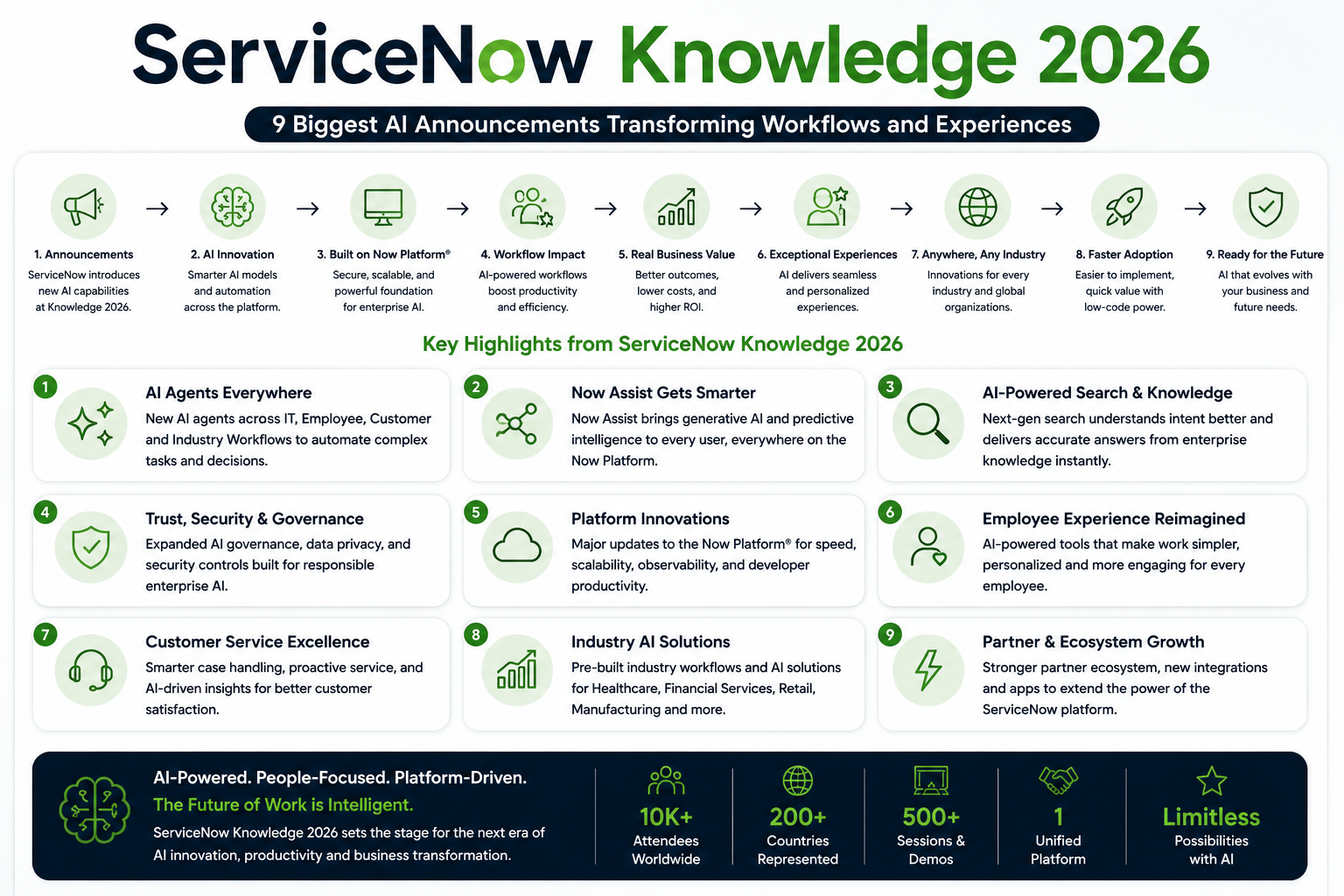
Visual note: the infographic above is an editorial summary. The nine sections below follow ServiceNow’s official Knowledge 2026 announcement themes rather than relying on illustrative statistics shown in the graphic.
1. AI Control Tower Becomes the Command Center for Enterprise AI
One of the most important ServiceNow Knowledge 2026 announcements was the expansion of AI Control Tower. ServiceNow describes it as a unified command center for monitoring, governing and optimizing AI agents across the enterprise.
The problem it addresses is increasingly common: enterprises may have AI agents from multiple vendors, departments and cloud platforms, but limited centralized visibility into ownership, permissions, risk, cost or performance.
AI Control Tower is designed to bring those areas together so organizations can discover AI assets, apply governance, monitor activity and evaluate value from a more centralized layer.
Why AI Control Tower matters
- Creates greater visibility across enterprise AI deployments.
- Helps establish consistent governance and policy enforcement.
- Connects AI activity with security and identity controls.
- Supports measurement and optimization of AI performance and value.
- Can help reduce fragmented AI management across departments.
2. ServiceNow Otto: A Unified AI Experience for Work
ServiceNow Otto was another major headline from Knowledge 2026. ServiceNow introduced Otto as a unified enterprise AI experience combining capabilities from Now Assist, Moveworks and AI Experience.
The goal is not simply to answer questions. Otto is designed to understand what the user wants, route work to the appropriate agent or workflow and help complete the task across departments and systems.
That distinction is important. Traditional enterprise assistants often provide information but leave the employee to navigate applications, approvals and workflows manually. ServiceNow’s positioning for Otto is centered on completing work within governed enterprise processes.
ServiceNow also says actions performed through Otto can be governed by AI Control Tower, providing policy enforcement and auditability around AI-driven work.
3. Autonomous Workforce Expands AI Agents Across Business Functions
ServiceNow’s Autonomous Workforce focuses on AI agents that can execute, coordinate and handle multi-step workflows rather than only provide recommendations to human users.
This is where ServiceNow’s “agentic business” message becomes practical. An AI agent might help resolve a service request, coordinate steps across systems or work alongside human employees on a structured business process.
For organizations, the value is potentially significant in high-volume workflows where employees spend substantial time moving information between systems or repeatedly following the same procedures.
4. EmployeeWorks Creates an AI-Native Front Door for Employees
ServiceNow also highlighted EmployeeWorks, described in the Knowledge 2026 announcements as a unified AI-native experience for employees.
The broader objective is to reduce the number of places employees must visit to find information, request services or get work completed. Instead of expecting users to understand which department, portal or backend system owns a task, an AI-native experience can act as the front door and route the request appropriately.
This can be particularly relevant for organizations with fragmented HR, IT, workplace and enterprise-service systems.
5. ServiceNow Action Fabric Connects External AI Agents to Workflows
Action Fabric may be one of the most strategically important ServiceNow Knowledge 2026 announcements because it addresses a multi-vendor AI reality.
ServiceNow says Action Fabric can bring existing AI agents and tools into ServiceNow workflows without forcing organizations into a single AI vendor. This means third-party agents can potentially use ServiceNow as a governed system of action for executing enterprise work.
For businesses already investing in several AI platforms, that approach could be more practical than replacing every tool with one proprietary agent ecosystem.
6. AI Security and Risk Focuses on the Invisible Workforce
As autonomous agents gain the ability to perform actions, enterprise security must evolve alongside them. Knowledge 2026 therefore included a strong focus on what ServiceNow calls the “invisible workforce”—AI agents and digital identities that can act inside business systems.
AI Security and Risk is designed to help organizations secure agents, identities and connected assets while linking detected issues with action.
This matters because the risk of AI is different when an agent can execute workflows. Enterprises need to understand what an agent can access, which actions it is authorized to take and how those actions can be monitored and audited.
7. Build Anywhere, Run on ServiceNow
Developers were also a major part of the Knowledge 2026 story. ServiceNow announced a Build Anywhere, run on ServiceNow direction that connects modern development environments with production-grade applications running on the ServiceNow platform.
The official announcement references tools including Codex, Figma and Claude alongside ServiceNow Build Agent and Studio. The aim is to let developers work with the tools they prefer while still using ServiceNow’s enterprise context, workflow execution and governance.
For ServiceNow customers, this could make the platform more attractive to developers who expect modern AI-assisted development workflows rather than being restricted to one development interface.
8. Australia Release Brings the Next Platform Generation
Knowledge 2026 also highlighted the Australia Release, ServiceNow’s latest platform release. ServiceNow describes Australia as delivering agentic execution through orchestration, intelligence and built-in governance.
The release is important because the conference announcements are not isolated AI demos. ServiceNow is integrating agentic capabilities into the broader Now Platform so organizations can deploy AI alongside existing workflows, data, security and governance.
Organizations planning upgrades should review the official Australia release documentation because feature availability can vary by product, licensing and release timing.
9. ServiceNow Expands Its AI Partnership Ecosystem
The ninth major theme was partnership expansion. ServiceNow highlighted alliances across AI infrastructure, technology and global delivery, including an NVIDIA AI Factory integration and deeper relationships with major consulting and implementation partners.
This ecosystem matters because enterprise AI projects rarely involve one software vendor. Organizations need infrastructure, models, consulting expertise, integrations, security and implementation services. A broader partner ecosystem can make the ServiceNow platform easier to connect with the rest of an enterprise technology stack.
What ServiceNow Knowledge 2026 Means for Enterprise AI
Taken together, the announcements show a clear strategy: ServiceNow wants to become the orchestration and governance layer that connects enterprise AI with real business actions.
The company is moving beyond the idea of AI as a chatbot embedded in an application. AI Control Tower governs agents, Otto acts as a unified user experience, Autonomous Workforce performs multi-step work, Action Fabric connects outside agents and the Now Platform provides workflow, data and policy context underneath.
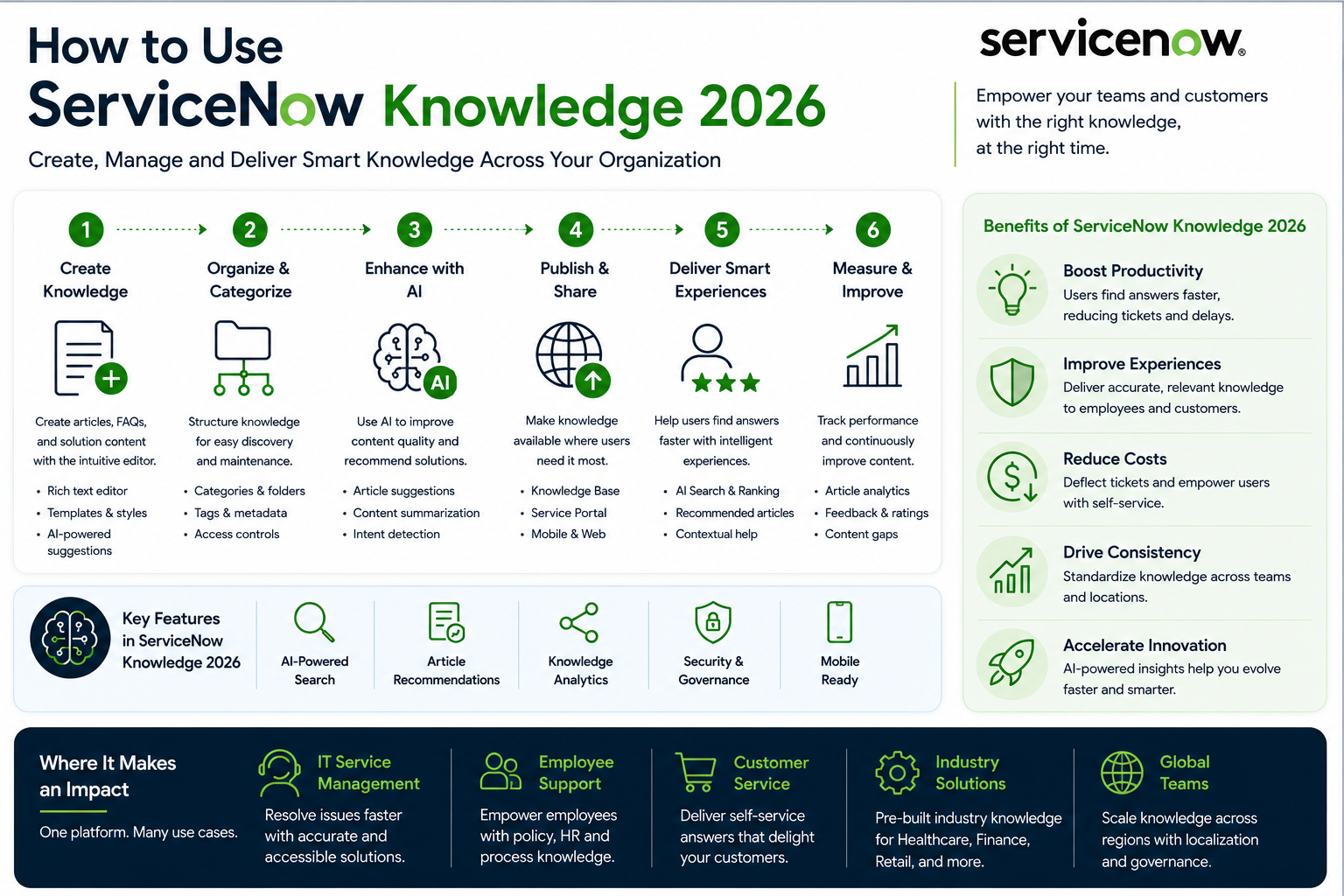
The image above is an editorial visualization rather than a literal screenshot of the Knowledge 2026 event or ServiceNow product interface.
ServiceNow Knowledge 2026 vs Traditional Enterprise AI
| Traditional AI Approach | ServiceNow Knowledge 2026 Direction |
|---|---|
| AI assistant answers questions | AI agents can help execute governed work |
| Separate agents in different applications | AI Control Tower provides centralized governance |
| Users navigate systems themselves | Otto aims to route and complete work across systems |
| Vendor-specific automation | Action Fabric supports external agents and tools |
| AI security handled separately | Security, identity and AI governance are increasingly connected |
| Development tied to one environment | Build Anywhere aims to support broader developer tooling |
Who Should Pay Attention to These Announcements?
- CIOs and technology leaders: especially those trying to consolidate fragmented AI programs.
- ServiceNow administrators and architects: because AI capabilities are becoming more deeply integrated with the platform.
- IT service teams: where agentic workflows may automate high-volume service operations.
- HR and employee-experience teams: because EmployeeWorks and Otto target employee service workflows.
- Security and risk leaders: as AI agents create new identity, access and governance requirements.
- Developers: due to Build Agent, Studio and the broader Build Anywhere direction.
- Business leaders: who need measurable productivity rather than isolated AI experiments.
Potential Benefits of ServiceNow’s Agentic AI Direction
- Automate more complex, multi-step business workflows.
- Reduce application switching for employees.
- Create stronger governance around AI agents.
- Connect AI with enterprise permissions and workflows.
- Bring external AI tools into a governed execution environment.
- Improve visibility into AI performance, risk and cost.
- Give developers more flexibility in how AI applications are created.
Risks and Considerations
Agentic AI creates more value only when organizations can trust what the agents are allowed to do. Businesses evaluating the ServiceNow Knowledge 2026 announcements should therefore consider governance and implementation as seriously as the AI capabilities themselves.
- Autonomous agents require carefully defined permissions.
- Poor enterprise data can reduce AI reliability.
- Complex cross-system workflows require strong integration design.
- Organizations need monitoring and auditability for AI-driven actions.
- Licensing and implementation costs should be evaluated against measurable outcomes.
- Not every announced capability will necessarily be available to every customer immediately.
- Human review should remain part of sensitive or high-impact decisions.
How Businesses Should Approach ServiceNow AI After Knowledge 2026
- Inventory existing AI. Identify agents, copilots, models and automated workflows already operating across the business.
- Choose high-value workflows. Focus first on repetitive processes where automation can create measurable improvement.
- Define governance. Decide what agents may access, which actions they may perform and what requires human approval.
- Connect reliable data. AI agents need trustworthy enterprise context to make useful decisions.
- Test in controlled environments. Validate workflows before granting autonomous access to sensitive systems.
- Measure outcomes. Track resolution time, hours saved, cost, quality, errors and user experience.
- Scale gradually. Expand agentic automation after successful pilots rather than deploying everywhere at once.
Can You Still Watch ServiceNow Knowledge 2026?
Yes. ServiceNow provides Knowledge 2026 content on demand, including keynotes, event highlights and conference sessions. This is useful for administrators, developers and technology leaders who did not attend the Las Vegas event in person.
You can review current event material through the official ServiceNow Knowledge 2026 page and the official Knowledge 2026 announcements page.
Frequently Asked Questions About ServiceNow Knowledge 2026
When was ServiceNow Knowledge 2026?
ServiceNow Knowledge 2026 took place May 5–7, 2026 in Las Vegas, Nevada, at the Venetian Resort and Wynn Las Vegas properties.
What was the main theme of Knowledge 2026?
A major theme was the move toward “agentic business”: using governed AI agents that can move beyond answering questions and help execute real business workflows across systems.
What is ServiceNow Otto?
ServiceNow Otto is a unified enterprise AI experience introduced at Knowledge 2026. It combines capabilities from Now Assist, Moveworks and AI Experience and is designed to help users turn intent into completed work across systems and departments.
What is ServiceNow AI Control Tower?
AI Control Tower is ServiceNow’s centralized platform capability for discovering, governing, monitoring and optimizing enterprise AI agents and related AI activity.
What is Action Fabric?
Action Fabric is designed to connect external AI agents and tools with ServiceNow workflows so organizations can use third-party AI while retaining governed enterprise execution.
What is the ServiceNow Autonomous Workforce?
Autonomous Workforce is ServiceNow’s concept for AI agents that can execute, coordinate and manage multi-step workflows across enterprise business functions.
What is the ServiceNow Australia Release?
Australia is ServiceNow’s latest platform release highlighted at Knowledge 2026. ServiceNow positions it around agentic execution, orchestration, intelligence and built-in governance.
Are Knowledge 2026 sessions available online?
Yes. ServiceNow makes Knowledge 2026 keynotes, event material and on-demand conference content available through its official Knowledge event site.
Final Verdict: What ServiceNow Knowledge 2026 Signals for Enterprise AI
ServiceNow Knowledge 2026 was less about introducing another standalone AI assistant and more about building an operating model for governed autonomous work. AI Control Tower provides oversight, Otto creates a unified interaction layer, Autonomous Workforce adds execution, Action Fabric connects outside agents and AI Security and Risk helps address the security challenges created by autonomous systems.
For ServiceNow customers, the key question is no longer simply whether they should use generative AI. The more important question is which workflows should become agentic, how much autonomy those agents should receive and how the organization will govern the resulting AI workforce.
Businesses should avoid adopting every new capability at once. The strongest approach is to start with well-defined workflows, reliable data, clear permissions and measurable success criteria, then expand only when the first deployments demonstrate real value.
For official details, review ServiceNow’s nine Knowledge 2026 announcements and the Knowledge 2026 on-demand experience.
For related automation content on XVIFS, explore our Make.com tutorial for beginners, AI tools for customer support, and best AI tools for small businesses.
Editor’s note: ServiceNow product availability, licensing, release timing and AI capabilities can change. Verify implementation details against current official ServiceNow documentation before making production decisions.