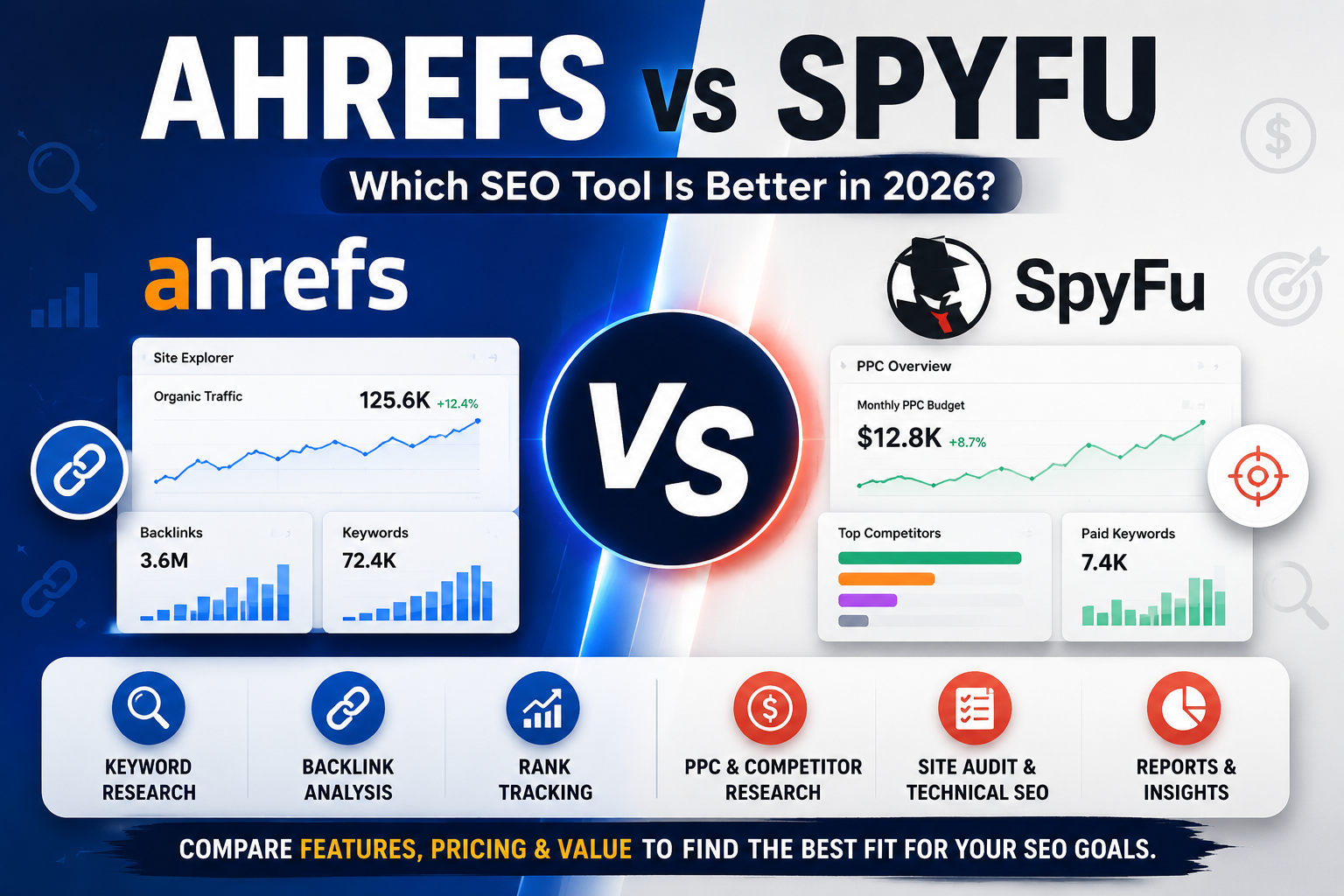
Ahrefs vs SpyFu: Which SEO Tool Should You Choose in 2026?
Ahrefs vs SpyFu is a useful comparison for marketers who want better keyword research, competitor intelligence and search visibility without paying for tools they do not need. Both platforms help you understand what competitors rank for, where traffic opportunities exist and how search strategies are performing, but their strongest use cases are different.
Ahrefs is the broader organic SEO platform. It is especially strong for backlink analysis, keyword research, site auditing, rank tracking, content research and competitive SEO analysis. In 2026, Ahrefs has also expanded further into AI-search visibility through Brand Radar and tracked AI prompts.
SpyFu, by contrast, is particularly well known for competitor keyword intelligence and PPC research. It can show which keywords competitors rank for, which terms they advertise on, historical ad activity and competitive search trends. That makes it especially attractive to marketers who want to study both organic and paid-search strategies without buying a larger enterprise SEO suite.
So which one should you actually pay for? This Ahrefs vs SpyFu 2026 comparison breaks down keyword research, backlinks, competitor analysis, PPC, site audits, rank tracking, AI-search features, pricing and overall value so you can choose the tool that best matches your work.
Quick verdict: Choose Ahrefs if your priority is broad organic SEO, backlinks, technical SEO and deeper site research. Choose SpyFu if competitor intelligence, PPC/Google Ads research and historical paid-search data are more important to you.
Editorial note: XVIFS reviewed current public product information and official provider documentation. We do not claim hands-on testing of every feature discussed below. Pricing, limits and product features can change, so confirm current details on the providers’ official websites before purchasing.
Ahrefs vs SpyFu: Quick Comparison
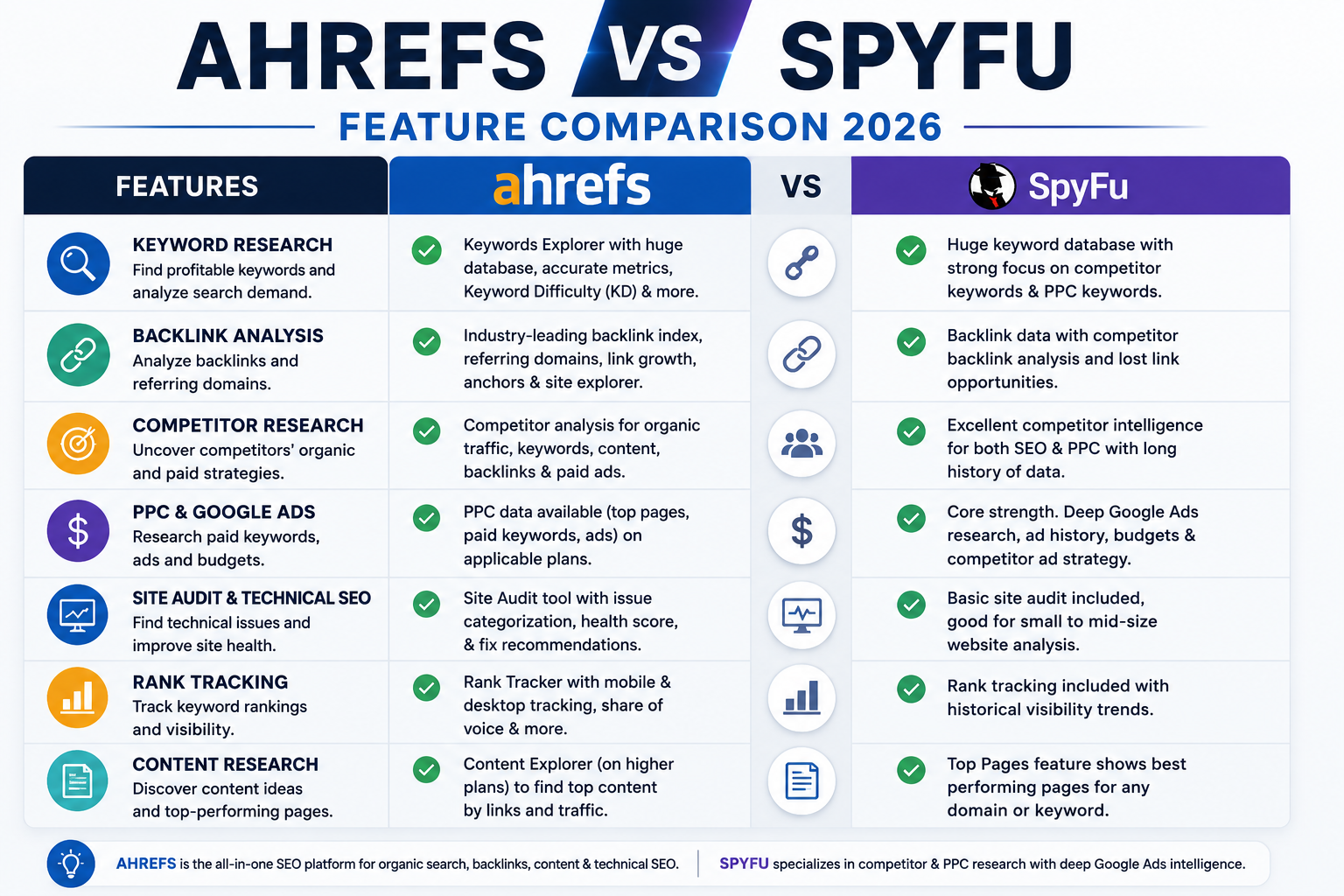
| Category | Ahrefs | SpyFu | Winner |
|---|---|---|---|
| Keyword Research | Excellent organic keyword research with Keywords Explorer | Strong keyword and competitor keyword research | Ahrefs for depth |
| Backlink Analysis | Major strength with a large backlink index and Site Explorer | Useful competitor backlink data | Ahrefs |
| Competitor Research | Excellent organic competitor analysis | Excellent organic + paid competitor intelligence | Tie by use case |
| PPC / Google Ads | Paid-search data available, but not the core strength | Deep PPC history, paid keywords and competitor ad research | SpyFu |
| Technical SEO | Strong Site Audit platform | More limited technical SEO depth | Ahrefs |
| Rank Tracking | Strong project-based Rank Tracker | Rank tracking and historical visibility tools | Ahrefs overall |
| Content Research | Strong via Content Explorer and related tools on applicable plans | Useful top-page and keyword intelligence | Ahrefs |
| AI Search Visibility | Brand Radar + tracked AI prompts | AI-related features and RivalFlow AI on applicable plans | Ahrefs for dedicated visibility research |
| PPC Competitor Intelligence | Useful | Core strength | SpyFu |
| Best For | Organic SEO teams, agencies, content sites and link research | PPC marketers, competitor research and cost-conscious teams | Depends on goal |
What Is Ahrefs?
Ahrefs is an SEO platform built around large-scale search, backlink and website data. Its core tools include Site Explorer, Keywords Explorer, Site Audit and Rank Tracker, with additional content, competitive and AI-search capabilities depending on the plan.
Ahrefs is particularly useful when your SEO work depends on understanding how websites earn traffic and links. Site Explorer can help you study competitors’ organic traffic, keywords, backlinks and top-performing pages. Keywords Explorer is designed for keyword discovery and difficulty analysis, while Site Audit focuses on technical SEO issues.
Ahrefs’ current plans also include tracked AI prompts from Lite upward, while its Brand Radar product focuses specifically on AI-search visibility, brand mentions, citations and share of voice across AI answers.
Best for: SEO professionals, agencies, content teams, affiliate sites and businesses where organic search is a serious acquisition channel.
What Is SpyFu?
SpyFu is a competitive search-intelligence platform best known for showing what competitors rank for and what they advertise on in paid search.
Its value comes from combining SEO keyword information with historical PPC intelligence. Marketers can investigate competitor keywords, paid terms, ad history, ranking history and search visibility without needing to build every competitor report manually.
SpyFu’s official 2026 help documentation describes the Basic plan as the entry option for its core tools, while higher plans add more functionality, historical data, API access and AI-related features. Its Pro + AI tier also bundles RivalFlow AI and AI visibility features.
Best for: PPC marketers, agencies, small businesses and teams focused heavily on competitor search strategy.
Ahrefs vs SpyFu for Keyword Research
Keyword research is one of the most important parts of the Ahrefs vs SpyFu comparison because both platforms are capable here, but they approach the problem differently.
Ahrefs Keyword Research
Ahrefs’ Keywords Explorer is designed for large-scale organic keyword research. It provides keyword ideas, search-volume estimates, difficulty metrics, SERP information, traffic potential and related keyword discovery.
Its biggest advantage is the connection between keyword research and the rest of the Ahrefs ecosystem. You can move from a keyword into competitor pages, backlinks, organic traffic and ranking history without leaving the broader platform.
This is especially useful for sites building long-term content strategies or topical clusters.
SpyFu Keyword Research
SpyFu also provides strong keyword research, but it becomes especially interesting when you want to know which keywords competitors already use.
You can study terms competitors rank for organically, paid keywords they buy, overlapping keywords between domains and historical ranking or ad activity.
Winner: Ahrefs for broad organic keyword research and deeper SEO workflows. SpyFu remains very useful when competitor keyword intelligence is the main objective.
Ahrefs vs SpyFu for Competitor Research
Both platforms are strong for competitor analysis, but this category is closer than backlink research.
Ahrefs allows users to examine competitor traffic, ranking keywords, top pages, link profiles, referring domains and broader search visibility. This is particularly useful when reverse-engineering an organic SEO strategy.
SpyFu’s identity is even more directly tied to competitor research. Its platform can show competitor SEO keywords, PPC keywords, ad history, budget-related signals and historical search activity.
If you primarily want to know how a competitor gets organic traffic and links, Ahrefs is usually the stronger choice. If you want to know what competitors rank for and what they have paid to advertise on, SpyFu becomes especially valuable.
Winner: Tie, depending on the use case. Ahrefs wins organic competitor depth; SpyFu wins paid-search competitor intelligence.
Ahrefs vs SpyFu for Backlink Analysis
This is one of the clearest categories in the comparison.
Ahrefs has built much of its reputation around backlink intelligence. Site Explorer can help users inspect referring domains, backlinks, anchor text, link growth, top linked pages and competing websites.
That makes Ahrefs particularly useful for link-building campaigns, digital PR research, competitor backlink analysis and diagnosing why certain pages or domains have stronger authority.
SpyFu includes backlink-related capabilities, but backlink intelligence is not the platform’s defining strength in the same way.
Winner: Ahrefs.
Ahrefs vs SpyFu for PPC and Google Ads Research
This is where the advantage reverses.
SpyFu is built around the ability to investigate competitors’ paid-search strategies. Its historical data can show terms competitors have advertised on, estimated search-ad activity and older ads where data is available.
For PPC teams, this can reduce the amount of guessing required when entering a competitive Google Ads market. Instead of starting with a blank keyword list, you can study which terms have appeared repeatedly in competitors’ paid-search strategies.
Ahrefs contains useful paid-search information, but PPC intelligence is not its central proposition.
Winner: SpyFu.
Ahrefs vs SpyFu for Site Audits and Technical SEO
Ahrefs has the stronger technical SEO environment through Site Audit. Current Ahrefs plans include crawl credits and project-level auditing, allowing users to identify technical issues across websites and monitor site health over time.
Typical use cases include finding broken links, crawlability issues, metadata problems, internal-linking problems and other technical signals that can reduce search performance.
SpyFu can contribute useful SEO diagnostics and site-level intelligence, but teams doing serious technical SEO will generally find Ahrefs more complete.
Winner: Ahrefs.
Ahrefs vs SpyFu for Rank Tracking
Both tools can help monitor rankings, but Ahrefs’ Rank Tracker fits naturally into its wider project-based SEO workflow.
Current Ahrefs plans include tracked keyword allowances, competitor projects and historical data depending on subscription level. That makes it convenient for SEO teams already using Ahrefs for keyword research, backlinks and site auditing.
SpyFu also provides rank tracking and historical visibility information, which can be useful for understanding competitor movement over time.
Winner: Ahrefs overall, although SpyFu remains useful for historical competitive visibility.
Ahrefs vs SpyFu for Content Research
Content marketers usually need more than keyword volume. They need to know which pages already attract traffic, where competitors have content gaps and which topics have evidence of search demand.
Ahrefs supports this through tools such as Site Explorer, Keywords Explorer and Content Explorer on applicable plans. These can help users discover successful pages, linkable content and topics with meaningful organic demand.
SpyFu can also reveal competitors’ top pages and keyword performance, but it is less focused on full content-strategy workflows.
Winner: Ahrefs.
AI Search and 2026 Features
The SEO software market has changed significantly because search visibility now extends beyond standard Google rankings.
Ahrefs has responded with Brand Radar, which tracks brand visibility across AI answers and measures signals such as mentions, citations, impressions and AI share of voice. Ahrefs also includes tracked AI prompts on its core paid plans.
SpyFu has also expanded its AI offering. Its current Pro + AI plan adds RivalFlow AI for SEO improvement and AI visibility functionality, while its API is available on higher plans.
For teams specifically focused on generative search visibility, Ahrefs currently offers the more dedicated AI-search research environment. SpyFu’s AI features are more closely connected with its broader competitor and SEO workflow.
If AI search is becoming part of your marketing strategy, see our broader guide to the best AI SEO tools 2026, where we compare platforms for Google SEO, GEO and AI-search visibility.
Ahrefs vs SpyFu Pricing in 2026
Pricing needs careful interpretation because both companies can change plans, billing discounts and regional presentation.
Ahrefs Pricing
Ahrefs currently offers a free limited option for verified websites, a lower-cost Starter option and full subscriptions including Lite, Standard, Advanced and Enterprise.
The live Ahrefs pricing page we reviewed displays localized UK pricing, including Lite at £99/month, Standard at £199/month and Advanced at £359/month, while Starter is shown at £23/month. Prices can vary by region and billing cycle.
SpyFu Pricing
SpyFu’s official pricing page currently displays a Basic plan at $39/month on monthly billing, with a lower effective monthly price when paid annually. Higher Professional and Team plans add more capacity and features.
SpyFu also provides a 30-day money-back guarantee according to its official pricing page.
Important: Do not compare headline prices alone. Ahrefs and SpyFu are not identical products. The better value depends on whether you need broad organic SEO infrastructure or concentrated competitor/PPC intelligence.
Ahrefs vs SpyFu: Which SEO Tool Should You Choose?
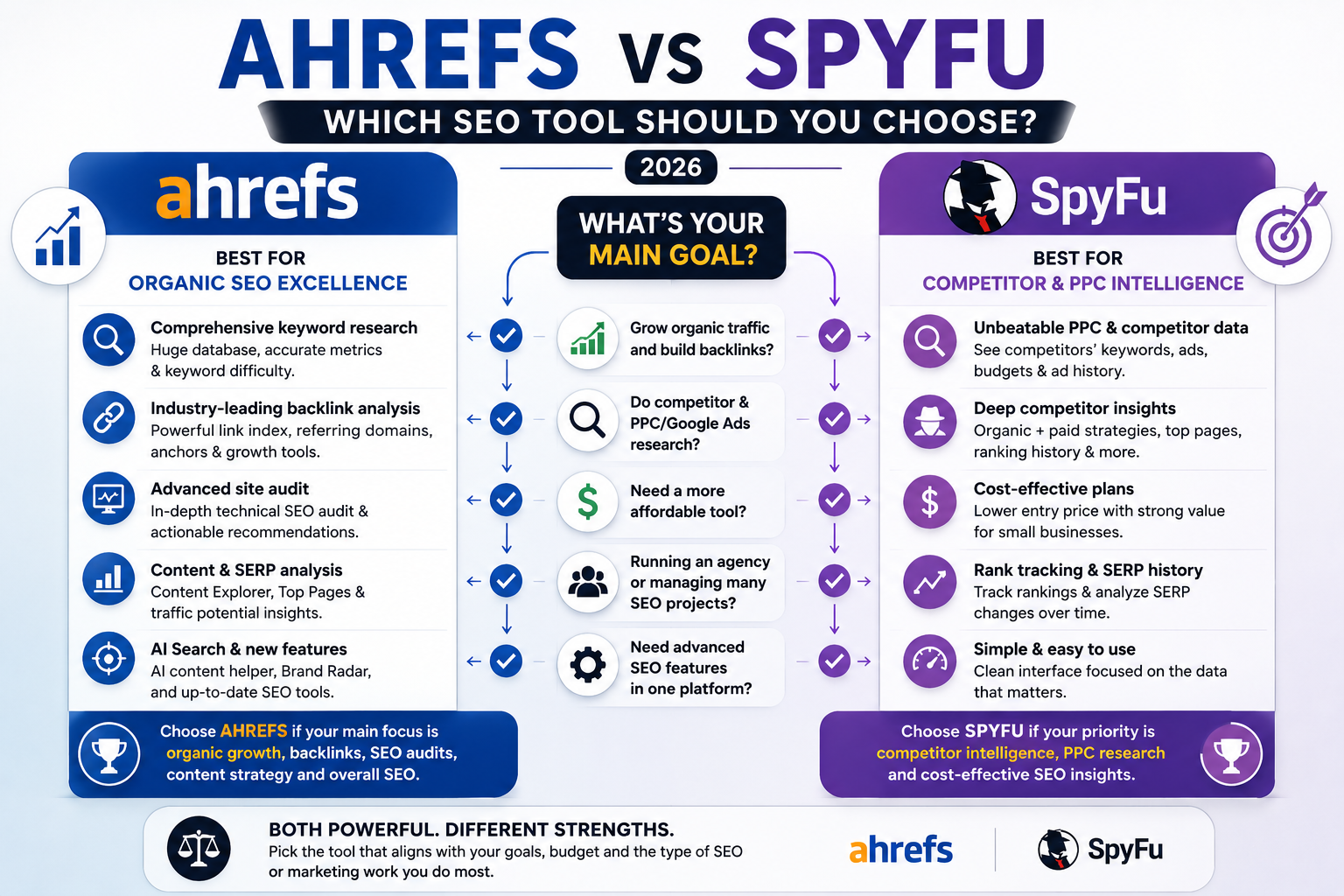
Choose Ahrefs If You Want:
- Deep backlink analysis.
- Comprehensive organic keyword research.
- Site Audit and technical SEO.
- Strong competitor organic research.
- Content and top-page analysis.
- Rank tracking inside a broader SEO platform.
- Dedicated AI-search visibility research through Brand Radar.
- A platform that can support a growing SEO team over time.
Choose SpyFu If You Want:
- Competitor keyword intelligence.
- Strong PPC and Google Ads research.
- Historical competitor advertising data.
- Organic and paid competitor research in one focused environment.
- A simpler starting point for competitor-driven SEO and PPC research.
- Lower-cost access to core competitive-search tools.
Ahrefs vs SpyFu for Small Businesses
Small businesses should not automatically choose the cheaper product. They should choose the platform that solves the highest-value problem.
If organic search is a major long-term acquisition channel and you need keyword research, link analysis, site auditing and content research, Ahrefs may justify the higher cost.
If your business mostly wants to understand competitors, identify proven search terms and improve PPC decisions, SpyFu may provide better value without requiring a broader SEO platform.
For smaller companies building a wider AI and software stack, our guide to AI tools for small businesses covers additional tools for productivity, sales, customer support, design and automation.
Ahrefs vs SpyFu for Bloggers and Content Websites
Bloggers and content-driven websites usually benefit more from Ahrefs because organic keyword research, backlinks, top-page analysis and content opportunity discovery are central to editorial SEO.
SpyFu can still be useful for competitor keywords and ranking history, particularly when you want a lower-cost view into what competing sites are doing.
But if your strategy depends heavily on link building, technical SEO and content-gap research, Ahrefs is generally the more complete fit.
Content teams may also want a specialist optimizer in addition to a research platform. Our Surfer SEO content optimization guide explains how Surfer approaches on-page content recommendations.
Ahrefs vs SpyFu for Agencies
Agencies need to think about client volume, reporting, seats, projects, exports, historical data and the type of services they actually sell.
An SEO agency delivering backlink audits, technical SEO, content research and organic competitor analysis will usually extract more value from Ahrefs.
An agency focused on paid search, competitive intelligence or businesses where Google Ads research is central may find SpyFu highly useful.
Some agencies may reasonably use both: Ahrefs for broad organic SEO and SpyFu for PPC competitor intelligence.
Ahrefs vs SpyFu for PPC Marketers
This is SpyFu’s strongest audience.
PPC marketers can use competitor paid-keyword data and historical advertising intelligence to study what other companies repeatedly bid on and how their paid-search strategies have changed.
Ahrefs can support paid-search research, but teams whose main job is Google Ads competitive analysis will generally get more specialized value from SpyFu.
Winner: SpyFu.
Ahrefs Pros and Cons
Ahrefs Pros
- Excellent backlink research.
- Strong keyword research.
- Powerful organic competitor analysis.
- Integrated technical Site Audit.
- Useful Rank Tracker.
- Strong content and page-level research.
- Growing AI-search visibility functionality.
Ahrefs Cons
- Can be expensive for very small websites.
- Credit and usage limits require attention on some plans.
- May be more platform than a casual SEO user needs.
- PPC research is not its main specialization.
SpyFu Pros and Cons
SpyFu Pros
- Excellent competitor-focused search research.
- Strong PPC and Google Ads intelligence.
- Historical paid-search data.
- Useful SEO competitor keyword research.
- More accessible pricing for many smaller teams.
- Higher plans add API and AI-related functionality.
SpyFu Cons
- Not as deep as Ahrefs for backlink analysis.
- Technical SEO capability is less comprehensive.
- Content research is not as broad as Ahrefs’ ecosystem.
- Not the best fit if you want one platform to handle advanced organic SEO end to end.
Ahrefs vs SpyFu: Winner by Category
| Category | Winner | Why |
|---|---|---|
| Organic Keyword Research | Ahrefs | Deeper organic SEO workflow and keyword ecosystem |
| Backlink Analysis | Ahrefs | Backlink intelligence is a core strength |
| Organic Competitor Research | Ahrefs | Strong domain, page, keyword and link research |
| PPC Competitor Research | SpyFu | Paid-search history and competitor ad intelligence |
| Technical SEO | Ahrefs | Site Audit provides a deeper technical workflow |
| Rank Tracking | Ahrefs | More integrated with broader SEO projects |
| Content Research | Ahrefs | Stronger content and top-page research ecosystem |
| AI Search Visibility | Ahrefs | Dedicated Brand Radar and AI prompt tracking |
| PPC Value | SpyFu | Built around competitive paid-search intelligence |
| Lower-Cost Competitive Research | SpyFu | Accessible entry point for core competitor tools |
| Overall Organic SEO | Ahrefs | Broader professional SEO toolkit |
Can You Use Ahrefs and SpyFu Together?
Yes. The two platforms overlap, but their strengths are different enough that some marketers can justify using both.
A team might use Ahrefs for backlink research, technical audits, keyword research and content strategy while using SpyFu specifically for paid-search intelligence and competitor ad history.
Whether that makes financial sense depends on your search budget and workload. Small companies should usually master one platform before adding another subscription.
Ahrefs and SpyFu Alternatives
Neither tool is automatically the right choice for every business.
Semrush is worth considering if you want a broad SEO and marketing platform with keyword research, site auditing, competitor intelligence and AI-search capabilities.
SE Ranking is another all-in-one option combining traditional SEO with GEO and AI-search tracking.
Surfer SEO is more specialized around content optimization rather than replacing Ahrefs or SpyFu.
For a broader market comparison, see our best AI SEO tools 2026 guide.
Frequently Asked Questions About Ahrefs vs SpyFu
Is Ahrefs better than SpyFu?
Ahrefs is generally the stronger choice for broad organic SEO, backlinks, technical SEO, content research and site analysis. SpyFu can be the better choice when PPC intelligence and competitor paid-search research are the main priorities.
Is SpyFu better than Ahrefs for PPC?
For dedicated competitor PPC and Google Ads intelligence, SpyFu has the advantage. Paid-search research and historical competitor advertising data are central parts of its platform.
Which is better for backlinks, Ahrefs or SpyFu?
Ahrefs is the stronger backlink platform. Its Site Explorer and backlink data are major reasons many SEO professionals use the product.
Which is better for keyword research?
Ahrefs is our choice for broad organic keyword research. SpyFu is particularly useful when the research starts with competitors and you want to see both their organic and paid keywords.
Is SpyFu cheaper than Ahrefs?
SpyFu currently has a lower monthly entry price for its core paid plan than Ahrefs’ full Lite subscription. However, the products include different capabilities, so price should be compared alongside the features you actually need.
Can SpyFu replace Ahrefs?
It can replace Ahrefs for some competitor and keyword research workflows, especially if PPC is important. It is less likely to fully replace Ahrefs for teams that depend heavily on backlinks, technical SEO and broader organic-search research.
Can Ahrefs replace SpyFu?
Ahrefs can cover much of an organic SEO workflow, but marketers who rely heavily on historical Google Ads competitor intelligence may still prefer SpyFu’s specialized paid-search research.
Which is better for small businesses?
SpyFu may provide better value for a small company primarily interested in competitor and PPC research. Ahrefs may be worth the extra investment when organic SEO, backlinks and technical site improvement are major growth channels.
Does Ahrefs track AI search visibility?
Yes. Ahrefs offers Brand Radar for AI-search visibility research and includes tracked AI prompts on its current core paid plans.
Does SpyFu include AI features?
Yes. SpyFu’s current Pro + AI offering includes RivalFlow AI and AI visibility functionality, with additional higher-plan capabilities.
Final Verdict: Ahrefs vs SpyFu in 2026
The Ahrefs vs SpyFu decision becomes much easier once you stop asking which product has more features and start asking which search problem you need to solve.
Choose Ahrefs if your work revolves around organic SEO, backlink analysis, keyword research, technical audits, content research and building a complete search strategy. It is the stronger overall SEO platform in this comparison.
Choose SpyFu if competitor intelligence and PPC research are your main priorities. It is particularly valuable when you want to study competitors’ organic keywords, paid keywords, ad history and search strategy without paying primarily for backlink and technical SEO depth.
For many small businesses, SpyFu may be the more economical competitor-research tool. For professional SEO teams, content sites and agencies managing serious organic-search campaigns, Ahrefs is more likely to justify the additional investment.
There is no universal winner. Ahrefs wins overall organic SEO; SpyFu wins specialized PPC competitor intelligence. Choose according to the work you do most often.
Last reviewed: August 2026
Disclosure: Features, plan limits and pricing can change. Always confirm the latest information on the official Ahrefs and SpyFu websites before purchasing. If XVIFS later adds affiliate relationships to this comparison, those relationships should be disclosed without changing our editorial conclusions.