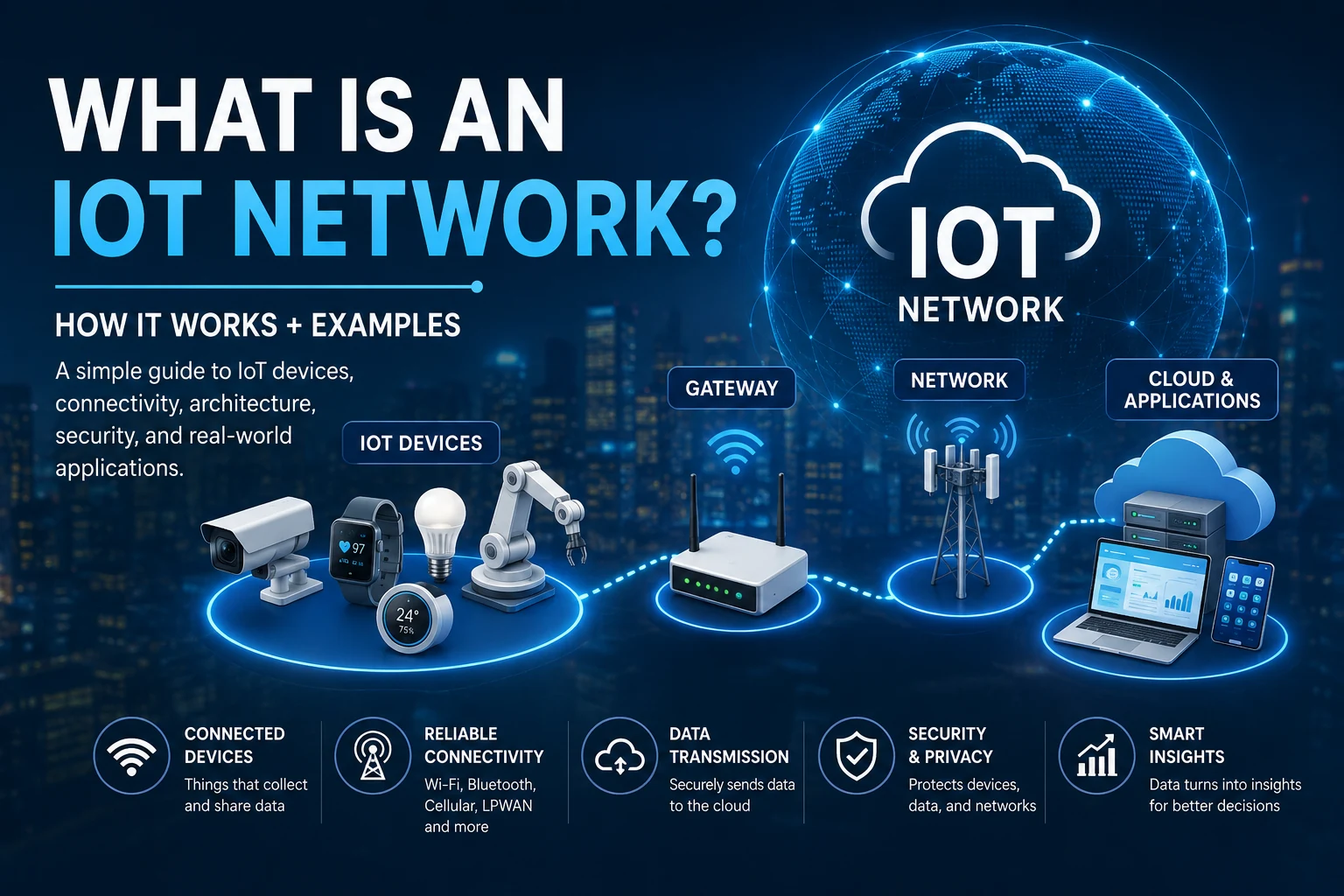
The simplest way to understand an IoT network is to think of it as a bridge between the physical and digital worlds. Devices collect information from the real world, networks move that information, cloud or edge systems process it, and applications turn it into alerts, automation, dashboards, and decisions.
What Is an IoT Network? Quick Definition
An IoT network is the communication and computing environment that allows Internet of Things devices to send data to other devices, gateways, edge systems, cloud platforms, and applications.
For example, a smart thermostat may collect temperature data, send it over Wi-Fi to a gateway or directly to a cloud platform, and allow a mobile app to display the current temperature or automatically adjust the HVAC system.
In larger systems, thousands of sensors may communicate through cellular, Wi-Fi, Bluetooth, Ethernet, or low-power wide-area networks before the data reaches cloud services and business applications.
How Does an IoT Network Work?
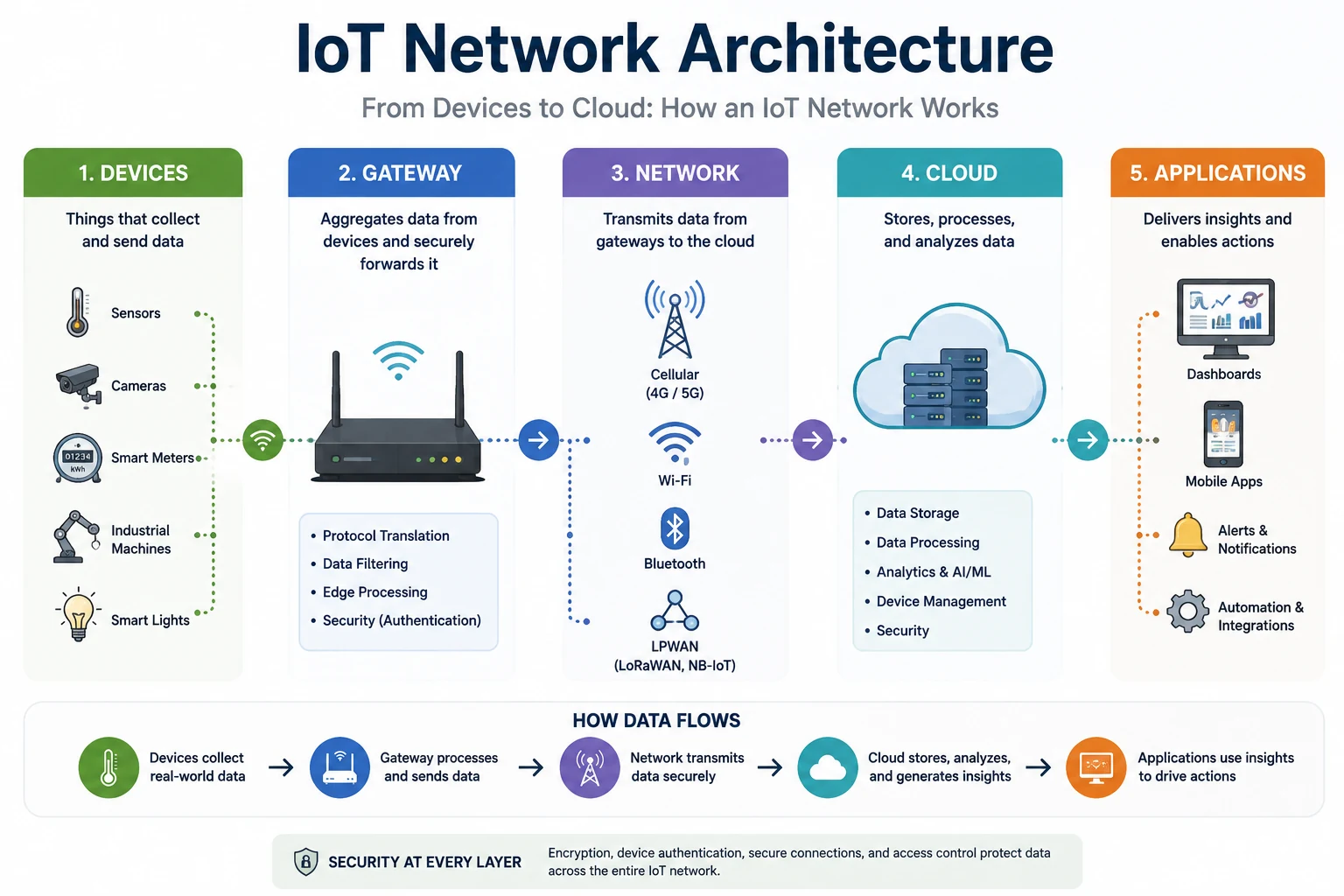
Most IoT networks follow the same basic data flow:
- Devices collect data.
- A gateway or edge system may process and forward it.
- A communication network transports the data.
- Cloud or edge services store and analyze it.
- Applications use the results to display information or trigger actions.
AWS explains that its IoT services connect devices to other devices and cloud services, while supporting protocols such as MQTT, MQTT over secure WebSockets, HTTPS, and LoRaWAN. AWS IoT Core documentation provides a useful example of how cloud platforms fit into this architecture.
IoT Network Architecture
IoT architecture can be described in several ways, but most designs include device, connectivity, processing, and application layers. Microsoft’s Azure Architecture Center describes an IoT architecture using layers such as sensing, networking, data ingestion, data processing, and application/presentation. Microsoft’s IoT architecture guidance is a useful reference for this layered approach.
1. IoT Devices and Sensors
The first layer contains the physical devices that collect information or perform actions.
Examples include:
- temperature and humidity sensors;
- security cameras;
- smart meters;
- wearables;
- industrial machines;
- vehicle trackers;
- smart lights;
- medical monitoring devices;
- agricultural sensors.
Some devices only send information. Others can both send data and receive commands, allowing the network to control equipment remotely.
2. IoT Gateway
An IoT gateway sits between devices and the wider network. It can collect data from multiple devices, translate protocols, filter information, perform basic security checks, and reduce the amount of data that must travel to the cloud.
Gateways are especially important when local devices use short-range or specialized protocols that cannot connect directly to cloud services.
3. Connectivity and Network Layer
The communication layer transports data from devices or gateways to processing systems. The best technology depends on range, bandwidth, power consumption, cost, and reliability requirements.
Common connectivity options include:
| Technology | Typical Use | Strength |
|---|---|---|
| Wi-Fi | Homes, offices, buildings | Good bandwidth and familiar infrastructure |
| Bluetooth / BLE | Wearables, nearby sensors | Low power and short range |
| Ethernet | Industrial and fixed devices | Reliable wired connection |
| 4G / 5G | Vehicles, remote assets, cities | Wide coverage and mobility |
| LoRaWAN | Agriculture, smart meters, remote sensors | Long range and low power |
| NB-IoT / LTE-M | Low-power cellular IoT | Wide-area cellular connectivity |
4. Cloud or Edge Processing
After transmission, data is stored, processed, analyzed, and sometimes combined with other information.
Cloud platforms can support:
- device management;
- data storage;
- stream processing;
- analytics;
- AI and machine learning;
- alerting;
- application integration.
Some processing may happen closer to the device at the edge. This can reduce latency, lower bandwidth use, and keep certain operations working even if the internet connection is interrupted.
Organizations building custom cloud-connected systems can also review the XVIFS guide to Cloud Application Development for architecture, deployment, integration, and scalability considerations.
5. Applications and User Interfaces
The final layer turns raw IoT data into something useful.
Applications may provide:
- dashboards;
- mobile apps;
- alerts and notifications;
- automated actions;
- reports;
- integration with business systems.
A warehouse manager might see equipment status on a dashboard, while an automated system may create a maintenance ticket when a machine exceeds a temperature threshold.
Common IoT Network Protocols
IoT networks use communication protocols that define how devices exchange information.
MQTT
MQTT is a lightweight publish-subscribe messaging protocol widely used in IoT. Devices can publish data to topics while other systems subscribe to the information they need.
Its lightweight design makes it useful for environments where devices have limited processing power or bandwidth.
HTTP and HTTPS
Web protocols can also be used by IoT systems, especially where devices communicate with REST APIs or cloud services. HTTPS provides encryption for data transmitted over the network.
CoAP
The Constrained Application Protocol is designed for resource-constrained devices and networks. It supports web-style interactions while using less overhead than traditional HTTP in some environments.
LoRaWAN
LoRaWAN is designed for long-range, low-power communications. It is commonly associated with remote sensors, agriculture, utility metering, and large-area monitoring.
Real-World IoT Network Examples
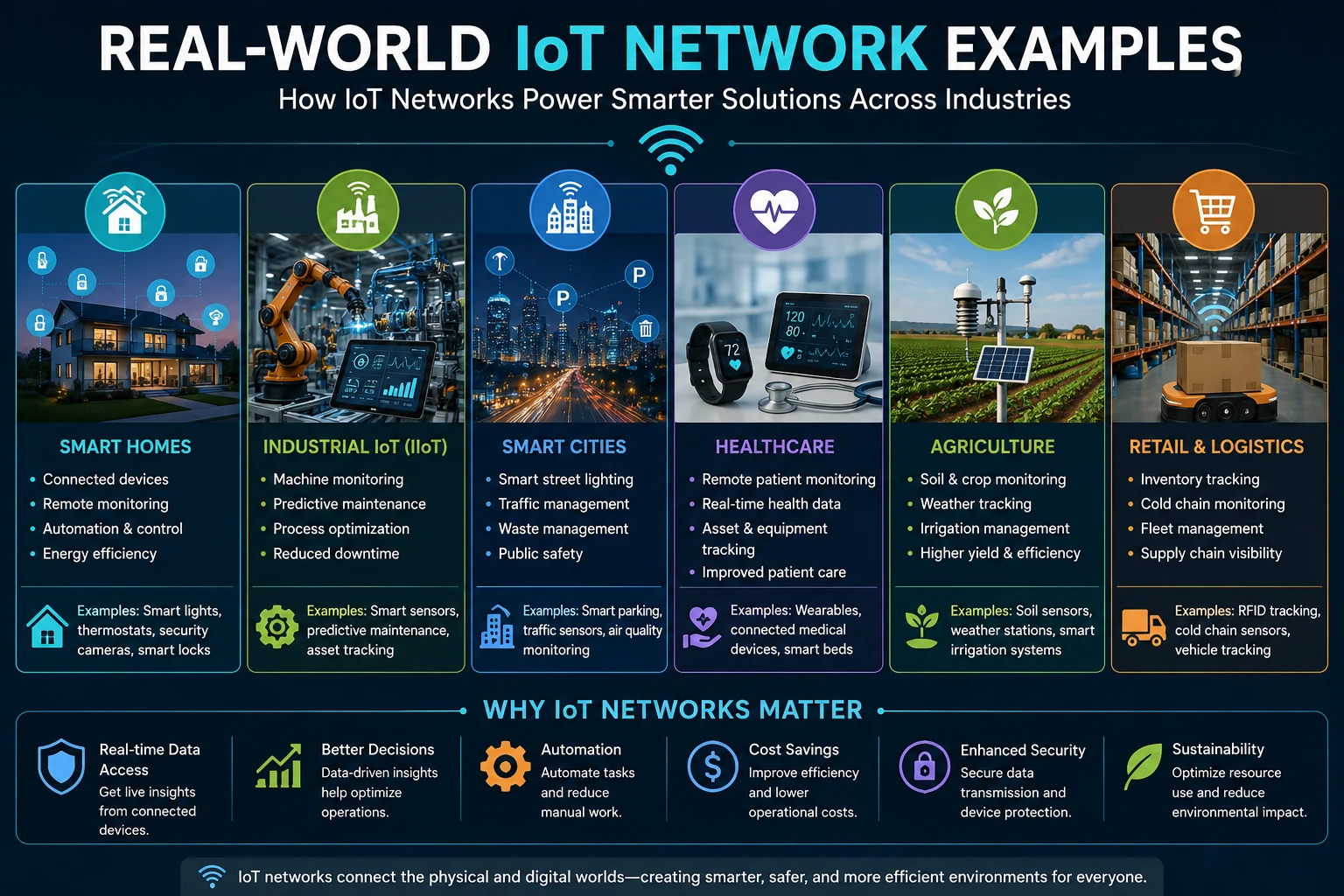
IoT networks already operate across homes, factories, transportation systems, healthcare, agriculture, retail, and public infrastructure.
Smart Homes
Smart-home networks connect devices such as:
- thermostats;
- lights;
- security cameras;
- door locks;
- smart speakers;
- energy monitors.
These devices can be monitored or controlled through apps, voice assistants, automation rules, or centralized hubs.
Industrial IoT
Factories use connected sensors and machines to monitor vibration, temperature, pressure, equipment condition, production output, and energy use.
This data can support predictive maintenance, process optimization, asset tracking, and reduced downtime.
Smart Cities
IoT networks can support:
- smart street lighting;
- parking sensors;
- traffic monitoring;
- waste management;
- air-quality monitoring;
- public-safety systems.
Because these applications may include large numbers of distributed devices, network coverage, reliability, security, and lifecycle management become especially important.
Healthcare
Connected healthcare systems can use wearables and medical devices to collect health data, monitor equipment, and support remote patient care.
Because health information is sensitive, healthcare IoT requires particularly strong security, privacy, access control, and compliance processes.
Agriculture
Farmers can use IoT networks to monitor soil moisture, weather conditions, irrigation, livestock, machinery, and crop health.
Long-range, low-power technologies are especially useful when sensors are spread across large outdoor areas.
Retail and Logistics
Retailers and logistics companies use connected devices for inventory tracking, cold-chain monitoring, fleet management, warehouse automation, and shipment visibility.
IoT data can also support better stock planning. Small companies managing physical products may find the XVIFS guide to Small Business Inventory Management useful for understanding the operational side of inventory control.
IoT Network Security
Security is one of the most important parts of IoT network design because every connected device can potentially become another point of exposure.
NIST’s IoT cybersecurity guidance emphasizes that organizations should consider device cybersecurity requirements as part of broader system risk management. NIST SP 800-213 provides guidance on establishing security requirements for IoT devices integrated into information systems.
NIST also defines a core baseline of cybersecurity capabilities for IoT devices to support common security controls. This includes capabilities related to device identification, configuration, data protection, logical access, software updates, and cybersecurity-state awareness.
Important IoT Security Controls
- Strong device authentication: Verify devices before allowing them onto the network.
- Encryption: Protect data while it is transmitted and stored.
- Access control: Limit users, systems, and devices to the permissions they actually require.
- Secure updates: Keep device firmware and software patched.
- Network segmentation: Separate IoT devices from critical systems where appropriate.
- Monitoring: Detect unusual device behavior or communication patterns.
- Credential management: Avoid default passwords and rotate credentials when required.
For organizations using cloud-connected IoT services, the XVIFS guide to Cloud Security Policy can help with broader governance around access, data protection, monitoring, and third-party services.
IoT Network vs Traditional Computer Network
| Feature | IoT Network | Traditional Network |
|---|---|---|
| Primary endpoints | Sensors, machines, appliances, embedded devices | PCs, laptops, servers, phones |
| Device capability | Often limited power and processing | Usually more powerful |
| Scale | Can include very large numbers of devices | Typically fewer managed endpoints |
| Connectivity | Wi-Fi, cellular, BLE, LPWAN, Ethernet and more | Mostly Ethernet, Wi-Fi, cellular |
| Main purpose | Sense, monitor, automate, control | General computing and communications |
IoT Network vs Edge Computing
IoT and edge computing are related but different.
An IoT network connects devices and moves data. Edge computing describes processing that happens close to where the data is generated instead of sending everything to a distant cloud environment.
For example, a factory camera may analyze video locally and send only an alert when it detects a problem. This reduces bandwidth requirements and may allow faster responses.
Readers interested in local AI processing can also explore the XVIFS guide to Edge AI for Real-Time Analytics.
Benefits of IoT Networks
Real-Time Visibility
Connected sensors can provide continuous information about equipment, environments, assets, or customer activity.
Automation
IoT data can trigger automatic actions such as turning equipment off, adjusting temperature, creating a maintenance request, or sending an alert.
Better Decisions
Organizations can use historical and real-time data to understand performance and make more informed operational decisions.
Reduced Costs
Monitoring energy, maintenance needs, inventory, and equipment performance can help reduce waste and unnecessary downtime.
Improved Customer Experience
Connected products can provide remote control, proactive support, personalized services, and better visibility.
Challenges of IoT Networks
IoT networks also introduce practical challenges.
Security and Privacy
A larger number of connected devices increases the number of systems that must be configured, monitored, patched, and protected.
Interoperability
Devices from different manufacturers may use different protocols, data formats, or management platforms.
Scalability
A solution that works with ten devices may need a different architecture when it grows to ten thousand devices.
Connectivity
Remote locations, interference, bandwidth limits, or unreliable coverage can affect network performance.
Device Lifecycle Management
Organizations must plan how devices are provisioned, updated, monitored, replaced, and eventually retired.
How to Design an IoT Network
A practical IoT network design process can follow these steps:
- Define the business problem. Decide what needs to be monitored, controlled, or automated.
- Select the right devices. Consider sensors, power requirements, environment, and expected lifetime.
- Choose connectivity. Balance range, speed, power consumption, cost, and coverage.
- Decide on gateway and edge processing. Determine what should happen locally.
- Choose cloud or platform services. Plan storage, analytics, integrations, and device management.
- Design security from the beginning. Authentication, encryption, access control, updates, and monitoring should not be afterthoughts.
- Plan for scale. Consider what happens when device counts and data volumes grow.
- Monitor continuously. Track device health, communication failures, security events, and application performance.
Frequently Asked Questions About IoT Networks
What is an IoT network in simple terms?
An IoT network is a group of connected physical devices that collect and exchange data through communication networks so applications can monitor, analyze, or control them.
What devices are part of an IoT network?
Devices may include sensors, cameras, smart meters, wearables, machines, vehicles, appliances, industrial equipment, medical devices, and other connected hardware.
Does every IoT device connect directly to the internet?
No. Some devices connect to a local gateway, hub, or edge device first. The gateway then communicates with cloud or business systems.
What networks are used for IoT?
IoT systems may use Wi-Fi, Bluetooth, Ethernet, 4G, 5G, LoRaWAN, NB-IoT, LTE-M, and other wired or wireless technologies depending on the application.
What is an IoT gateway?
An IoT gateway connects local devices with wider networks or cloud services. It may also translate protocols, filter data, perform local processing, and apply security controls.
Is IoT the same as cloud computing?
No. IoT refers to connected physical devices and systems, while cloud computing provides remote computing resources such as storage, processing, analytics, and applications. Many IoT solutions use cloud services, but the two concepts are different.
Are IoT networks secure?
They can be secure when designed and managed properly, but security depends on device capabilities, configuration, authentication, encryption, updates, network design, monitoring, and operational practices.
Final Thoughts
If you are asking what is an IoT network, the simplest answer is that it is the system that allows connected physical devices to communicate, share data, and interact with digital services.
A complete IoT network typically includes devices, gateways, communication technologies, cloud or edge processing, applications, and security controls.
The technology becomes valuable when those components work together to create a useful outcome: monitoring equipment, automating a process, reducing energy use, tracking assets, improving healthcare, or helping a business make faster decisions.
As IoT deployments grow, strong architecture, reliable connectivity, security, device management, and scalable cloud or edge processing will remain just as important as the devices themselves.