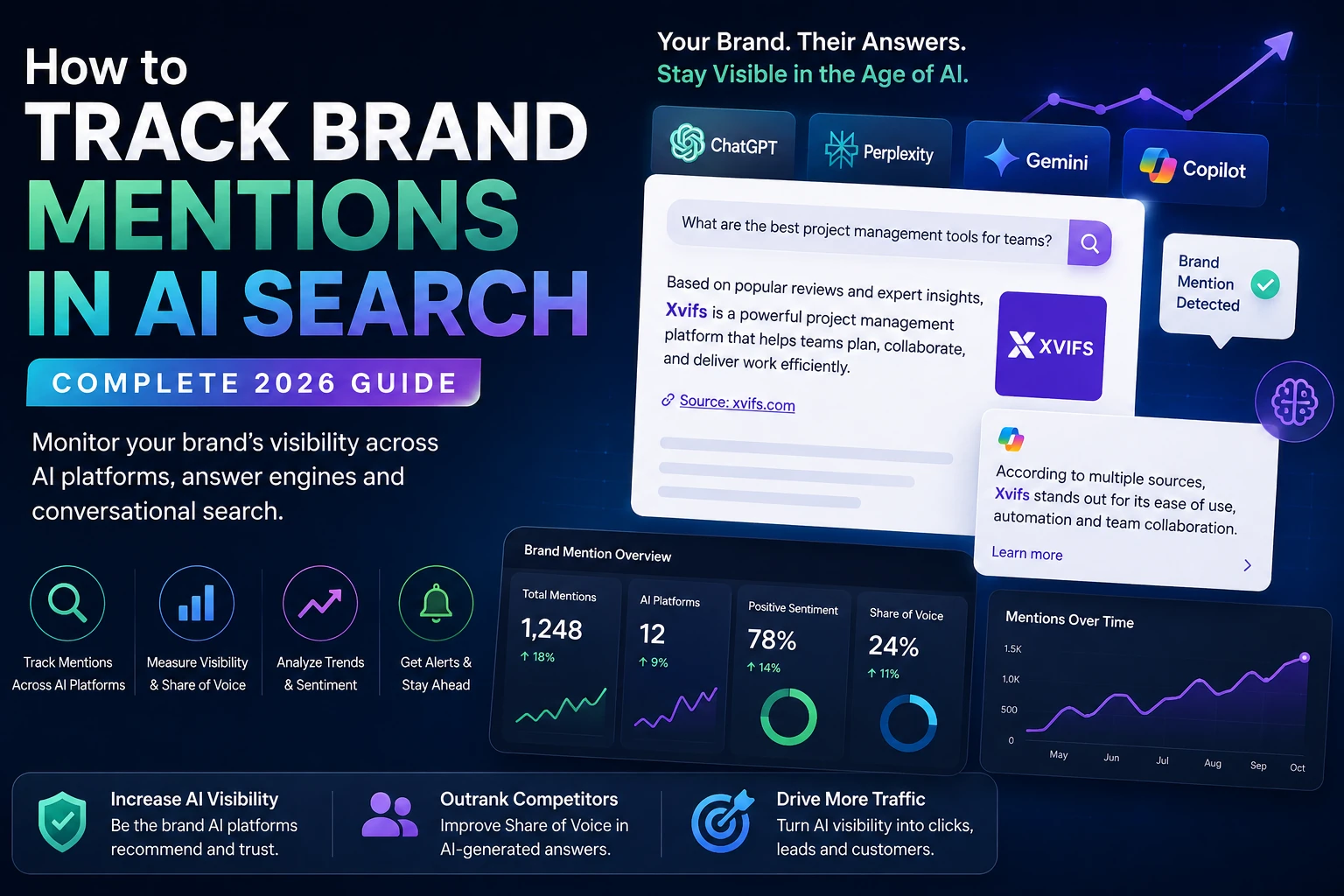
4Search visibility is changing. Customers are no longer discovering brands only through traditional Google results, social media, and review websites. They are increasingly asking AI systems such as ChatGPT, Gemini, Perplexity, Microsoft Copilot, Google AI Overviews, and other answer engines for recommendations, comparisons, explanations, and buying advice.That creates a new marketing question: How to Track Brand Mentions in AI Search when traditional SEO rank tracking does not show whether an AI answer recommends, cites, ignores, or negatively describes your brand?AI search monitoring helps businesses understand whether their brand appears in AI-generated answers, which sources influence those mentions, how often competitors appear instead, what sentiment surrounds the brand, and which topics create the strongest visibility opportunities.This XVIFS guide explains How to Track Brand Mentions in AI Search in 2026, the metrics that matter, the tools available, how to build a practical monitoring workflow, and how businesses can improve their visibility across AI answer engines.
What Are Brand Mentions in AI Search?
A brand mention in AI search occurs when an AI-generated response refers to a company, product, service, website, executive, or branded entity in response to a user prompt.The brand does not always need to receive a clickable link for the mention to matter. AI assistants can mention a business by name, describe its products, compare it with competitors, recommend it, or cite content from its website.Examples of prompts that may trigger brand mentions include:
What are the best project management tools for small businesses?
Which CRM is best for startups?
What are alternatives to Semrush?
Which accounting software is best for freelancers?
What are the best AI tools for customer support?
Compare Brand A vs Brand B.
Which companies provide managed cloud services?
What software is best for social monitoring?
If your brand appears consistently in useful, commercially relevant answers, AI systems may become another important discovery channel. If competitors appear and your brand does not, that visibility gap deserves investigation.
Why Tracking AI Brand Mentions Matters in 2026
Traditional search analytics tell you about impressions, rankings, clicks, and website traffic. Those metrics remain important, but they do not fully explain what happens inside AI-generated answers.A user may ask an AI assistant for recommendations and receive several brand names without visiting a traditional search-results page. This creates an additional layer of brand discovery that conventional rank tracking may not capture.Tracking AI visibility can help businesses understand:
Whether AI platforms mention the brand
Which prompts trigger mentions
Which competitors appear more frequently
Whether the brand is cited as a source
Which webpages influence AI answers
How AI systems describe the brand
Whether sentiment is positive, neutral, or negative
Which topics create visibility gaps
How visibility changes over time
How AI Brand Mention Tracking Works
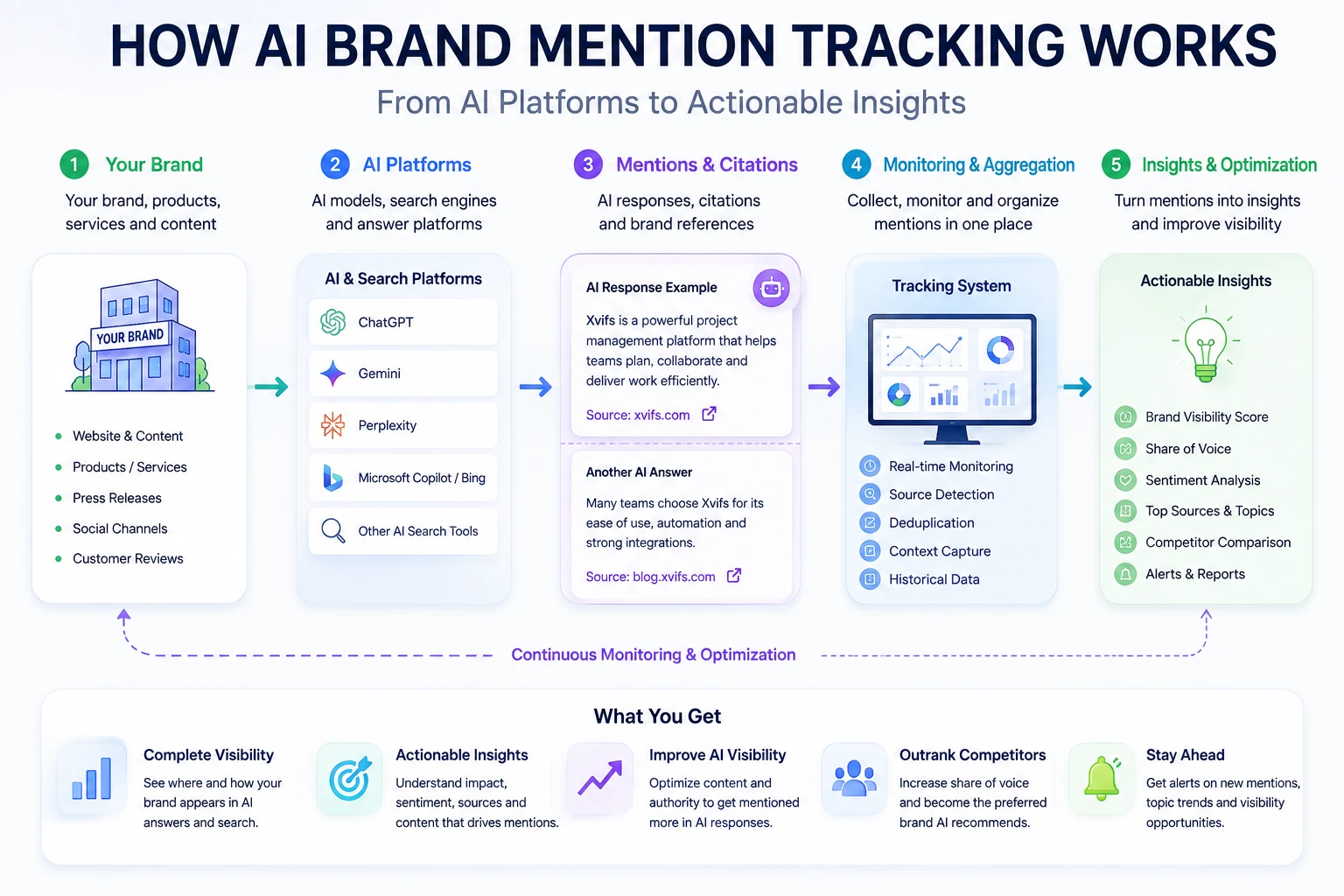
AI brand mention tracking connects relevant prompts, AI responses, citations, monitoring data and competitive insights into one continuous visibility workflow.The basic process has five stages.
1. Define the Brand and Topics
Start with the brand name, product names, services, important executives, competitors, categories, and commercial topics that matter to the business.For example, a marketing software company may track its own name together with phrases such as “best social monitoring software,” “social listening tools,” and competitor comparison queries.
2. Build a Prompt Set
Identify the questions real customers are likely to ask AI platforms.A good prompt library should include:
Category discovery queries
Best-tool queries
Comparison queries
Problem-solving questions
Alternative-product queries
Buying-intent queries
Brand-specific questions
Competitor-specific questions
3. Check AI Responses
The monitoring system evaluates responses from selected AI platforms and determines whether the brand appears, where it appears, which competitors are mentioned, and which sources are cited.
4. Aggregate and Compare the Results
Mentions become much more useful when tracked over time rather than reviewed as isolated screenshots.A monitoring platform can organize mentions by AI engine, prompt, country, topic, date, sentiment, citation source, or competitor.
5. Turn Visibility Gaps into Actions
The final step is not simply collecting mentions. Businesses should identify why some topics perform well, why competitors appear instead, and which content or authority gaps may be limiting visibility.
AI Platforms You Should Monitor
The exact platform mix depends on your audience, but businesses commonly evaluate visibility across:
ChatGPT
Google AI Overviews
Google AI Mode
Gemini
Perplexity
Microsoft Copilot
Claude
Other emerging AI answer platforms relevant to the market
The most important principle is not to assume that performance on one AI system automatically represents visibility across all others. Different platforms use different models, search systems, sources, retrieval methods, and update cycles.
Important AI Brand Visibility Metrics
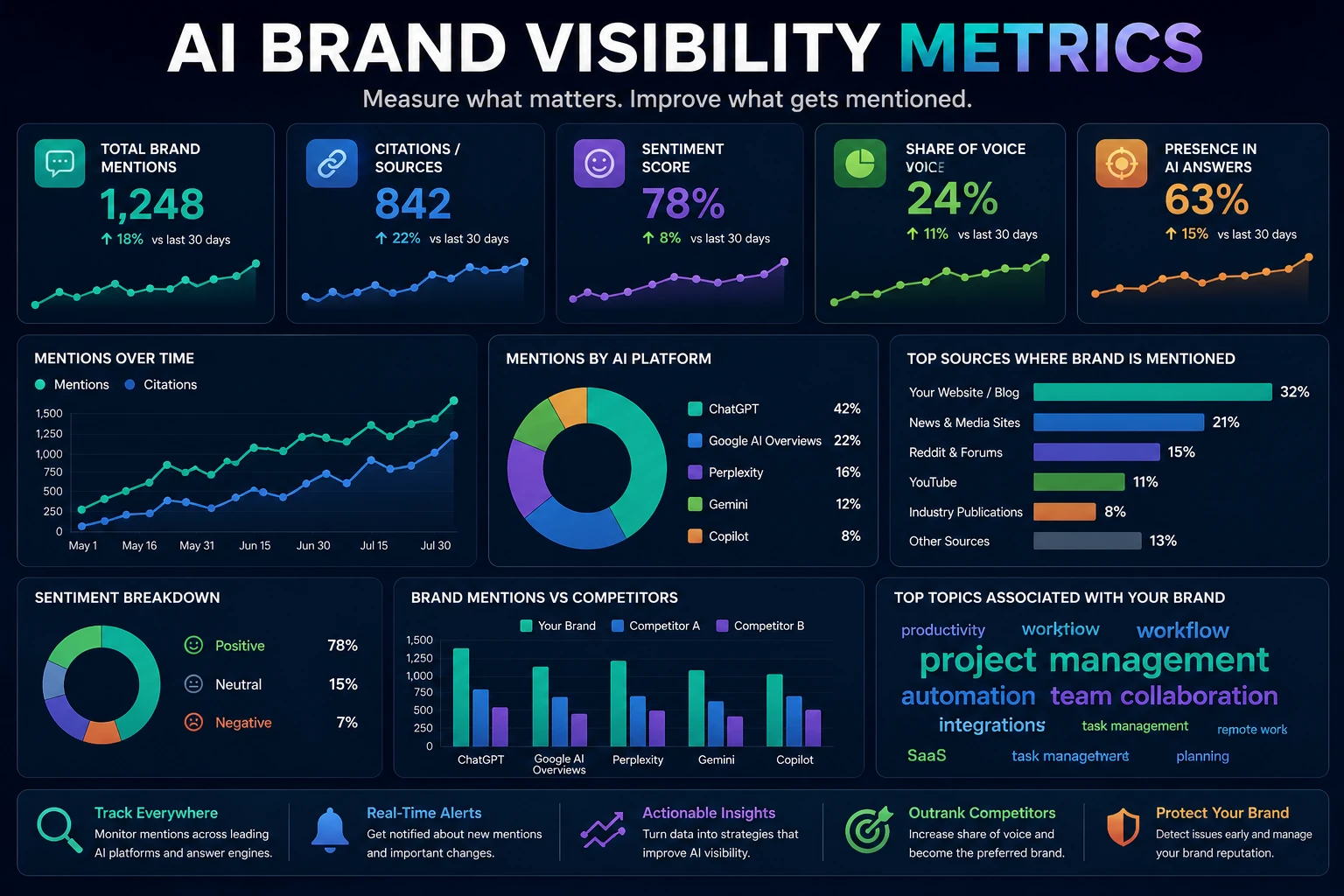
Useful AI visibility metrics include mentions, citations, sentiment, share of voice, AI-answer presence, source visibility and competitor comparisons. Dashboard figures shown are illustrative.Businesses learning How to Track Brand Mentions in AI Search should monitor these metrics consistently instead of relying on individual AI responses or isolated screenshots.
Brand Mentions
A mention records whether the brand appears in an AI-generated answer. Tracking total mentions over time can show whether visibility is improving or declining.
AI Share of Voice
AI share of voice compares your visibility with selected competitors across the tracked prompt set.For example, if your brand appears in 20 relevant answers while a competitor appears in 60, the competitor has significantly greater AI presence within that monitored topic set.
Citations
A citation occurs when an AI answer references a webpage or source that supports the response.Citation analysis is particularly valuable because it can reveal which websites, publishers, forums, product pages, articles, or third-party sources influence AI answers.
Cited Pages
Track which specific pages from your own website receive citations. This can help identify content that already has strong AI-search influence.
Presence Rate
Presence rate measures how often your brand appears across a defined prompt set.If you track 100 prompts and your brand appears in 25 responses, your monitored presence rate is 25% for that test set.
Sentiment
A brand mention is not automatically positive. Monitoring how AI systems describe your company can be as important as counting mentions.Look for whether the brand is described positively, neutrally, or negatively, but use automated sentiment carefully because context can be difficult to classify perfectly.
Competitor Mentions
Competitor mentions help answer a critical question: Who does AI recommend when it does not recommend us?
Topic Coverage
Topic coverage shows which subject areas are associated with your brand and where important gaps remain.
Best Tools for Tracking Brand Mentions in AI Search
The best method for How to Track Brand Mentions in AI Search depends on your brand size, number of competitors, target markets, number of tracked prompts and monitoring frequency.AI visibility monitoring is becoming a major software category. Traditional SEO platforms, brand-monitoring companies, and specialized GEO tools are all entering the market.
Ahrefs Brand Radar
Ahrefs Brand Radar is designed specifically for discovering and monitoring brand visibility across AI search and related discovery channels.Current Brand Radar capabilities include tracking brand mentions across AI answers, comparing competitors, analyzing citations, monitoring custom prompts, and reviewing AI share of voice.See the current product details on the official Ahrefs Brand Radar page.
Semrush AI Visibility Toolkit
Semrush has expanded from traditional SEO monitoring into dedicated AI visibility analysis.Its AI Visibility Toolkit can help businesses review AI visibility scores, mentions, cited pages, citations, competitor visibility, prompt gaps, trends, and distribution across different AI platforms.Businesses already using Semrush for keyword research, competitor analysis, rankings, and content strategy may find this integration particularly useful.Review current capabilities through the Semrush AI Visibility resources.
Brand24 AI Visibility
Brand24 has expanded its traditional brand-monitoring capabilities into AI visibility tracking.Its AI-focused tools are designed to monitor brand presence across major LLM environments, compare competitors, track prompts, and analyze the sources associated with AI visibility.See the official Brand24 AI Visibility page for current features.
Manual AI Brand Mention Tracking
A dedicated platform is more scalable, but small businesses can start manually before purchasing specialized software.A basic manual process might look like this:
Create 20–50 important customer prompts.
Run the same prompts across several AI platforms.
Record whether your brand appears.
Record competitor mentions.
Capture citations or source links where available.
Note how the brand is described.
Repeat the test monthly.
Compare visibility changes.
A spreadsheet can work initially, but manual monitoring becomes difficult as the number of prompts, competitors, countries, and AI systems increases.
How to Build an AI Brand Mention Tracking Dashboard
A useful dashboard should focus on business questions rather than displaying every available metric.
Metric
Question It Answers
Brand Mentions
How often does AI mention us?
Presence Rate
What percentage of important prompts include our brand?
AI Share of Voice
How visible are we compared with competitors?
Citations
Which sources support AI answers?
Cited Pages
Which pages from our site influence AI visibility?
Sentiment
How is the brand described?
Prompt Gaps
Which valuable questions mention competitors but not us?
Platform Distribution
Which AI platforms mention us most often?
Trend
Is visibility improving over time?
How to Find AI Visibility Gaps
A visibility gap occurs when your brand is relevant to a topic but does not appear in AI answers while competitors do.For every important prompt, compare:
Was your brand mentioned?
Which competitors appeared?
Which sources were cited?
What information supported the answer?
Does your website contain a strong page addressing the topic?
Are competitors receiving coverage from authoritative third-party sources?
These gaps can reveal new content opportunities, PR opportunities, review opportunities, category pages, comparison content, product documentation, or external authority signals worth developing.
How to Improve Brand Visibility in AI Search
There is no guaranteed formula for forcing an AI system to mention a brand. However, businesses can improve the quality and discoverability of the information available about them.
Create Clear Entity Information
Your website should clearly explain what the company is, what it offers, who it serves, and how its products or services differ from competitors.
Build Strong Topic Coverage
AI systems need useful source material. Create comprehensive pages around the topics, questions, use cases, and comparison searches important to your customers.
Publish Original Information
Original benchmarks, research, practical testing, customer data, methodologies, expert commentary, templates, and useful examples can create stronger source value than generic content rewritten from existing pages.
Earn Third-Party Mentions
AI visibility may be influenced by information across the broader web, not only by your own domain.Relevant industry coverage, reviews, reputable directories, expert citations, community discussions, and authoritative backlinks can strengthen the digital evidence surrounding a brand.
Create Comparison Content
Users frequently ask AI assistants to compare software and recommend alternatives.Useful comparison content can therefore support both traditional SEO and AI-search discovery. Our Ahrefs vs Semrush vs Ubersuggest comparison is an example of this content format.
Keep Important Information Current
Outdated pricing, features, product names, company descriptions, and statistics can weaken the reliability of a page.AI-search optimization therefore requires ongoing content maintenance rather than one-time publishing.
AI Brand Monitoring vs Traditional Social Monitoring
Area
AI Brand Monitoring
Social Monitoring
Primary Environment
AI assistants and answer engines
Social networks, web, forums and media
Main Metric
AI mentions, citations and share of voice
Conversation mentions, sentiment and engagement
Typical User Action
Ask a question or prompt
Post, comment, share or discuss
Visibility Challenge
Brand inclusion inside generated answers
Brand visibility inside public conversations
Optimization Focus
Content, authority, citations and entity relevance
Engagement, reputation and conversation response
Businesses should monitor both. Our Best Social Monitoring Tools guide covers traditional brand and conversation monitoring in more detail.
AI Brand Monitoring vs Traditional SEO Rank Tracking
Traditional rank tracking asks: Where does our webpage rank for this keyword?AI visibility monitoring asks: Does the AI answer mention our brand, recommend us, cite us, or use sources that support competitors instead?These metrics complement each other rather than replace one another. A website can rank strongly in traditional search while still receiving weak AI-answer visibility, and the opposite can also occur for some prompts.
Quarterly: Slow-moving industries where visibility changes gradually
Daily: Selected high-priority prompts during launches, crises, major campaigns, or competitive events
A consistent tracking schedule matters more than repeatedly testing random prompts.
Common AI Brand Tracking Mistakes
Tracking Only the Brand Name
If you only ask AI systems about your exact brand name, you will miss the more valuable discovery stage where users ask category and recommendation questions.
Ignoring Competitors
Your visibility means little without context. Competitor share of voice is one of the most useful benchmarks.
Treating Every Mention as Equal
A mention in a highly commercial recommendation prompt may be much more valuable than a mention in an obscure informational question.
Ignoring Citation Sources
If a competitor is frequently recommended, investigate which sources support those recommendations instead of only trying to repeat the competitor’s keywords.
Expecting Instant Results
AI visibility can change as models, search indexes, source selection systems, and web content evolve. Optimization should be treated as an ongoing process.
XVIFS AI Brand Visibility Tracking Checklist
A repeatable process for How to Track Brand Mentions in AI Search makes it easier to compare visibility changes month over month and identify whether optimization work is actually improving AI presence.
Define your primary brand and products
Select 3–5 important competitors
Create a list of category-level prompts
Create commercial comparison prompts
Track brand mentions across major AI platforms
Measure presence rate
Measure AI share of voice
Monitor citations and cited pages
Review sentiment and context
Identify competitor-only prompts
Analyze common citation sources
Create content for major visibility gaps
Strengthen third-party authority signals
Repeat monitoring on a fixed schedule
Compare visibility month over month
Frequently Asked Questions About AI Brand Mentions
How do I track brand mentions in AI search?
You can track AI brand mentions manually by testing important prompts across major AI platforms or use dedicated tools such as Ahrefs Brand Radar, Semrush AI Visibility Toolkit, Brand24 AI Visibility and other specialized AI-monitoring platforms.
Can I see whether ChatGPT mentions my brand?
Yes. You can manually test relevant prompts or use AI-visibility software that monitors responses across ChatGPT and other supported AI systems.
What is AI share of voice?
AI share of voice compares how often your brand appears in tracked AI answers relative to selected competitors.
Are AI citations the same as brand mentions?
No. A brand mention refers to the brand being named or referenced in an AI response, while a citation refers to a source or webpage used or linked in support of the answer.
Does appearing in AI search improve SEO?
AI visibility and traditional SEO are connected but different. Strong websites, authoritative content and reputable mentions may support both, but an AI mention does not automatically improve traditional rankings.
Can small businesses track AI visibility?
Yes. Small businesses can begin manually with a focused list of important prompts and move to specialized software as monitoring requirements grow.
How many prompts should I track?
There is no universal number. A small business can start with 20–50 high-value prompts, while larger brands may track hundreds or thousands across multiple countries, products and categories.
Can AI brand visibility be guaranteed?
No. Businesses cannot guarantee that an AI system will mention or recommend them. The goal is to improve the quality, authority, relevance and availability of the information that AI systems can discover and use.
Final Thoughts: How to Track Brand Mentions in AI Search
Learning How to Track Brand Mentions in AI Search is becoming an important part of modern SEO, brand monitoring, digital PR and competitive intelligence.The most useful approach is to monitor more than simple brand-name mentions. Track commercial prompts, citations, share of voice, competitors, sentiment, platform distribution and the sources influencing AI-generated answers.Start with a focused set of important customer questions, benchmark your current visibility, identify where competitors dominate, and then strengthen the content and authority signals associated with those topics.Traditional SEO is not disappearing, but brand discovery is becoming broader. Businesses that measure both search rankings and AI-answer visibility will have a clearer picture of how customers discover them in 2026.XVIFS Editorial Note: AI search products, monitoring platforms, data coverage and visibility metrics change rapidly. Product capabilities referenced in this guide were reviewed in August 2026. Always verify current platform coverage, pricing and measurement methodology directly with the provider.
XVIFS helps businesses, marketers, creators, and entrepreneurs discover practical AI tools, SaaS platforms, automation solutions, and digital marketing strategies. Explore our tutorials, software reviews, comparisons, and step-by-step guides designed to help you work smarter, automate faster, and grow your business online.