Artificial Intelligence Automation Agency services are becoming a practical way for businesses to automate repetitive work, connect disconnected systems, use AI in everyday operations, and scale without adding unnecessary manual processes. Instead of automating only one isolated task, a modern AI automation agency can combine artificial intelligence, workflow automation, APIs, business data, and human approval steps into complete operational systems. This guide explains what an Artificial Intelligence Automation Agency does, the services it can provide, how AI-powered automation differs from traditional automation, typical business use cases, costs, implementation steps, risks, and how to decide whether hiring an agency makes sense for your organization in 2026.
What Is an Artificial Intelligence Automation Agency?
An Artificial Intelligence Automation Agency is a specialist service provider that designs and implements automated business processes using AI and automation technologies. Depending on the project, the solution may combine AI models, workflow platforms, APIs, databases, CRM systems, spreadsheets, communication tools, document-processing systems, and custom software. The objective is not simply to “add AI” to a company. A good agency starts with a business problem and determines where automation can reduce manual work, improve response times, standardize processes, or help employees make better decisions. For example, a company may receive hundreds of customer inquiries every week. Instead of manually reading every message, an AI-powered workflow could classify each inquiry, extract important details, route it to the correct department, prepare a suggested response, and escalate sensitive cases to a human employee.
What Does an Artificial Intelligence Automation Agency Do?
An Artificial Intelligence Automation Agency normally evaluates existing processes, identifies automation opportunities, designs the required workflow, connects business systems, introduces AI where it creates measurable value, tests the solution, and monitors performance after deployment. Common services include AI agents and chatbots, workflow automation, document processing, CRM and lead automation, data integration, reporting, internal knowledge assistants, customer-support automation, and API-based system integration.
AI Agents and Business Assistants
AI agents can perform more than simple question-and-answer tasks. Depending on permissions and system design, an agent may retrieve information, classify requests, create drafts, call approved tools, update records, or initiate workflows. Businesses should still define clear permissions, validation rules, and human escalation points. For a deeper look at goal-driven agents that can reason, choose actions, use connected tools, and adapt multi-step workflows, see our guide to agentic process automation. Organizations exploring AI-powered operations can also read our AI Business Solutions guide for practical examples across customer service, marketing, sales, analytics, and operations.
Workflow Automation
Workflow automation connects triggers, business rules, processing steps, and actions. A new form submission might create a CRM record, notify a salesperson, enrich lead data, generate a personalized draft, and schedule a follow-up task automatically. Platforms such as Make can connect applications and automate multi-step processes. XVIFS also maintains a practical guide to Make.com workflows for businesses that want to understand how connected automation scenarios work.
Document Processing
AI can help extract, classify, summarize, and organize information from invoices, contracts, forms, emails, and other documents. A well-designed system can send extracted information to the correct database or business application while routing uncertain cases for human review.
CRM and Lead Automation
An AI automation agency can connect website forms, advertising platforms, email, CRM software, spreadsheets, and communication tools. Leads can be captured, categorized, scored, routed, enriched, and followed up according to predefined business rules. Teams managing paid acquisition can also compare Internet Advertising Platforms when deciding which advertising channels should feed leads into these automated workflows.
Data Integration and Reporting
Many companies have useful information spread across several systems. Automation can synchronize selected records, consolidate data, prepare recurring reports, and notify teams when important conditions are detected. AI can then add summarization or analysis where appropriate.
Artificial Intelligence Automation Agency vs Traditional Automation
Traditional automation is highly effective for predictable, rule-based processes. AI-powered automation becomes useful when a workflow also needs to interpret language, classify unstructured information, summarize content, extract meaning, or generate context-aware output.
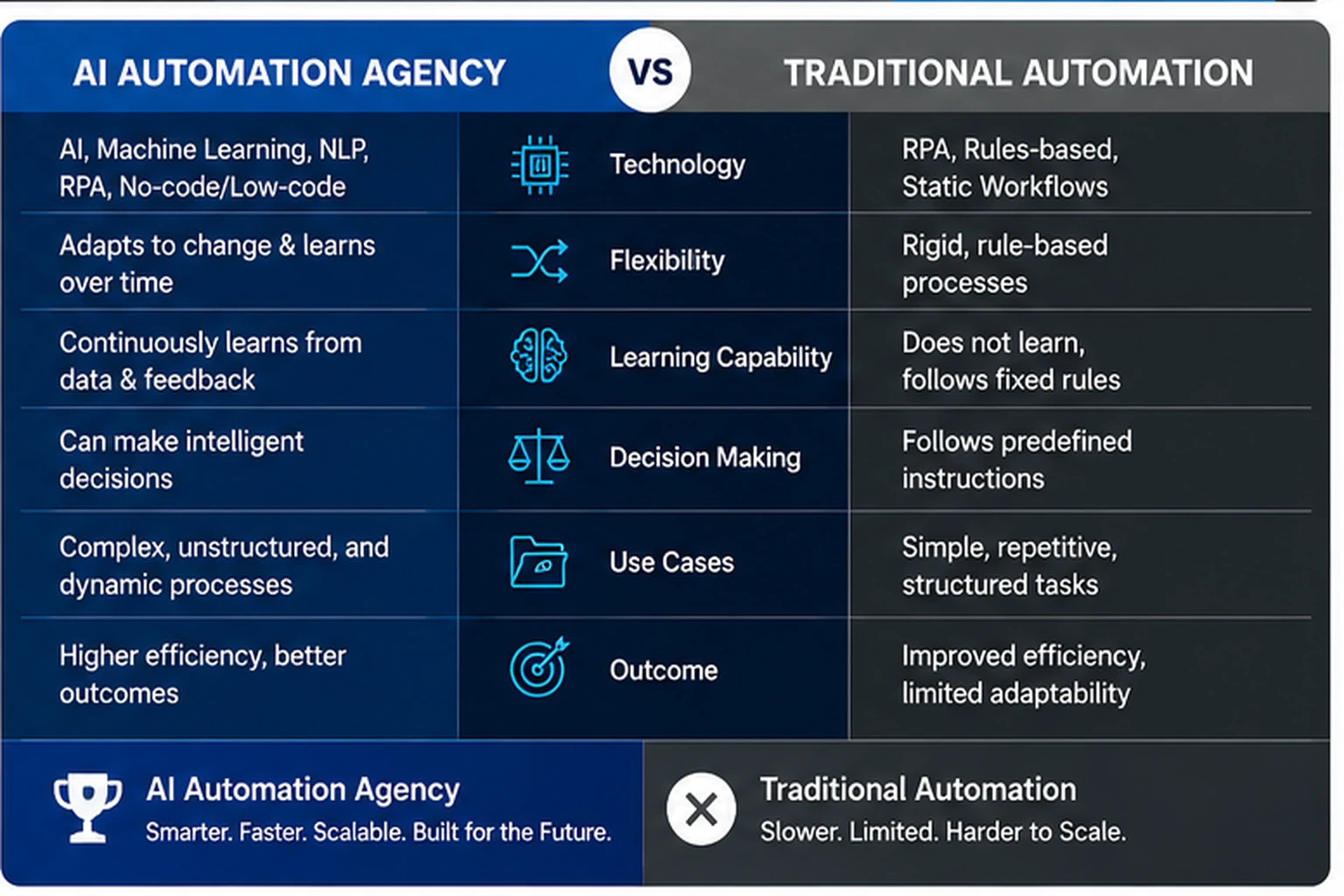
| Area | AI-Powered Automation | Traditional Automation |
|---|---|---|
| Best for | Dynamic or information-heavy processes | Predictable repetitive processes |
| Data | Can work with text and other less-structured inputs | Usually works best with structured inputs |
| Decision support | Can classify, summarize, extract, or generate | Follows predefined rules |
| Control | Requires guardrails and validation | Usually more deterministic |
| Human review | Important for high-impact or uncertain outputs | Used mainly for exceptions |
The strongest systems often use both approaches. Deterministic rules can control permissions and routing, while AI handles tasks that require interpretation. This hybrid approach can provide flexibility without giving an AI model unnecessary control over critical business actions.
10 Business Use Cases for an Artificial Intelligence Automation Agency
1. Customer Support Automation
Incoming tickets can be classified by topic, urgency, language, or customer type. AI can retrieve approved knowledge, prepare response drafts, and route difficult cases to human agents. Businesses evaluating this area can also review our AI tools for customer support guide.
2. Lead Qualification
Automation can capture new leads, check required fields, enrich available information, apply qualification rules, and assign promising opportunities to the appropriate salesperson.
3. Sales Follow-Up
After a meeting or form submission, a workflow can create tasks, update CRM records, prepare personalized follow-up drafts, and remind sales teams when action is overdue.
4. Invoice and Document Processing
Documents can be received, categorized, checked for required information, and routed to the correct team. Human approval should remain part of workflows involving financial commitments or uncertain extraction results.
5. Email Triage
AI can identify the subject of incoming messages, extract action items, summarize long conversations, and route messages to sales, support, billing, HR, or other departments.
6. Internal Knowledge Assistants
A controlled assistant can help employees find information in approved policies, procedures, product documentation, and internal knowledge bases. Access controls should ensure users only retrieve information they are authorized to see.
7. Marketing Operations
Automation can organize campaign data, generate first drafts, repurpose approved content, categorize leads, and prepare performance summaries. Human review remains important for brand claims and public-facing content.
8. Reporting and Analytics
Recurring data can be collected from approved sources and transformed into dashboards or summaries. AI can help explain trends, while the underlying metrics should remain traceable to reliable source data.
9. Employee Onboarding Workflows
Once an employee is approved, automation can create checklists, send onboarding information, notify relevant departments, and track completion of required steps.
10. Ecommerce and Operations
Businesses can automate order notifications, exception handling, inventory alerts, customer communications, product-data processing, and recurring operational reports. Smaller companies can also use our Small Business Inventory Management guide to understand practical stock-control processes that can later be supported by automation.
Core Services and Technology Used by an AI Automation Agency
The exact technology stack depends on the business problem. An agency may use AI APIs, automation platforms, cloud services, databases, CRM systems, communication tools, and custom code. Projects that require custom cloud software can benefit from a structured cloud application development approach for architecture, deployment, integrations, and scalability. OpenAI provides AI products and business offerings that can support applications involving language and intelligent processing. Microsoft Power Automate focuses on workflow and process automation, while platforms such as Make provide visual automation across connected applications. The technology itself is only one part of the project. Process design, data quality, permissions, security, monitoring, and employee adoption frequently determine whether the automation delivers lasting value.
Benefits of Hiring an Artificial Intelligence Automation Agency
- Reduced repetitive work: employees spend less time copying, sorting, routing, and re-entering information.
- Faster response: automated workflows can react immediately to defined triggers.
- Better consistency: documented workflows can apply the same process across repeated cases.
- Connected systems: APIs and automation platforms can reduce isolated manual handoffs.
- Scalability: well-designed workflows can process larger volumes without increasing manual work at the same rate.
- Improved visibility: logging and reporting can make process performance easier to measure.
How an Artificial Intelligence Automation Agency Implements a Project
Step 1: Identify the Business Problem
Start with a measurable operational problem rather than choosing an AI tool first. Examples include slow lead response, repetitive data entry, overloaded support teams, or manual reporting.
Step 2: Map the Existing Process
Document triggers, people, systems, decisions, inputs, outputs, exceptions, and approvals. A process should be understood before it is automated.
Step 3: Define Success Metrics
Useful metrics may include processing time, manual hours saved, response time, error rate, cost per transaction, conversion rate, or percentage of cases requiring human intervention.
Step 4: Design the Automation
The agency decides which steps should use fixed rules, which steps benefit from AI, where human approval is necessary, and how systems will exchange data.
Step 5: Build a Controlled Pilot
A smaller pilot is usually safer than automating an entire department at once. It provides real data about accuracy, exceptions, cost, and employee adoption.
Step 6: Test Edge Cases and Failures
Testing should include incomplete inputs, duplicate records, unavailable APIs, incorrect model output, permission failures, and other realistic exceptions.
Step 7: Deploy, Monitor, and Improve
After launch, teams should monitor logs, costs, accuracy, exceptions, and business results. AI-enabled systems require ongoing evaluation because source data, models, APIs, and business requirements can change.
How Much Does an AI Automation Agency Cost?
There is no universal price because projects vary significantly. A simple workflow connecting a few applications is very different from a company-wide system involving custom AI, multiple databases, security controls, and ongoing support. Cost is normally influenced by the number of workflows, integrations, API usage, AI-model usage, data preparation, custom development, security requirements, testing, monitoring, documentation, and maintenance. Instead of selecting an agency only by the lowest quote, businesses should compare the expected value of the automation with the total cost of building and operating it. A small workflow that removes a high-volume repetitive task can sometimes produce more value than an expensive project with unclear objectives.
How to Choose an Artificial Intelligence Automation Agency
Before hiring an Artificial Intelligence Automation Agency, ask for a clear explanation of the business process, proposed architecture, responsibilities, security approach, expected outcomes, and ongoing costs.
- Does the agency understand your business process before recommending tools?
- Can it explain where AI is necessary and where simple automation is better?
- How will sensitive data be handled?
- Who owns the workflows, prompts, documentation, and custom code?
- How are failures and exceptions handled?
- What human approvals will remain?
- How will success be measured?
- What recurring software and AI usage costs should you expect?
- What happens if an API, model, or connected application changes?
- Will your internal team receive documentation and training?
When You May Not Need an AI Automation Agency
Not every automation project requires an agency. A small business with one straightforward workflow may be able to build it internally using a no-code platform and existing documentation. If the process is simple, low-risk, and well understood, hiring an agency may add unnecessary cost. An agency becomes more valuable when workflows cross multiple departments or applications, require AI interpretation, involve APIs or custom logic, process sensitive information, need robust monitoring, or must operate reliably at larger scale.
Risks and Challenges of AI Business Automation
AI automation can create significant value, but poor implementation can introduce new problems. Businesses should consider data privacy, access permissions, inaccurate model outputs, excessive automation, vendor dependence, API changes, unexpected usage costs, and inadequate monitoring. For cloud-hosted systems, a documented cloud security policy can help establish consistent requirements for access, data protection, monitoring, vendors, and incident response. The NIST AI Risk Management Framework provides a useful official reference for organizations thinking about AI risk and trustworthy AI practices. Critical decisions should not be delegated blindly to an AI system. High-impact workflows should use appropriate validation, access controls, logging, human review, and clear escalation procedures.
Artificial Intelligence Automation Agency ROI: What Should You Measure?
Automation ROI should be connected to measurable business outcomes. Before implementation, record a baseline so improvements can be compared fairly.
- Hours of manual work saved
- Average processing or response time
- Number of transactions handled
- Error and rework rates
- Lead-response speed
- Conversion or qualification rates
- Support resolution time
- Percentage of cases requiring human intervention
- Software, API, and model costs
- Revenue protected or generated where measurable
A successful automation does not need to remove people from a process. Often the better outcome is allowing employees to spend more time on judgment, customer relationships, creative work, and exceptions while software handles repetitive processing.
The Future of Artificial Intelligence Automation Agencies
AI automation is moving toward systems that combine workflow orchestration with AI models, agents, structured business rules, retrieval, APIs, and human approvals. As these systems become more capable, implementation quality and governance will become increasingly important. The most useful Artificial Intelligence Automation Agency will therefore not be the one that promises to automate everything. It will be the one that identifies the right processes, chooses the simplest reliable architecture, protects business data, measures results, and keeps humans involved where judgment matters.
Frequently Asked Questions About an Artificial Intelligence Automation Agency
What is an Artificial Intelligence Automation Agency?
It is a specialist provider that designs and implements business automation using AI, workflow platforms, APIs, data systems, and connected applications.
What can an AI automation agency automate?
Common areas include customer support, lead management, CRM updates, email processing, document handling, reporting, internal knowledge retrieval, marketing operations, and recurring administrative workflows.
Is AI automation the same as traditional automation?
No. Traditional automation generally follows predefined rules. AI can add capabilities such as classification, summarization, extraction, language understanding, and content generation. Many effective systems combine both.
Do small businesses need an AI automation agency?
Not always. Simple, low-risk workflows may be built internally. An agency is more useful when the process is complex, crosses multiple systems, requires AI expertise, or needs stronger testing and monitoring.
Can an Artificial Intelligence Automation Agency use Make.com?
Yes. Make can be used as an automation layer for connecting applications, APIs, data, and AI services. The appropriate platform depends on the workflow’s requirements.
How do I calculate AI automation ROI?
Compare implementation and operating costs with measurable benefits such as hours saved, faster processing, reduced errors, increased capacity, improved lead response, or other relevant business outcomes.
Final Thoughts
An Artificial Intelligence Automation Agency can help businesses move from isolated AI experiments to practical, connected workflows. The best projects begin with a clear business problem, use AI only where it adds value, keep deterministic controls around important actions, and measure results after deployment. For companies exploring automation in 2026, start small. Choose one repetitive, measurable process, document how it works today, build a controlled pilot, and compare the results. Once the workflow proves reliable and valuable, it can be expanded carefully across additional business processes. Continue learning on XVIFS: explore our AI Business Solutions guide and Make.com Workflows tutorial for more practical ways to use AI and automation in business.