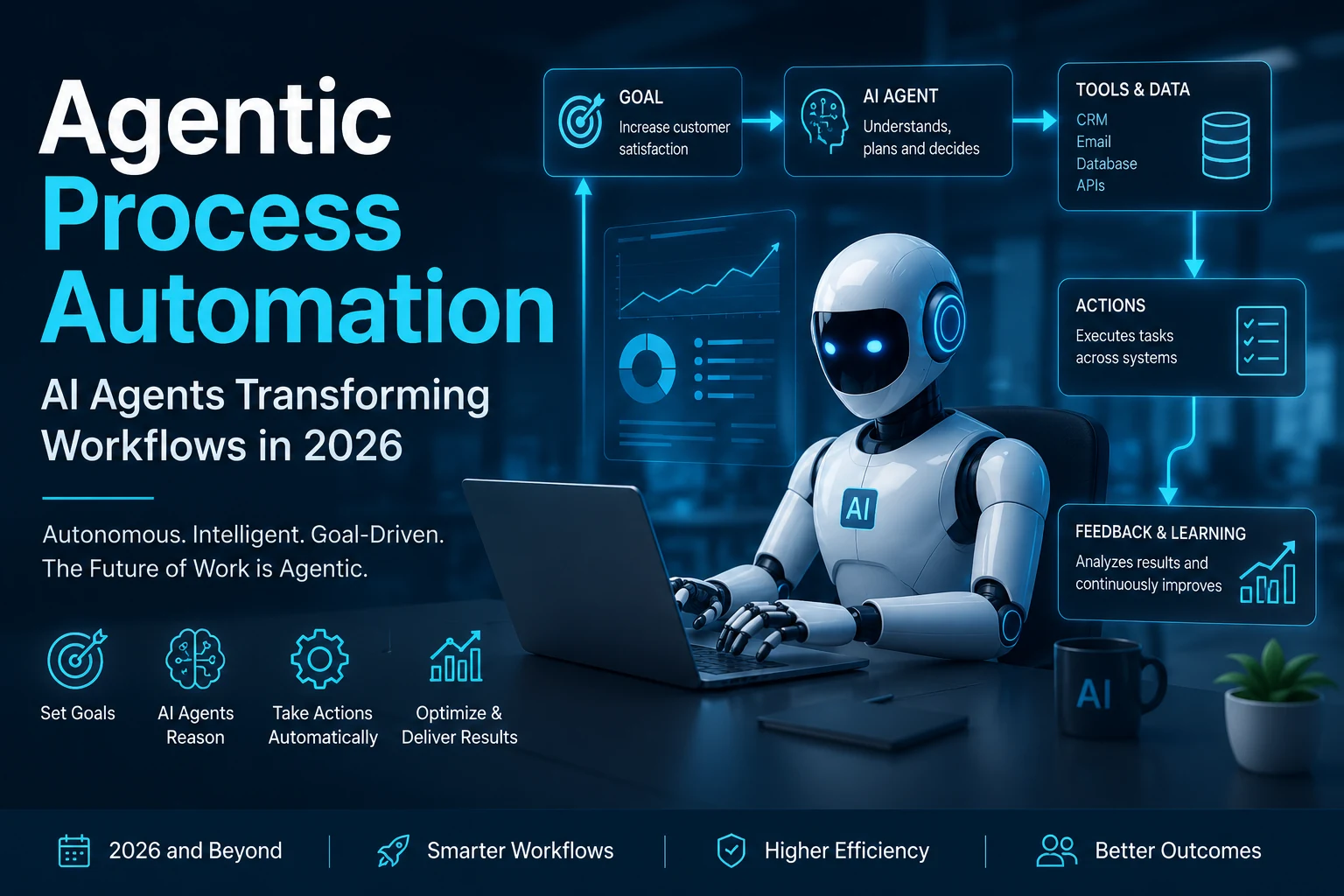
In practice, agentic process automation combines AI agents with workflow orchestration, APIs, business applications, data sources, and human oversight. The objective is not simply to automate individual tasks, but to move an entire process toward a defined business outcome with less manual intervention.
What Is Agentic Process Automation?
Agentic process automation uses AI agents to plan, execute, and adapt business workflows. Instead of following only fixed rules such as “if X happens, do Y,” an agentic system can evaluate the situation, decide what should happen next, use available tools, and adjust when circumstances change.
The concept builds on earlier forms of business process automation and robotic process automation. Research on ProAgent: From Robotic Process Automation to Agentic Process Automation describes APA as a paradigm that uses LLM-based agents for workflow construction and dynamic decision-making during workflow execution. That helps explain why agentic automation is better suited to less predictable processes than traditional scripts alone.
Salesforce similarly defines agentic process automation as AI systems that autonomously plan, execute, and adapt business workflows using reasoning and goal-driven decision-making. See the official Salesforce guide to agentic process automation.
How Agentic Process Automation Works
Most agentic automation systems follow a recurring loop: understand the goal, plan, use tools, take action, evaluate the result, and adjust if needed.
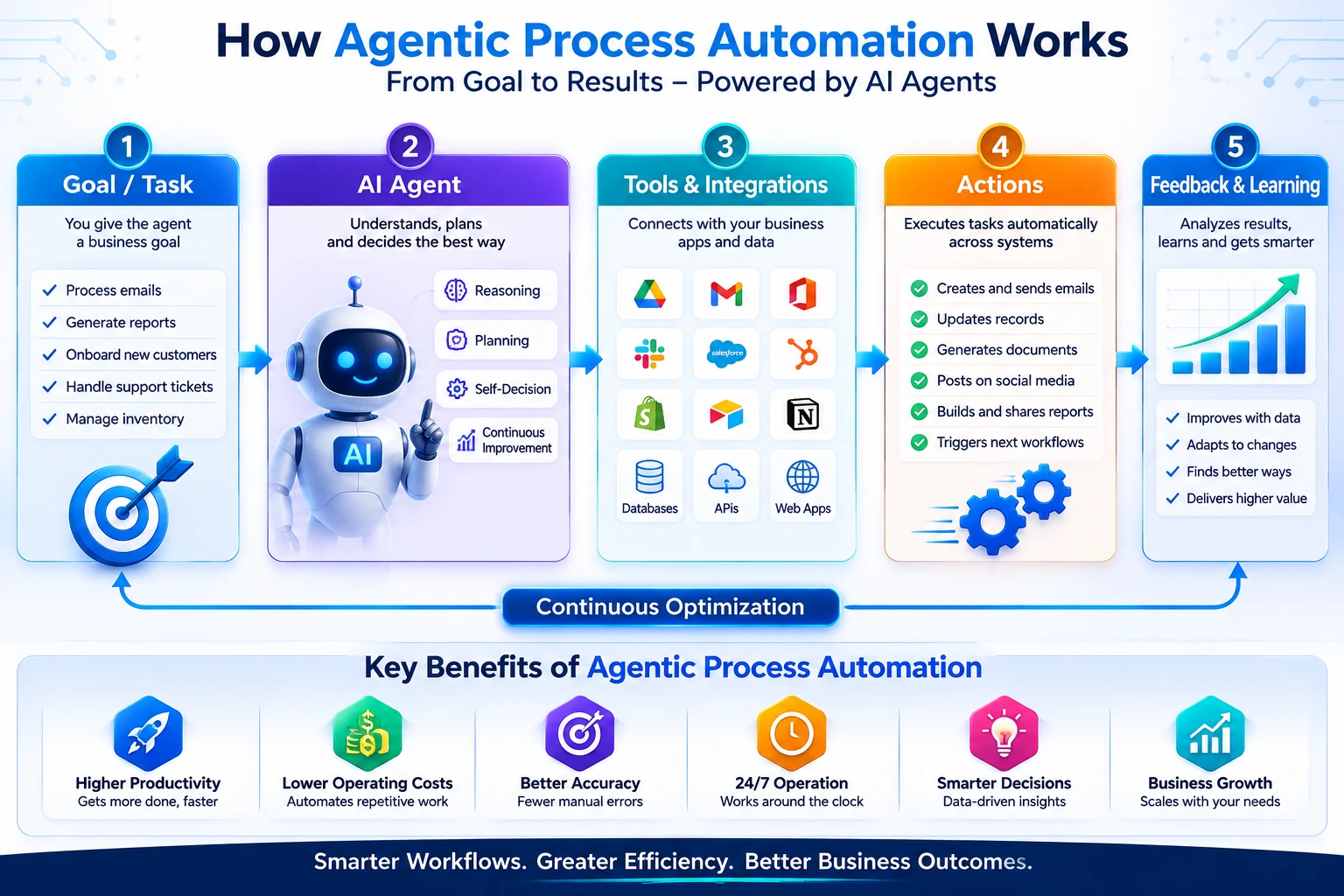
1. Define the Goal
The process begins with an objective rather than a fixed sequence of steps.
Examples include:
- resolve a customer support request;
- qualify and route a sales lead;
- investigate a failed payment;
- prepare a weekly operational report;
- coordinate onboarding tasks across multiple systems.
2. Interpret Context
The AI agent gathers information from available systems and determines what the situation means.
That context may come from:
- CRM records;
- email;
- documents;
- databases;
- business applications;
- APIs;
- previous workflow history.
3. Plan the Next Actions
Instead of following one predetermined path, the agent can identify the steps needed to reach the goal.
For example, if a customer asks for a refund, the agent may need to verify the order, check policy rules, inspect payment status, determine whether approval is required, and choose the correct communication.
4. Use Tools and Integrations
Agents become useful in business workflows when they can interact with real systems.
They may:
- query a CRM;
- update a ticket;
- create a document;
- send an email;
- call an API;
- retrieve information from a database;
- start another automation;
- request human approval.
5. Take Action
The system executes the selected steps according to permissions, policy, and workflow controls.
6. Evaluate and Adapt
After acting, the agent can check whether the expected result occurred. If not, it may retry, choose a different action, escalate to a person, or revise the plan.
This feedback loop is one of the clearest differences between agentic process automation and static rule-based automation.
Agentic Process Automation vs RPA vs Traditional Automation
Agentic automation does not make older automation approaches obsolete. Each method is useful for different types of work.
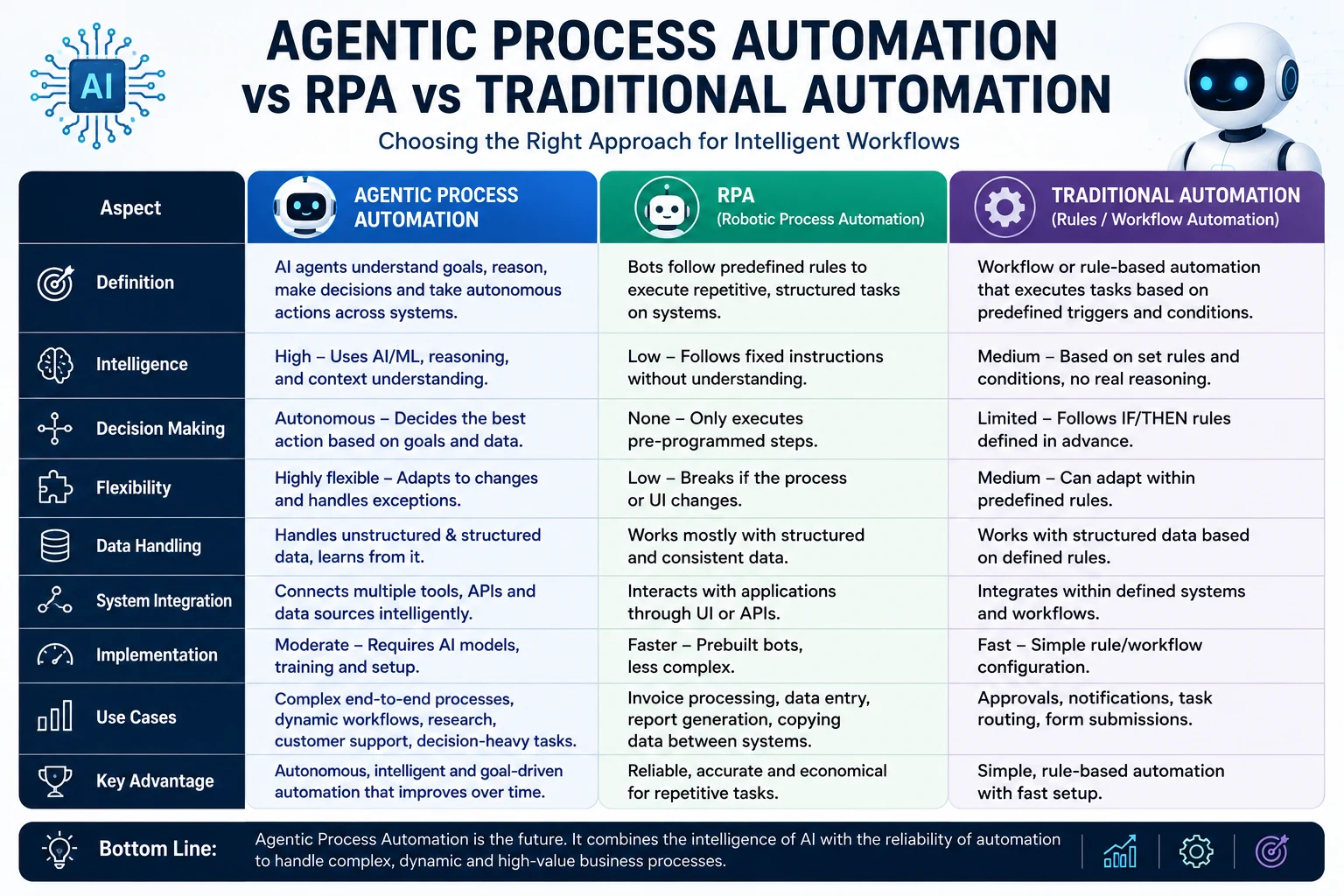
| Area | Agentic Process Automation | RPA | Traditional Automation |
|---|---|---|---|
| Decision-making | Context-aware and goal-driven | Mostly predefined | Rule-based |
| Flexibility | High | Moderate | Low to moderate |
| Best for | Dynamic multi-step workflows | Repetitive UI-based tasks | Stable deterministic processes |
| Adaptation | Can adjust based on context | Usually requires reconfiguration | Requires rule changes |
| Human oversight | Often used for approval and exceptions | Used for exceptions | Depends on workflow |
Deloitte notes that AI agents can extend automation into more complex and dynamic processes while organizations continue using RPA for structured work. That hybrid approach is often more practical than replacing existing automation completely.
9 Powerful Agentic Process Automation Use Cases
1. Customer Support Resolution
An AI agent can read a customer message, retrieve account history, identify the issue, check policy information, prepare a response, update the support system, and escalate only when necessary.
This goes beyond a simple chatbot because the agent can coordinate actions across several systems.
2. Sales Lead Qualification
An agent can review a new lead, enrich company information, analyze fit, score the opportunity, assign the lead to the right salesperson, and draft a personalized follow-up.
3. Employee Onboarding
Agentic automation can coordinate tasks such as:
- creating accounts;
- requesting equipment;
- assigning training;
- preparing documents;
- notifying managers;
- tracking missing steps.
4. Finance and Invoice Exceptions
Rather than automatically processing only perfect invoices, an agent can investigate missing information, compare records, identify likely causes, request clarification, and route exceptions appropriately.
5. IT Service Management
An agent may classify an incident, collect diagnostic information, check known solutions, execute approved remediation steps, and escalate when the issue falls outside allowed actions.
6. Marketing Operations
AI agents can coordinate research, campaign setup, content preparation, CRM updates, reporting, and performance analysis across several marketing systems.
Businesses exploring broader marketing automation can also review the XVIFS guide to Effective Marketing Strategies for Small Businesses.
7. Procurement Workflows
An agent can compare supplier information, check purchasing rules, gather approvals, prepare a recommendation, and track the process until completion.
8. Data and Reporting Workflows
Agentic systems can retrieve data from different sources, identify anomalies, summarize findings, and prepare reports for review.
9. Cross-Application Business Processes
Many valuable workflows involve several systems rather than one application. Agentic automation can coordinate work across CRM, finance, support, documents, messaging, databases, and custom APIs.
Agentic Process Automation and AI Agents
An AI agent is the reasoning component that can interpret objectives, decide what to do, and interact with tools.
In a simple workflow, one agent may handle the entire task. More complex systems may use several specialized agents.
For example:
- a research agent gathers information;
- a planning agent decides the workflow;
- an execution agent performs actions;
- a verification agent checks results;
- a human reviewer approves sensitive decisions.
This multi-agent structure can improve specialization, but it also increases orchestration, monitoring, and governance requirements.
Benefits of Agentic Process Automation
More Flexible Automation
Agentic systems can handle situations where the exact workflow cannot always be predicted in advance.
Better Handling of Exceptions
Instead of stopping whenever data is incomplete or unexpected, an agent may be able to investigate the problem and choose an appropriate next step.
Reduced Manual Coordination
Processes that require employees to move between several tools can be coordinated automatically.
Faster Response Times
Agents can work continuously and act as soon as required information becomes available.
Scalable Knowledge Work
Some repetitive knowledge-work tasks can be automated without converting every decision into rigid rules.
Risks and Limitations of Agentic Process Automation
Greater autonomy creates greater responsibility for governance.
Incorrect Decisions
AI agents can misunderstand information, choose weak actions, or generate inaccurate outputs.
Excessive Permissions
An agent connected to many business systems may have access to sensitive information or high-impact actions.
Unpredictable Behavior
Dynamic reasoning can create more varied outcomes than deterministic scripts.
Data Privacy
Workflows may process customer, employee, financial, or confidential business information.
Cost Control
Complex multi-step agent workflows may trigger many AI calls, APIs, and cloud operations.
Auditability
Businesses need to understand which actions were taken, why they were taken, and what data influenced the decision.
NIST’s AI Risk Management Framework is designed to help organizations incorporate trustworthiness considerations into the design, development, deployment, use, and evaluation of AI systems. Its core approach emphasizes governance, mapping risks, measurement, and management.
Human-in-the-Loop Controls
Agentic automation does not require removing people from every decision.
Human approval is especially useful when a workflow involves:
- large payments;
- legal decisions;
- customer account termination;
- security changes;
- sensitive communications;
- high-value purchases;
- irreversible actions.
A practical model is:
AI prepares → human reviews → automation executes.
This can preserve much of the speed benefit while maintaining accountability.
How to Implement Agentic Process Automation
Step 1: Choose the Right Process
Start with a workflow that is valuable but difficult to automate with simple fixed rules.
Step 2: Define the Goal Clearly
The agent needs a measurable objective, constraints, and success criteria.
Step 3: Map Systems and Data
Identify which applications, APIs, records, and documents the agent needs.
Step 4: Limit Permissions
Give the agent only the access necessary for the workflow.
Step 5: Define Guardrails
Specify actions the agent may perform automatically and actions that require approval.
Step 6: Add Error Handling
Plan what happens if a system is unavailable, information is missing, or the agent cannot confidently decide.
For practical automation failure design, see the XVIFS Make.com Error Handling Tutorial.
Step 7: Test With Realistic Scenarios
Include normal cases, missing data, contradictory information, unusual requests, and system failures.
Step 8: Monitor Decisions and Actions
Record prompts, decisions, tool calls, approvals, errors, and final outcomes where appropriate.
Step 9: Improve Gradually
Expand autonomy only after the workflow demonstrates reliable performance.
Agentic Process Automation vs AI Automation
AI automation is a broad term that can include any workflow using artificial intelligence.
Agentic process automation is more specific. It emphasizes autonomous agents that reason about goals, decide what actions to take, use tools, and adapt during workflow execution.
For broader implementation models, the XVIFS guide to Artificial Intelligence Automation Agency explains how businesses can combine AI systems with workflow automation and integrations.
Agentic Process Automation vs Generative AI
Generative AI creates new content such as text, images, code, or audio. Agentic automation may use generative models, but its main purpose is to coordinate actions toward an outcome.
A generative AI model might draft an email. An agentic workflow might decide that an email is needed, retrieve account data, create the message, send it through the correct system, record the action, and check whether the customer responded.
Agentic Process Automation and Existing Automation Platforms
Businesses do not necessarily need to replace existing automation systems.
Agentic capabilities can be combined with:
- workflow automation platforms;
- RPA tools;
- CRM automation;
- API integrations;
- business process management systems;
- cloud applications.
IBM’s current agentic process automation approach similarly combines an automation process layer with AI orchestration, human approvals, audit logging, policy controls, and connected agents rather than treating autonomous AI as a replacement for all workflow infrastructure.
How to Measure Agentic Automation Success
Useful metrics depend on the process, but organizations may track:
- processing time;
- manual hours saved;
- completion rate;
- exception rate;
- human escalation rate;
- accuracy;
- cost per completed workflow;
- customer response time;
- rework;
- business outcome achieved.
Do not measure success only by the number of AI actions performed. The goal is better business outcomes.
Frequently Asked Questions About Agentic Process Automation
What is agentic process automation?
Agentic process automation is an AI-driven automation approach in which autonomous agents can understand goals, reason about context, use tools, make decisions, take actions, and adapt workflows as conditions change.
How is agentic process automation different from RPA?
RPA is strongest for repetitive, structured tasks with predefined steps. Agentic process automation can handle more dynamic workflows that require reasoning, contextual decisions, and adaptation.
Does agentic automation replace RPA?
Not necessarily. Many organizations can use RPA for stable structured tasks while adding AI agents where judgment or flexibility is required.
What are examples of agentic automation?
Examples include customer support resolution, lead qualification, invoice exception handling, IT service management, employee onboarding, procurement workflows, and cross-application reporting.
Does agentic process automation require generative AI?
Agentic systems often use large language models or other generative AI technologies for reasoning and communication, but agentic automation also depends on tools, integrations, rules, permissions, and workflow orchestration.
Is human oversight still needed?
Yes. Human approval is especially important for high-impact, sensitive, financial, legal, security, or irreversible actions.
What is the biggest risk of agentic automation?
One of the biggest risks is giving an AI agent too much autonomy or access without sufficient monitoring, validation, and governance.
Final Thoughts
Agentic process automation represents a shift from automating fixed tasks toward automating outcomes.
Traditional automation remains highly valuable for predictable work. Agentic systems become more useful when processes require context, judgment, multiple tools, changing conditions, and exception handling.
The strongest implementations are unlikely to be completely autonomous. They will combine AI reasoning with reliable automation, clear permissions, human oversight, monitoring, and measurable business goals.
For businesses, the practical question is not whether every workflow should become agentic. It is where AI-driven reasoning can safely remove coordination work that fixed rules cannot handle well.